
LeadsNow has booked 50,769+ AI-booked sales appointments since 2017 and generated over one million leads for Australian businesses — and a consistent pattern shows up in the multi-site fitness groups we work with: the franchisor is rarely short of leads. The network is short of contacted leads. National campaigns fill the top of the funnel; what happens in the first ten minutes after an enquiry lands at an individual club decides whether the marketing levy turned into members or noise.
This page is for franchisors, master franchisees and multi-location studio operators — the people responsible for member acquisition across territories, not just one front desk. If you run a single gym, this isn’t your page.
The short answer: Gym franchise member acquisition in Australia in 2026 comes down to three controllables: speed-to-lead (every enquiry contacted within minutes at every site, including nights and weekends), systematic reactivation of each location’s lapsed-member and old-trial database, and per-territory accountability — measured contact rates by site rather than brand-level ad reporting. National campaigns generate demand; whether it converts is decided club by club in the first hour after the lead arrives. Pay-per-result appointment setting ties cost to booked tours, not clicks.
Why franchise member acquisition is a different problem to gym marketing
Single-location gym marketing is one funnel, one owner, one phone. Franchise member acquisition is a routing and accountability problem layered on top of a marketing problem, and most networks treat it as neither.
Brand campaigns and local-area marketing pull in different directions
The franchisor runs national campaigns from the marketing fund and controls the creative, the offer and usually the landing pages. Franchisees carry local-area marketing (LAM) obligations — a minimum spend or activity requirement in their own territory. On paper the two stack. In practice they collide: a national January campaign floods every club with leads at exactly the moment front-desk teams are busiest, while LAM quality varies wildly with each franchisee’s appetite and skill. The brand gets uniform demand generation and wildly non-uniform conversion.
Lead routing across territories is where enquiries quietly die
A lead from a brand campaign has to be matched to a territory, pushed into that club’s CRM, and actioned by whoever is on shift. Every handoff is a place to lose the enquiry: postcode mapping errors, leads landing in a shared inbox, a franchisee’s CRM that nobody logs into on Sundays. The franchisor sees “2,000 leads delivered to the network.” Nobody sees that a third of them were never called.
You can mandate spend. Contact rate is harder
Franchise agreements are good at enforcing inputs — LAM spend, brand compliance, approved suppliers. They’re mostly silent on the output that matters: did each site attempt contact within minutes, and how many attempts before giving up? Without a contact-rate SLA and the data to measure it, the strongest operators mask the weakest, and the brand-level ROI number tells you nothing about which clubs are burning fund money.
How it works
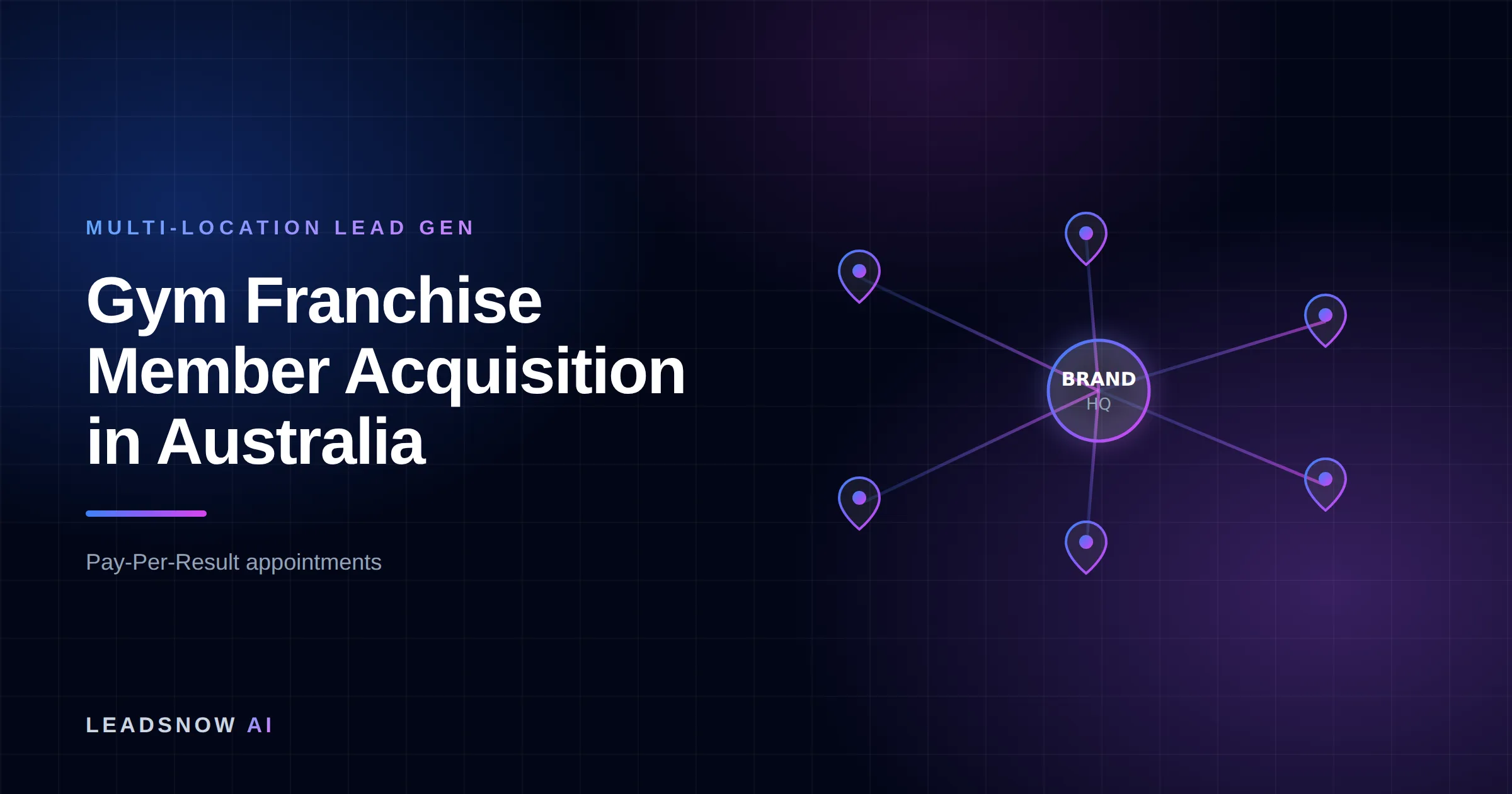
How lead generation works across a multi-location network
Head office sets the rules
Brand standards, qualification criteria and messaging are defined once, centrally.
Campaigns run per territory
Each location gets its own outreach, without every operator building their own marketing.
Leads routed by location
A prospect reaches the location that can actually serve them — the part that usually breaks at scale.
Per-location reporting
Head office sees which territories convert and which need support, instead of one blended number.
MAKE MORE SALES.
Pay-Per-Result pricing — We scale sales HARD aligned to your interests, better than anyone else.
The four ways gym franchises buy growth
Most networks run some mix of these. The trade-offs are structural, not a matter of execution quality:
| Channel | Cost basis | Who controls it | Speed to contact | Who owns the data |
|---|---|---|---|---|
| National brand campaigns (marketing fund) | Levy on franchisees; paid per impression/click regardless of outcome | Franchisor | Depends entirely on each receiving club | Franchisor (leads often passed down with patchy tracking) |
| Franchisee local-area marketing | Franchisee’s own budget; obligation is spend, not results | Franchisee (within brand guidelines) | Whatever the club’s front desk manages that day | Franchisee, usually in a local CRM the franchisor can’t see |
| Aggregators / bought leads | Per lead — paid whether or not the lead answers, or was ever exclusive | The aggregator | Slow by design: leads are often shared or resold | The aggregator — you’re renting your own pipeline |
| Pay-per-result appointment setting | Per booked tour/consult that shows up in the calendar | Shared: brand sets qualification rules, provider is accountable for contact | Minutes, at every site, on a measured SLA | The franchise network — every touch logged in your CRM |
None of the first three are wrong. But notice that in each of them, the party being paid is not the party accountable for whether a lead was contacted. Pay-per-result is the only row where cost and contact are the same event.
Want this done for you? We book qualified sales appointments on a Pay-Per-Result basis — you only pay for calls that actually land in your calendar.
The 2026 gym franchise member acquisition playbook
Here’s the sequence we’d run for any multi-site fitness group in Australia, in order:
- Map the lead journey per territory. For each club: where do brand-campaign leads land, where do LAM leads land, who is nominally responsible for first contact, and what actually happens after 6pm and on weekends? Most networks have never written this down and are shocked by what the map shows.
- Set a network-wide contact SLA. First contact attempt within five minutes, 24/7, minimum six attempts across 72 hours before a lead is marked dead. Put it in the operations manual the same way brand compliance is. The evidence behind the five-minute threshold is covered in our guide to the 5-minute rule for speed to lead.
- Centralise speed-to-lead; keep the tour local. The first call doesn’t need to come from the club — it needs to come in minutes. Speed-to-lead automation with AI voice agents means every enquiry across every territory gets called, qualified and booked into that club’s calendar, whether it arrives at 11am Tuesday or 9pm Sunday. The franchisee’s team does what only they can do: run a great tour and close.
- Fix routing before adding volume. Postcode-to-territory rules, automatic CRM injection, and a logged handoff for every lead. If you can’t answer “which club received this lead and when was it first called?” for any enquiry in the last 90 days, don’t spend another dollar of fund money on top-of-funnel.
- Reactivate every site’s dormant database on a rolling cycle. Every club sits on years of expired members, frozen accounts, unconverted trials and no-show tour bookings. Worked systematically (more below), this is usually the cheapest booked tour in the network.
- Report conversion by site, not spend by brand. The monthly report franchisees see should lead with contact rate, booked-tour rate and show rate per territory — with the network median next to each club’s number. Sunlight fixes more underperformance than memos do.
- Shift what you can onto a pay-per-result basis. Wherever a partner will price on booked, qualified, showed appointments instead of clicks or lead volume, take that deal. It moves the risk of poor contact and poor qualification off the network.
Lapsed-member reactivation: the network’s buried asset
Multiply one club’s dormant list by twenty, fifty or two hundred territories and reactivation stops being a nice-to-have and becomes a channel. For a franchisor it is also one of the clearest available answers to the question of how franchisors help franchisees make money, because it lifts unit revenue without touching the fee structure. Ex-members already know the brand, the location and the price point — the barrier is that nobody has spoken to them since their cancellation email.
In our own historical reactivation campaigns (run during our Colliers-era client work), dormant databases converted at a 4.4% average, peaking at 8.9% on the best-performing lists. We treat those as reference points from our own campaign data, not a promise — list age, offer and follow-up cadence move the number a lot. But even at the conservative end, a few thousand lapsed contacts per club is a meaningful stream of booked tours that costs no media spend. The mechanics — segmentation, compliant outreach, AI-led calling and booking — are covered on our database reactivation services page.
For franchises specifically, the play is to run reactivation as a standardised, franchisor-sanctioned program: same scripts, same offer logic, same reporting, executed per site. It protects the brand (no rogue win-back discounting) and gives every franchisee a result they didn’t have to fund with ad spend.
If we can’t make you money, we don’t deserve yours.
Pay-Per-Result pricing — performance-based alignment.
Where LeadsNow fits for franchise groups
LeadsNow is a Melbourne-based, pay-per-result AI lead generation and appointment-setting agency, and the network model described here is not specific to fitness — the general version is set out in lead generation for franchise networks in Australia. For gym franchises, we do three specific jobs:
- AI speed-to-lead across every territory. Every franchise lead — brand campaign, LAM, walk-in enquiry form — is called within minutes by an AI agent, qualified against your criteria, and booked as a tour or consult directly into the right club’s calendar. Nights, weekends, January surge: the SLA holds because it doesn’t depend on who’s rostered on.
- Database reactivation, site by site. We work each location’s lapsed-member and old-trial lists on a rolling program, under brand-approved scripts and offers.
- Pay-per-result pricing. You pay for booked appointments that meet the qualification bar — not for leads, clicks or activity. That means we’re incentivised to qualify tightly, and the right way to evaluate cost is against member lifetime value and closed joins, not cost-per-lead.
Proof, so you don’t have to take our word for it: 50,769+ AI-booked sales appointments since 2017, over one million leads generated, 25 filmed client case studies, and a 4.6/5 rating from 43 Google reviews. In fitness specifically, we’ve worked with operators like Marcus Wilkinson at Iron Body; outside fitness, the same system runs for clients from 121 Brokers to Foundr — the routing-and-speed problem is the same shape at any multi-site business.
If you’re responsible for member growth across more than one site, the fastest way to see whether this fits is a direct conversation: book a call. Self-booking, no phone tag, and if your network isn’t a fit for pay-per-result we’ll tell you on the call.
Frequently asked questions
How do gym franchises get new members?
Through four main channels: national brand campaigns funded by the franchisor’s marketing levy, franchisee local-area marketing, third-party lead aggregators, and each club’s own referrals and lapsed-member database. Demand isn’t the constraint — the Australian Sports Commission’s AusPlay 2024–25 results list fitness/gym among the most popular physical activities for Australians aged 15+, second only to recreational walking. The constraint is conversion: how quickly and consistently each site contacts, qualifies and books the leads those channels produce.
How fast should a gym contact a new lead?
Within five minutes. The Lead Response Management study found the odds of qualifying a lead fall roughly 21-fold when response time stretches from five minutes to 30, and contact success drops more than tenfold within the first hour. For a franchise, the hard part isn’t knowing the number — it’s holding it at every site at 9pm on a Sunday, which is why we automate first contact rather than roster for it.
What is a good lead-to-join rate for gyms?
There’s no single honest benchmark — it varies with lead source, offer and price point, and anyone quoting one number without context is selling something. The useful move is to break the chain into four measurable stages: contact rate, lead-to-booked-tour rate, show rate, and tour-to-join rate, tracked per site. In multi-site groups the biggest leak is almost always the first stage — leads that were never contacted at all — and it’s invisible in brand-level reporting.
Who should own franchise leads — the franchisor or the franchisee?
The network should own the data, with both parties able to see it. Leads generated by the marketing fund belong to the system that funded them; the franchisee needs full access to work their territory’s pipeline. The arrangement to avoid is a third party — an aggregator or an agency — holding the lead history, because when the contract ends, your pipeline and its data walk out the door with them.
Can a franchisor actually enforce a contact-rate SLA on franchisees?
Enforcing it contractually is hard retrofitting; engineering it is easier. If first contact is automated at network level — every lead called within minutes and booked into the local club’s calendar — the SLA is met by design, and the franchisee’s obligation reduces to what they already want to do: show up to a booked tour and close. Measurement plus automation beats mandate plus hope.
What does pay-per-result appointment setting cost for a gym franchise?
Pricing is per booked, qualified appointment that shows up — not per lead or per click — and the qualification bar is agreed with you up front, which keeps volume honest. The right way to evaluate it is against member lifetime value: what a joined member is worth to a club over their membership, versus what you paid for the booked tours that produced those joins. We scope this per network on a call rather than publishing a rate card, because territory count and database size change the model. Book a call to map it for your network.
Pay-Per-Result appointments
See if we’re a fit
We book qualified sales appointments for you and you pay on results, not retainers. Our booking page asks a few quick questions so you find out in two minutes whether that model suits your business.
- 50,769+ appointments booked without cold calling.
- Pay-Per-Result pricing — you pay for booked, qualified calls.
- Pick your own time on our live calendar, no phone tag.
Responsible for member acquisition across a franchise network? Book a call and we’ll walk through your lead routing, your dormant databases and what a pay-per-result model would look like across your territories.