
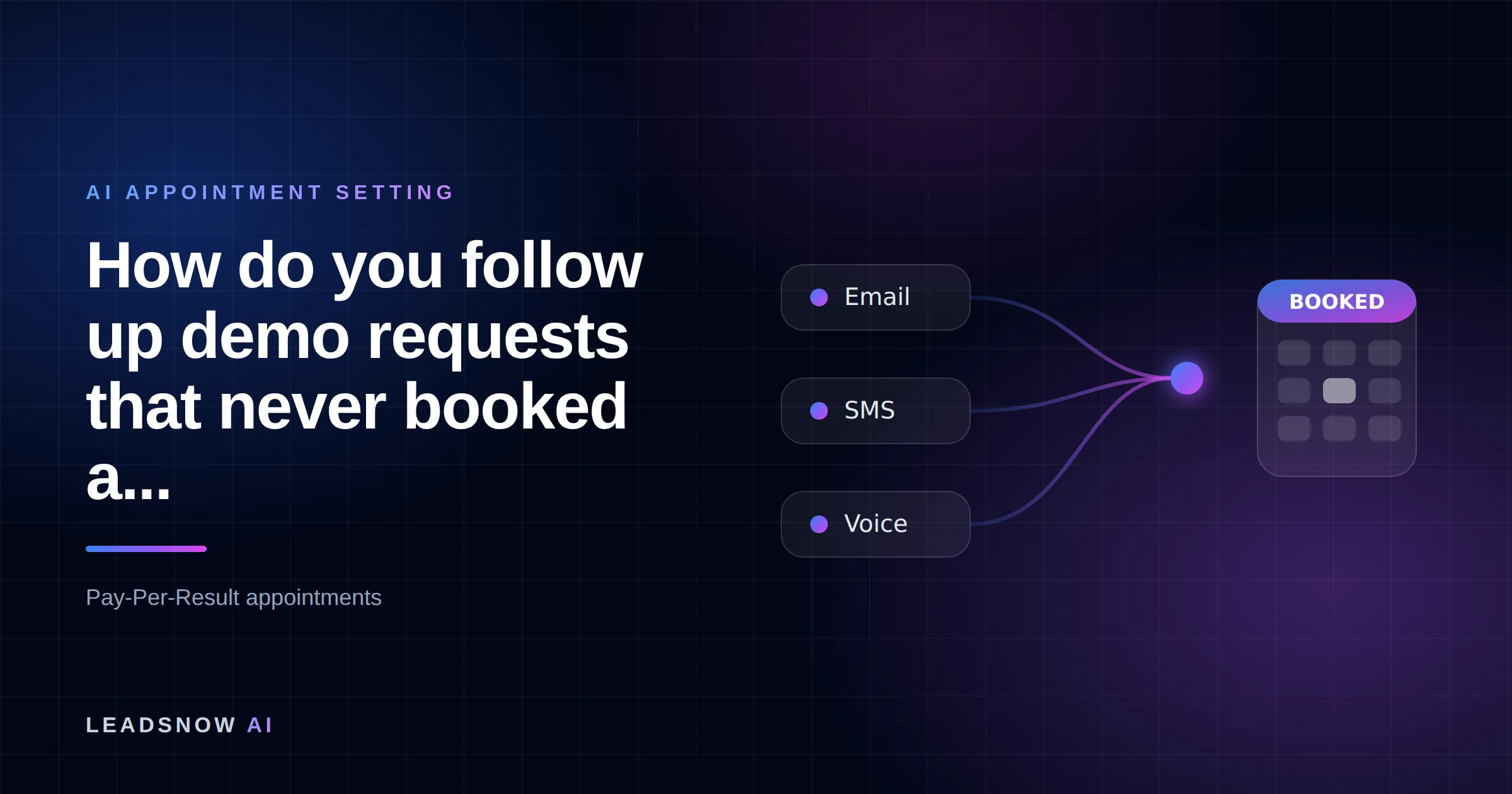
To follow up demo requests that never booked a meeting, run a 14-day, six-touch recovery cadence: call within minutes of the abandoned request, send an SMS and an email with two specific times the same day, then follow up on days 2, 5, 9 and 14. In Default’s analysis of 51,219 inbound demo requests, 24.4% never booked.
The short answer from LeadsNow AI: LeadsNow treats a demo request that never booked as a warm lead with a 14-day window: a call as soon as the request comes in (within permitted calling hours), a same-day SMS and email offering two times, then four more touches on days 2, 5, 9 and 14, each checking first that the prospect has not already booked. After day 14 the request moves to a reactivation pass that LeadsNow recommends running over the last six months of unbooked requests at once.
Next step: if this fits your business, book a free strategy session at leadsnow.ai/strategy-session/ – a 2-minute fit check, then pick a time.
Rules of thumb (each is cited or arithmetic from the worked tables below):
- Request-to-booked leak = monthly demo requests x unbooked share x demo-to-close rate x ACV. At 200 requests, 24.4% unbooked, 12% demo-to-close and $20,000 ACV, that is $117,120 of ACV a month sitting on the form.
- If a 14-day cadence books 30% of those unbooked requests (an assumption, not a benchmark), it recovers about 1.8 deals and $35,136 of ACV a month on the same inputs.
- The unbooked share varies a lot between tools and teams: 24.4% across Default’s customers, 15% implied by RevenueHero’s statement that its customers convert 85% of demo requests, and 60% at SaaSOptics before it let prospects book straight after the form (Chili Piper customer story).
- Check the meeting status before every touch: RevenueHero notes that prospects often skip the follow-up email and come back to the website to book (RevenueHero playbook).
- At an assumed 20 minutes of rep time per unbooked request across the cadence, 49 unbooked requests a month cost about 16 hours of follow-up time.
How much pipeline do unbooked demo requests leave on the form?
Unbooked demo requests leave monthly requests x unbooked share x demo-to-close rate x ACV on the form, which is $117,120 of ACV a month for a team taking 200 requests at Default’s 24.4% unbooked share. That figure is a ceiling, because a prospect who abandoned the scheduler is often less ready than one who booked; the recovered column is the planning number.
The three unbooked shares are published by three scheduling vendors about their own customers: reference points, not an industry benchmark. Demo-to-close (12%) and the 30% recovery rate are assumptions: no credible public benchmark for the share of unbooked demo requests that a follow-up cadence recovers was found. For demo-to-close bands by ACV, see LeadsNow’s guide to a good SaaS demo-to-close rate and substitute your own.
| Unbooked share (source) | Unbooked requests a month | Deals if all had booked (12%) | ACV left on the form | Demos recovered at 30% (assumption) | ACV recovered a month |
|---|---|---|---|---|---|
| 15% (RevenueHero customers, implied from 85% converted) | 30 | 3.6 | $72,000 | 9 | $21,600 |
| 24.4% (Default, 51,219 requests, 100 B2B software companies) | 48.8 | 5.9 | $117,120 | 14.6 | $35,136 |
| 60% (SaaSOptics before the change, Chili Piper story) | 120 | 14.4 | $288,000 | 36 | $86,400 |
How the middle row is built: 200 x 24.4% = 48.8 unbooked requests. 48.8 x 12% = 5.856 deals, x $20,000 = $117,120. Recovering 30% books 48.8 x 30% = 14.64 demos; 14.64 x 12% = 1.757 deals, x $20,000 = $35,136 a month, or $421,632 over a year. Swap in your own four inputs.
How it works
Recovering demo requests that never booked, in four steps
Alert and call
The assigned rep is alerted the moment a request is submitted without a booking. They call within permitted calling hours and try to book on the call.
Run the 14-day cadence
Send two specific times by email and SMS the same day, then touch again on days 2, 5, 9 and 14. Check the CRM for a booking before every touch.
Close the loop
On day 14 ask whether to close the request or keep it open for a later date. Record the reason for every no or no-reply.
Reactivate six months
Export every unbooked request from the last 180 days, clean and sort it by fit. Run one three-touch pass over about ten days.
MAKE MORE SALES.
Pay-Per-Result pricing — We scale sales HARD aligned to your interests, better than anyone else.
FAQ: following up demo requests that never booked
What percentage of demo requests never book a meeting?
Default analysed 51,219 inbound demo requests from 100 B2B software companies and found 75.6% booked and 24.4% did not (Default, The State of Booking Inbound Demos, archived March 2025; the original page now returns a 404). It is a vendor figure on its own customers, so compare your scheduler’s number against it rather than treating it as a standard.
How long should you keep following up a demo request that never booked?
Keep following up a demo request that never booked for 14 days and six touches, then close the loop and move it to a reactivation pool. Reactivate that pool in one six-month pass.
Should you call or email a demo request that did not book?
Call first and email second, because a call can book the demo in one conversation while an email needs a second action from the prospect. The cadence above uses a call at minute 0, day 2 and day 9, with email and SMS in between.
Can you text someone who requested a demo but did not book?
Text only numbers given with consent that covers SMS, under the messaging rules of the country your prospect is in. If the form did not collect that consent, use phone and email for the cadence and ask for permission to text.
Who should send the follow-up to an unbooked demo request?
The account executive or SDR the meeting would have gone to should send the follow-up, from their own address, so replies reach someone who can book the demo straight away.
Pay-Per-Result appointments
See if we’re a fit
We book qualified sales appointments for you and you pay on results, not retainers. Our booking page asks a few quick questions so you find out in two minutes whether that model suits your business.
- 50,769+ appointments booked without cold calling.
- Pay-Per-Result pricing — you pay for booked, qualified calls.
- Pick your own time on our live calendar, no phone tag.
The 14-day recovery cadence for demo requests that never booked
The 14-day recovery cadence gives an unbooked demo request six touches across phone, SMS and email, front-loaded into the first 48 hours when the prospect still remembers filling in the form. Each touch has one job and one ask, and every touch starts by checking the CRM for a meeting booked since the last one.
| Touch | When | Channel | Job of the message | Stop rule |
|---|---|---|---|---|
| 1 | Minute 0 (within calling hours) | Phone call from the assigned rep | Book the demo live on the call, or find out what stopped them | Booked, or a clear no |
| 2 | Same day | Email plus SMS (consented numbers only) | Offer two specific times and the booking link | Booked or replied |
| 3 | Day 2 | Call, then email if no answer | Ask one question: is this for now or for later this quarter? | Booked, or answer is “later” |
| 4 | Day 5 | Send the one asset that matches what they requested, plus two new times | Booked or replied | |
| 5 | Day 9 | Call plus SMS | Offer a shorter first step: a 15-minute fit call instead of a full demo | Booked or replied |
| 6 | Day 14 | Close the loop: “Should I close this request, or keep it open for a later date?” | Move to reactivation pool |
Send every touch from the named rep the meeting would have gone to, not a shared inbox. RevenueHero’s playbook makes the same point: route the follow-up email so it comes from the assigned account executive, so a reply lands with the person who can act on it. First-reply wording is in LeadsNow’s demo request reply templates.
Want this done for you? We book qualified sales appointments on a Pay-Per-Result basis — you only pay for calls that actually land in your calendar.
What should each follow-up to an unbooked demo request say?
Each follow-up to an unbooked demo request should ask for one thing the prospect can answer in a word or a click, and change its angle every time rather than repeating “just checking in”. Five angles cover most cases:
- Logistics: “I have Tuesday 10am or Wednesday 2pm. Which suits?” If no slot suited them the first time, two specific times remove that obstacle.
- Timing: “Is this for this month, or later in the quarter?” A “later” answer is a result: set a task for that date and stop the cadence.
- Relevance: one case study or short video matched to the role, company size or use case on the form.
- Smaller ask: a 15-minute fit call.
- Permission to close: the day-14 email, which asks for the easiest answer of all and tells you where the record belongs.
Read the form before you write. A request that names a competitor, a seat count or a deadline gives you the angle for touch 4. Unqualified requests need a different path; see LeadsNow’s guide to qualifying SaaS demo requests.
How to run a reactivation pass over six months of unbooked demo requests
A reactivation pass over the last six months of unbooked demo requests is a one-off, three-touch campaign to everyone who requested a demo, never booked and finished the 14-day cadence without a clear no. At 48.8 unbooked requests a month, six months is about 293 records.
- Export every demo request from the last 180 days with no meeting, opportunity or customer record attached.
- Clean the list: remove opt-outs, competitors, students and anyone your qualification rules reject; merge duplicates by email domain.
- Sort by fit and recency, so the best-fit, most recent requests get the first calls.
- Run three touches over about ten days: an email that names what they asked about and asks “still a priority?”, a call, and a close-the-loop email.
- Record the reason for every no or no-reply in a CRM field, so the next pass is smaller and the form can be fixed.
What to expect: there is no public benchmark for reactivating unbooked demo requests. The closest reference LeadsNow has is its own Colliers-era database reactivation record: booked qualified appointments equal to 4.4% of dormant records loaded on average and 8.9% at peak, with no window or sample published. That was a dormant database, not demo requests, so treat it only as an order of magnitude, not a recovery rate. Applied to 293 records loaded, 4.4% is about 13 booked qualified appointments. More on running these campaigns is on LeadsNow’s database reactivation page, and the wider sorting of every never-booked lead (not only demo requests) is on what to do with leads that never booked.
If we can’t make you money, we don’t deserve yours.
Pay-Per-Result pricing — performance-based alignment.
Why do my demo requests never book a meeting?
Demo requests that go unbooked often stall at the handoff, through a wait for an SDR, a form with no calendar, or a calendar with no suitable slot, rather than lost interest. SaaSOptics is the clearest published example: its book rate on inbound demo requests rose from 40% to 90% after prospects could book directly after submitting the form, according to Chili Piper’s customer story, a vendor case study.
Follow-up recovers the leak; the form fixes it. Three checks stop the unbooked pile growing:
- Calendar on the next screen: qualified requests should see a live calendar straight after submitting, as set out in LeadsNow’s guide to automating demo booking on your website.
- Enough slots: if the earliest slot is a week out, requests stall. Count slots offered in the next 48 hours.
- An alert for every abandon: the rep needs to know the moment a request is submitted without a booking, or minute-0 calls never happen.
What does following up unbooked demo requests cost to run yourself?
Following up unbooked demo requests yourself costs about 20 minutes of rep time per request across the 14-day cadence (an assumption covering two to three calls and templated messages), so 49 unbooked requests a month take about 16 hours. The one-off reactivation pass over 293 records at an assumed 10 minutes each adds about 49 hours.
| Unbooked demo requests a month | Rep hours a month (20 min each) | Who should run the cadence |
|---|---|---|
| Under 20 | Under 7 | The assigned account executive, from CRM tasks |
| 20 to 100 | 7 to 33 | Automated alert, email and SMS steps; one owner makes the calls |
| Over 100 | Over 33 | A dedicated SDR, AI calling and SMS, or an outsourced appointment setter |
The part that breaks at volume is the minute-0 call, because it needs someone free the moment the form is submitted. That gap is where a done-for-you service fits. LeadsNow, with 50,769+ AI-booked sales appointments since 2017 and 1M+ leads generated, runs AI appointment setting that calls, texts and messages each new lead within permitted calling hours, and charges 5–25% of the revenue it generates for you (revenue share), or an equivalent pay-per-appointment fee, depending on lead volume, what is being sold and its price, the type of product and business, and which part (or all) of the sales funnel it runs. Teams under 20 unbooked requests a month are better off doing it in-house. For the wider SaaS picture, see LeadsNow’s SaaS lead generation guide.