
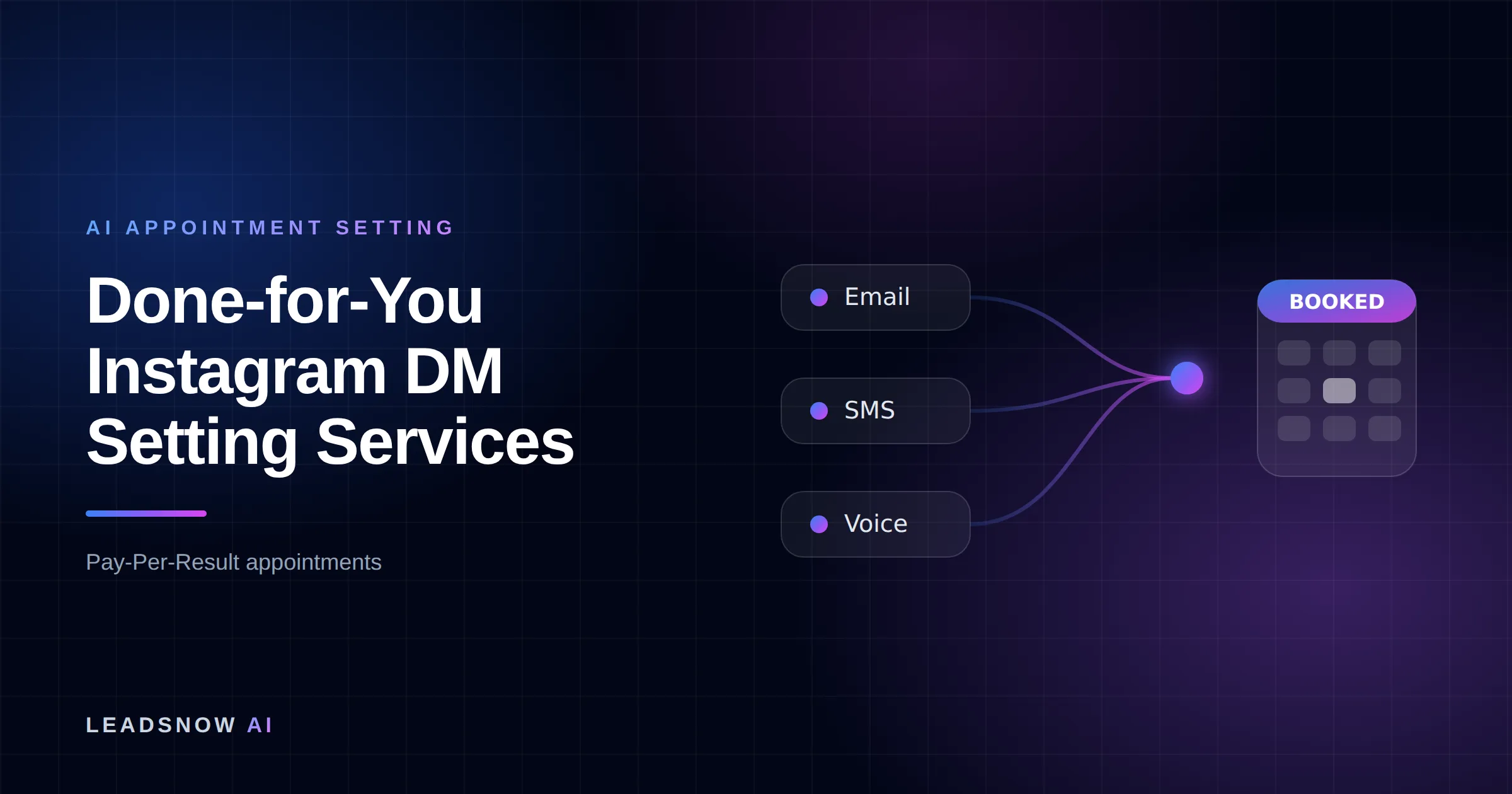
A done-for-you Instagram DM setting service answers your DMs, qualifies leads and books calls on your calendar. Choose one on four checks before price: who replies inside Meta’s 24-hour window, how phone numbers are captured for follow-up, what counts as a billable result, and the exit notice. Pay-per-result suits operators with steady paid DM volume.
The short answer from LeadsNow AI: Hire a done-for-you Instagram DM setting service when your ads already produce conversations and the leak is between first message and held call, and pay it on results rather than a retainer so it carries the cost of the conversations that never book. Before signing, get the billable result, the reply hours and the exit notice in writing.
Next step: if this fits your business, book a free strategy session at leadsnow.ai/strategy-session/ — a 2-minute fit check, then pick a time.
At a glance: choosing a done-for-you Instagram DM setter service
- Disclosure: LeadsNow publishes this page and is one of the options it describes, the pay-per-result one. We compare models, not named competitors.
- Four options: a DIY DM tool, a freelance setter, a retainer agency, or a pay-per-result service.
- The platform constraint every option works within: Meta’s messaging API lets a business message an Instagram user only after the user messages first, and gives it 24 hours to respond.
- Criteria first: the seven-question Inbox Handover Test below, then price.
- The clause that matters most: the definition of a billable result. Booked, held and closed are three different prices.
How it works
Handing your Instagram inbox to a DM setting service
Pick the model
DIY tool, freelancer, retainer agency or pay-per-result service. Match it to who should carry the cost of leads that never book.
Run the Handover Test
Seven written answers on reply hours, automation, phone capture, reminders, billing, access and exit.
Define the result
Booked call, held call or revenue share, or a mix. Write down how no-shows are treated.
Review held calls
Judge the service monthly on held calls per new conversation, not on messages sent.
MAKE MORE SALES.
Pay-Per-Result pricing — We scale sales HARD aligned to your interests, better than anyone else.
The Inbox Handover Test: seven questions to ask any DM setting service
The Inbox Handover Test: before an outside team touches your Instagram inbox, get a written answer to seven questions about hours, people, data and money. A provider that cannot answer one of them in a sentence has not run DM setting at volume.
| Question | A good answer sounds like | A warning sign |
|---|---|---|
| 1. Who replies, and in which hours? | Named coverage for every hour, with the first reply inside 24 hours | “Business hours” on an account whose DMs arrive at night |
| 2. Is the first reply automated, human, or both? | A clear split, with automated replies disclosed where the law requires it | Vague talk of “AI-powered” with no human named |
| 3. How is a lead’s phone number captured? | Asked for in the booking message, so follow-up can continue off Instagram | All follow-up stays inside the DM thread |
| 4. Who confirms and reminds booked calls? | The provider, by SMS and call, with consent handled | Reminders are “your side” |
| 5. What exactly is a billable result? | A written definition: booked call, held call, or revenue | “Qualified appointment” with no definition |
| 6. How do they access the account, and how do you remove them? | A documented access method you can revoke the same day | Asking for your password |
| 7. What is the notice period, and who keeps the conversation history? | A short notice period; your conversations and leads stay yours | Long lock-in; leads exported only on request |
For a broader vendor checklist that applies beyond Instagram, see how to evaluate AI setter vendors beyond the feature list.
Want this done for you? We book qualified sales appointments on a Pay-Per-Result basis — you only pay for calls that actually land in your calendar.
Four ways to get your Instagram DMs set, compared
The four ways to staff an Instagram DM inbox differ mostly in who carries the risk that a conversation never books. Price follows from that.
| DIY DM tool | Freelance setter | Retainer agency | Pay-per-result service | |
|---|---|---|---|---|
| How you pay | Software subscription | Hourly, commission, or both | Fixed monthly fee | A revenue share, a fee per appointment, or a mix |
| Who writes and tunes the script | You | Shared | Agency | Provider |
| Hours covered | Automated replies any hour; your team’s hours for the rest | The freelancer’s hours | Per contract | Per contract; ask (question 1) |
| Who pays for conversations that never book | You | You, unless commission-only | You | Provider |
| Who carries no-shows | You | You, if paid per booked call | You | Depends on contract; ask (question 5) |
| What you still do | Everything except typing the first reply | Manage, review, cover gaps | Review reports, take calls | Take the calls |
| What goes wrong | Nobody owns the transcripts | Single point of failure; classification questions | Fee due whether or not calls book | Provider declines accounts it can’t book |
The software-versus-service question is covered in more depth in AI appointment setter software vs done-for-you, and the fee-model question in pay-per-result vs retainer marketing agencies.
Who each DM setting option is wrong for
Each DM setting option has a buyer it suits badly, and knowing which one you are saves a contract.
- A DIY DM tool is wrong for an owner who will not read conversations weekly. The tool replies at any hour; it does not notice when its replies stop working.
- A freelance setter is wrong for a business whose DMs arrive evenings and weekends, or that cannot absorb the inbox going quiet when the freelancer leaves.
- A retainer agency is wrong for an operator who needs cost to track results month to month; it suits those who want a fixed budget and broader marketing work.
- A pay-per-result service is wrong for a new offer with no proof it sells, very low DM volume, or a business that cannot take the calls booked. A provider paid on results has to believe the account will book, so expect a fit check rather than an instant yes.
If we can’t make you money, we don’t deserve yours.
Pay-Per-Result pricing — performance-based alignment.
What counts as a result in a pay-per-result DM setting contract?
In a pay-per-result DM setting contract, the billable result is whatever the contract says it is, and the three common definitions price very differently.
- Booked call: billed when a time is on the calendar. Simple, but you pay for no-shows unless the contract excludes them.
- Held call: billed when the lead turns up. Aligns the provider with confirmation and reminders.
- Revenue share: billed as a percentage of revenue the provider generates. Aligns with closing, and needs agreed attribution.
Structures can be mixed: a fee per appointment plus a smaller revenue share, for example. Ask which events are billed, how no-shows are treated, and how revenue is attributed when a lead also saw your ads elsewhere.
A simple illustration with made-up numbers: if a month produces 10 booked calls and 7 of them are held, a per-booked-call contract bills 10 events, a per-held-call contract bills 7, and a contract where no-shows aren’t charged also bills 7. At the same fee per event, the per-booked-call contract costs about 43% more for the same month (10 ÷ 7), and the difference sits in one sentence of the agreement, which is why question 5 of the Inbox Handover Test comes before any conversation about price.
When should you hand Instagram DM setting to a done-for-you service?
Hand Instagram DM setting to a done-for-you service when your ads already produce a steady flow of conversations, those conversations arrive at hours your team doesn’t cover, and the owner is also the closer. Keep it in-house if DM volume is modest, someone on your team replies the same day, and you want the learning: the Inbox Handover Test above is the same list you would hold yourself to.
Whichever way you go, bring three numbers to the first conversation with any provider: new DM conversations per week from paid traffic, calls booked from them, and calls held. A provider that does not ask for them cannot tell you whether it will book your account, and one that quotes before seeing them is guessing.
LeadsNow is the pay-per-result option in this comparison. We book calls using AI calling, SMS and DM follow-up through our AI appointment setting service. You pay on results: a revenue share, a fee per appointment, or a mix of both. No-shows aren’t charged, and the cost of contacting people who never book is ours. There is no retainer, and you can cancel any time with 14 days notice. LeadsNow has booked 50,769+ sales appointments with AI since 2017, has 24 filmed client case studies and a 4.6 rating from 43 Google reviews, and show rates vary by offer and reminder cadence, up to 93% on our best-performing accounts.
Frequently asked questions about done-for-you DM setting
Can a DM setting service message people who haven’t messaged my Instagram account?
Not through Meta’s messaging API. Meta’s Instagram messaging documentation says an app can send a message only after the Instagram user has messaged the professional account, and then has 24 hours to respond. A service promising cold DMs at scale through the API is promising something the documented rules don’t allow.
Does a done-for-you DM setter need to disclose that it uses AI?
Where the law requires it, yes. Meta’s messaging policy says that when required by applicable law, automated chat experiences must disclose that a person is interacting with an automated service. California’s Business and Professions Code §17941 is one such law for bots used to incentivize a sale.
Should I pay a DM setting service per booked call or per held call?
Per held call, or on a contract where no-shows aren’t charged, if you can get it. Paying per booked call means every no-show is a cost, and the provider has less reason to confirm and remind.
How long before a done-for-you DM setting service books calls?
Expect setup first: scripts, calendar access, reminders and account access usually come before the first booked call, and the qualification questions improve over the following weeks of live conversations. Ask any provider for its own onboarding timeline in writing.
Will I lose my leads if I cancel a DM setting service?
You shouldn’t, and the contract should say so. Ask before signing who keeps the conversation history and lead records, how they are exported, and what the notice period is.
Pay-Per-Result appointments
See if we’re a fit
We book qualified sales appointments for you and you pay on results, not retainers. Our booking page asks a few quick questions so you find out in two minutes whether that model suits your business.
- 50,769+ appointments booked without cold calling.
- Pay-Per-Result pricing — you pay for booked, qualified calls.
- Pick your own time on our live calendar, no phone tag.