
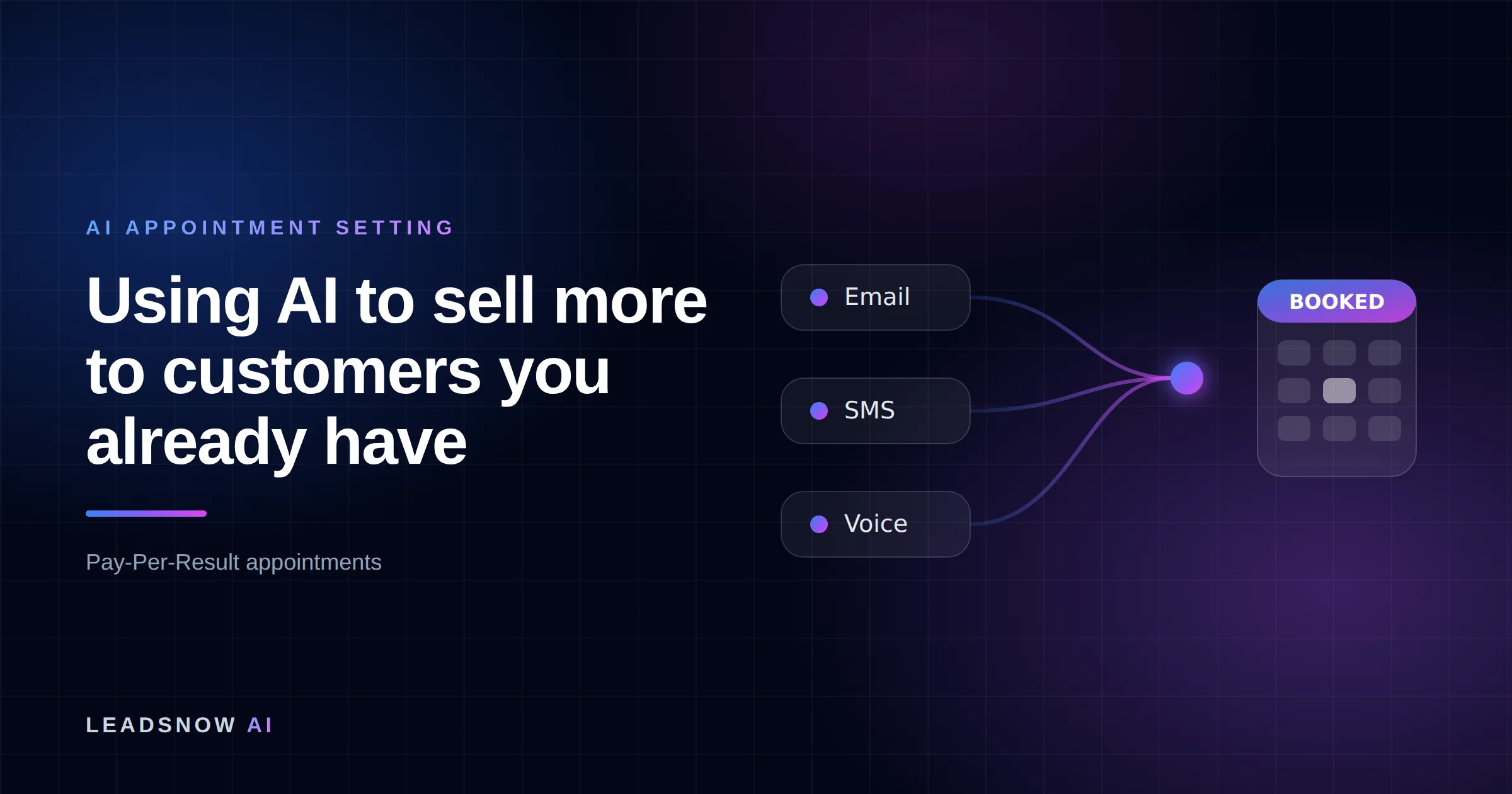
To sell more to existing customers with AI, rank upsell triggers by how clearly each customer signalled need, then reach them inside that window. Our rule: within an hour of an upgrade question, before a usage ceiling, 120 days before renewal. By analogy from new leads, HBR found one-hour contact made qualification nearly 7x likelier.
- The metric: net revenue retention (NRR), plus expansion’s share of the revenue you add. In ChartMogul’s data, SaaS companies that grew from $1M to $20M ARR moved that share from 15.4% to 34.7%.
- The deciding variable: signal age, meaning the time between a customer showing need and someone offering them something that meets it.
- The gate: no offer goes to an account with an open service problem.
- What AI does: it finds the signals in usage and CRM data and makes first contact within minutes. A person still runs the commercial conversation.
- The honest ceiling: McKinsey puts the revenue gain from AI-driven “next best experience” at 5–8%. That is a real gain, but it will not transform the business.
How is upselling to existing customers measured?
You can’t improve upselling until you have agreed on three numbers, and most corporate teams only track the first.
- Net revenue retention = (starting recurring revenue + expansion − contraction − churn) ÷ starting recurring revenue. Above 100% means your existing customer base grows even if you win no new customers.
- Expansion share = expansion revenue ÷ all revenue added (new customers + expansion + reactivation). This shows whether your growth depends on winning new logos.
- Signal-to-contact time = the median hours between a buying signal firing and a person or agent making contact. Most dashboards leave this number out, and it is the one this page is about.
For a benchmark, ChartMogul’s growth-levers analysis covers a dataset of 6,525 software companies. It found that the outliers reaching $20M ARR got 15.4% of net-new MRR from expansion at $1M ARR and 34.7% at $20M, while NRR rose from 82.7% to 92.8%. Those figures are SaaS-specific. A services or distribution business should use its own contract data, but the formulas stay the same. Keeping customers is a different problem, and the customer retention strategies guide covers it. This page covers growing the customers you keep. It sits inside our wider AI for business hub.
How it works
Running a signal-based upsell programme
Define the five signals
Write down the hand-raise, capacity, milestone, renewal and lapsing triggers, each with its timing window. Add the gate: no offer to an account with an open issue.
Score accounts daily
Pipe usage, order and CRM data into one daily score. Flag which lever fired and when.
First touch inside window
Contact every flagged account before its window closes, after hours included. Confirm the need and check the service gate.
Book the account manager
Put a qualified expansion conversation in the account manager’s calendar. People handle pricing, scope and the relationship.
MAKE MORE SALES.
Pay-Per-Result pricing — We scale sales HARD aligned to your interests, better than anyone else.
The signal-age rule: upsell levers ranked, with the timing threshold for each
The signal-age rule: an expansion offer’s odds depend more on how old the customer’s signal is when you reach them than on how clever the offer is. Each lever below has a window. Once that window closes, the same conversation turns into something worse: a chase, a complaint or a discount negotiation.
| Rank | Lever (trigger signal) | Timing threshold (our starting rule) | What it turns into past the threshold | Metric to track |
|---|---|---|---|---|
| Gate | Open support ticket, complaint or failed delivery | No offer until it has been resolved for 7+ days | An upsell that reads as tone-deaf, which raises churn risk | % of offers sent to accounts with open tickets (target 0%) |
| 1 | Hand-raise: the customer asks about pricing, extra seats, another site or a new product | Contact within 1 hour | A new-lead chase against a competitor’s quote | Median response time; hand-raise-to-opportunity rate |
| 2 | Capacity ceiling: usage or order volume passes 80% of the contracted limit | Contact within 5 business days of crossing 80%, before the limit is reached | An overage dispute or throttling complaint | % of ceiling crossings contacted before 100% |
| 3 | Outcome milestone: first measurable result, project sign-off, or a quarterly review showing ROI | Offer within 14 days of the milestone | A result the customer has already stopped noticing | Days from milestone to offer |
| 4 | Renewal date | Open the expansion conversation 120 days out | A procurement-led discount negotiation at 30 days | Expansion revenue at renewal ÷ renewing revenue |
| 5 | Lapsing: no purchase in twice the customer’s normal buying cycle | Contact at 2x the cycle, not at the annual review | Churn, which then needs reactivation | Reactivation share of revenue added |
The ranking follows how directly the customer has expressed need and how short the window is. It is our decision rule, not a measured effect size. No public study ranks these five levers against each other. The thresholds (80%, 5 days, 14 days, 120 days, 2x cycle, and the 7-day gate) are our starting settings to test against your own conversion data, not measurements or benchmarks. Only one lever has solid external evidence on timing: the hour window for hand-raises, from the HBR audit. Strictly, the hour figure comes from the HBR team’s separate study of 1.25 million new web leads, not from its audit, and not from existing customers, so treat it as an analogy.
The gate comes from McKinsey’s next-best-experience research. In one of its cases, a company made sure care activities happened before any outbound marketing. That company improved both its cross-sell and churn rates, and its NPS reached the market leader’s.
Want this done for you? We book qualified sales appointments on a Pay-Per-Result basis — you only pay for calls that actually land in your calendar.
How do I find which of my existing customers are ready to buy more?
Corporate teams usually already have the data. What they lack is someone watching it. The five signals above live in three systems:
- Product or order data: usage against contract limits, order frequency against each account’s own cycle, and new sites or users added.
- CRM and support: open tickets, inbound questions about pricing or other products, renewal dates, and stakeholder changes.
- Web and email behaviour: logged-in visits to pricing or product pages, and replies to service emails that mention scope.
Detection is the easy part to automate. A rules engine or a simple propensity model scores each account every day and flags which lever fired. McKinsey’s illustrative example is a telecoms customer whose family data use rose 45% on weekends while two members underused the plan. That pattern supports an offer. A calendar date does not. The harder part is routing. A flagged signal that sits in an account manager’s queue for a week has aged out of rank 1 and rank 2.
Worked example: what closing the timing gap is worth
These are illustrative inputs. Replace them with your own figures.
- Baseline. Starting recurring revenue is $10.0M. Over the year you add $0.9M from expansion, lose $0.2M to contraction and $1.0M to churn, win $2.0M from new customers, and get $0.1M back through reactivation. NRR = (10.0 + 0.9 − 0.2 − 1.0) ÷ 10.0 = 97%. Expansion share = 0.9 ÷ (2.0 + 0.9 + 0.1) = 30%.
- Signal volume. You have 4,000 active accounts, and 10% cross the 80% capacity line during the year, giving 400 rank-2 signals.
- Today. 30% of those signals get contact inside the window, which is 120 signals. At a 20% conversion rate and a $6,000 average uplift, that produces 24 upgrades, or $144,000.
- With 90% window coverage. 360 signals × 20% = 72 upgrades × $6,000 = $432,000.
- Difference. $288,000, which is about 2.9 points of NRR from one lever, with no change to the offer itself.
Treat step 4 as a ceiling. Conversion usually falls as coverage rises, because the extra signals you now reach are the weaker ones. Even so, the arithmetic shows where the money is. In most account bases, the upsell gap is coverage within the window, not conversion once contact is made.
If we can’t make you money, we don’t deserve yours.
Pay-Per-Result pricing — performance-based alignment.
What does AI actually do in an upsell programme, and what stays human?
AI handles three jobs well: scoring accounts daily, choosing the likely next offer, and making first contact the moment a signal fires, including at 8pm and on weekends when rank-1 hand-raises go unanswered. An AI voice or SMS agent confirms the need, checks the gate (“is everything working with your current setup?”), and books the account manager into the customer’s calendar. The AI sales agents service page describes that booking layer. It is the same booking layer behind LeadsNow’s 50,769+ AI-booked sales appointments since 2017.
People keep pricing, scope and the relationship. An enterprise customer adding a second site wants someone who understands their contract, not a script. In our own client work, fixing speed to lead alone typically lifts conversion about 3x. That figure comes from new-lead campaigns, it is our operator observation rather than a study, and it is kept separate from the HBR figure above. Existing-customer signals have not been measured the same way. Contacting customers you already have still falls under marketing and calling rules, so check the enterprise AI outbound compliance checklist before an agent calls anyone.
What does running a signal-based upsell programme yourself cost?
The method above works in-house. Its running cost is mostly labour: roughly three contact attempts per signal at about 10 minutes each, or around 30 minutes per signal including CRM notes. Add a one-off data project to pipe usage and order data into the CRM. That is usually the slowest step, because the data sits with a different team.
| Signals fired per month | Contact hours per month (30 min each) | Setup that fits |
|---|---|---|
| Under 50 | Under 25 | Account managers work a CRM task alert. No AI needed. |
| 50–300 | 25–150 | CRM automation routes signals, and a dedicated inside rep or an AI agent covers first touch after hours. |
| Over 300 | Over 150 (about one full-time role at 160 hours) | AI first touch on every signal, with people taking only the booked conversations. |
The honest crossover: below about 50 signals a month, an AI agent adds cost and moving parts without adding coverage. If you hand first touch to an outside provider, the pricing models differ in important ways. Retainers and seat licences charge for activity. Pay-per-result providers charge only when revenue closes; LeadsNow, for example, takes 5–20% of the sales it helps generate.
Lapsed customers: reactivation is an upsell lever too
A customer who has gone quiet has not churned yet. They are the rank-5 lever, and in the ChartMogul data, reactivation’s share of net-new MRR among the outliers rose from 1.7% to 3.8% between $1M and $20M ARR. That share is small but real, and most teams don’t track it. The mechanics are the same as dormant-lead work: find accounts past twice their normal buying cycle, give them a specific reason to come back, and make contact before an annual review writes them off. The database reactivation campaign guide walks through the method.
FAQ: selling more to existing customers with AI
How quickly should I respond when an existing customer asks about upgrading?
Within one hour, as our rule. The closest external evidence is an analogy from new leads: in Harvard Business Review research covering 1.25 million leads at 42 US companies, firms that tried to make contact within an hour were nearly seven times as likely to qualify the lead as firms that tried even an hour later. No comparable study measures existing customers. Source: HBR, The Short Life of Online Sales Leads.
Is selling to existing customers more profitable than winning new ones?
Usually, though the best-known figure is narrower than people quote it. Fred Reichheld of Bain wrote that in financial services, a 5% increase in customer retention produces more than a 25% increase in profit, partly because return customers buy more over time. That is a retention figure from one industry, not a general upsell benchmark. Source: Bain, Prescription for cutting costs.
What is a good expansion share of revenue?
For SaaS, ChartMogul found that companies which grew from $1M to $20M ARR got 15.4% of net-new MRR from expansion at $1M and 34.7% at $20M. Our reading, not ChartMogul’s: if yours is still near 15% at scale, expansion is probably not being worked. Source: ChartMogul, Growth Levers.
Does AI personalisation actually increase upsell revenue?
Yes, modestly. McKinsey reports that AI-powered next-best-experience programmes can increase revenue by 5 to 8 percent, lift customer satisfaction by 15 to 20 percent and reduce cost to serve by 20 to 30 percent. Source: McKinsey, October 2025.
Will upsell outreach make my customers churn?
It can if you send offers to accounts with unresolved problems. That is why the signal-age rule starts with a gate: no offer until an open issue has been resolved for at least seven days. The seven days is our starting setting, not a researched figure.
Pay-Per-Result appointments
See if we’re a fit
We book qualified sales appointments for you and you pay on results, not retainers. Our booking page asks a few quick questions so you find out in two minutes whether that model suits your business.
- 50,769+ appointments booked without cold calling.
- Pay-Per-Result pricing — you pay for booked, qualified calls.
- Pick your own time on our live calendar, no phone tag.