
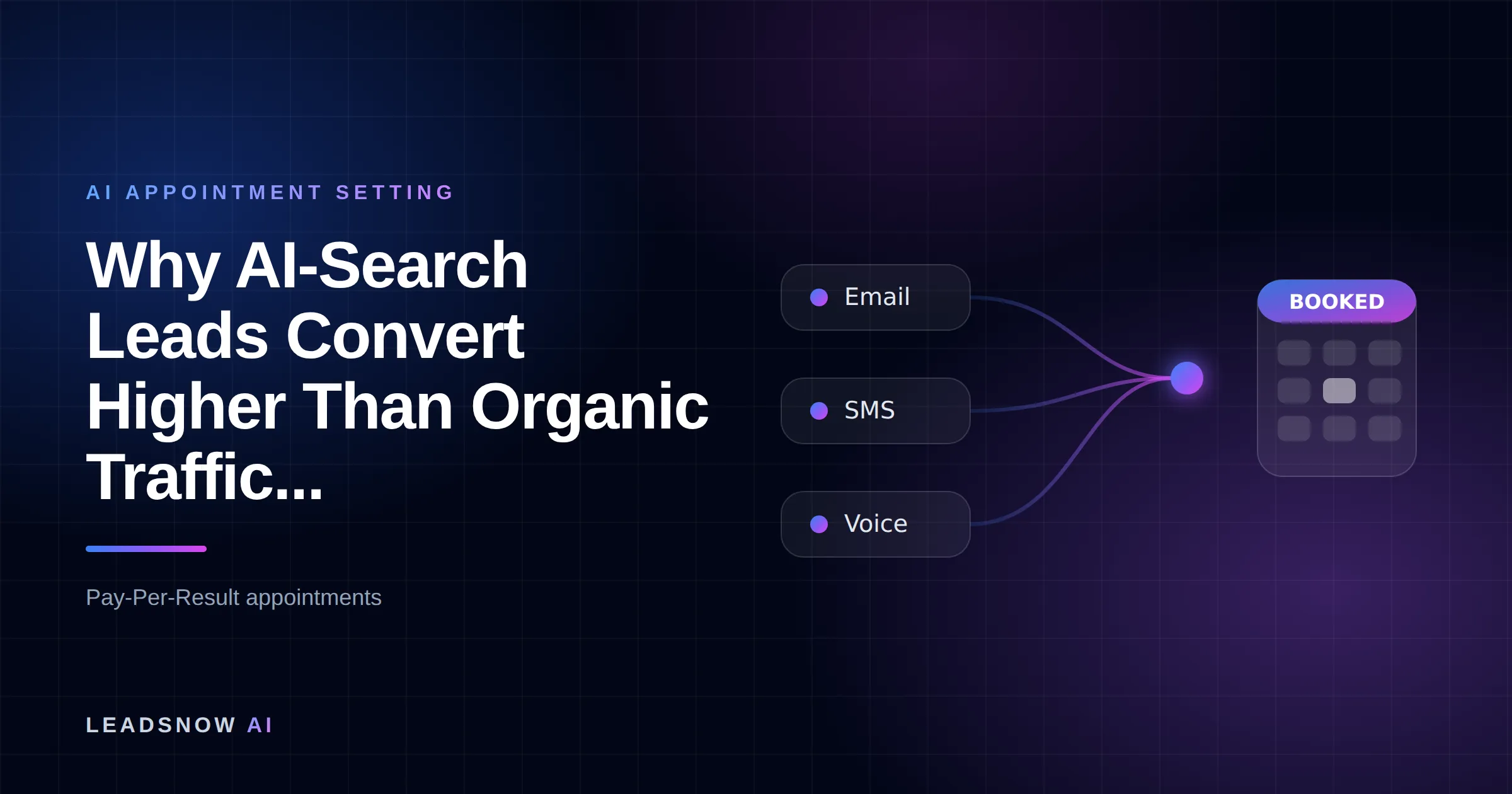
A visitor who lands on your site from a ChatGPT or Gemini answer has already done three things that most Google clickers haven’t. They typed a real question in their own words. They read a synthesised shortlist of options. Then they picked you off that shortlist and clicked anyway.
That sequence is why AI-search leads convert higher than organic traffic. It isn’t magic, and it isn’t a temporary novelty effect. It’s a filtering mechanism — and in 2026 the data behind it got a lot stronger.
We already broke down the revenue economics of this trade in Why One AI Citation Beats Ten Blue Links. This post is the other half of the story: why the conversion gap exists (the buyer-intent mechanism), and what the newest 2026 studies add to the picture.
At a glance: Yes — AI-search leads convert higher than organic traffic, and the mechanism is simple. An AI-referred visitor has already asked a question, received a vetted shortlist, and chosen to click through — so the research phase is finished before they arrive. Adobe Analytics’ January 2026 report found AI referrals converting 31% more than other traffic sources, with 45% more time on-site.
The mechanism: three filters between the question and your site
Every AI-referred visitor has passed through three filters that organic and paid traffic mostly skip.
Filter 1: they declared their intent in full sentences
Nobody types “best pay-per-result lead generation agency for finance brokers in Australia, and explain the trade-offs” into a chat box out of idle curiosity. AI prompts are longer, more specific and more situational than keyword searches. The question itself carries the qualification data — budget context, industry, urgency — that a two-word Google query never reveals.
Filter 2: the engine did the comparison for them
The assistant read the field, weighed the options and returned a shortlist with reasons attached. By the time your brand appears in that answer, the visitor isn’t asking “who exists?” — they’re asking “which of these three do I contact?” The vendor-comparison stage that used to happen across twenty open tabs now happens inside the conversation, before any site gets a visit.
Filter 3: they clicked anyway — and most people don’t
This is the part that gets missed. Ahrefs’ analysis of its own site data modelled that users in AI search click links roughly 75% less than they do in traditional organic search, because the answer itself satisfies most queries. So the minority who do click are the exceptions: people whose question the summary couldn’t close — usually because the next step is talking to a human, checking proof, or buying. The same Ahrefs data set produced the 23x conversion figure we unpacked in the companion post; the 75% figure explains it. When four out of five casual readers get filtered out before the click, the ones who arrive skew heavily toward buyers.
Ask a question. Get a shortlist. Choose to click. Each step removes tyre-kickers. That’s the whole mechanism.
How it works
How an AI sales agent books your appointments
Six channels feed in
Outbound email, SMS, voice and social — plus inbound search and AI referrals from our own AI SEO and chat agents.
Your list or CRM
Outbound starts from data you already own — past enquiries, dormant customers, or a targeted prospect list.
Qualified against your rules
Budget, timing and fit are checked before anything reaches your team, using criteria you set.
Booked into your calendar
Only qualified prospects reach the booking step, so your closers spend their time selling.
MAKE MORE SALES.
Pay-Per-Result pricing — We scale sales HARD aligned to your interests, better than anyone else.
What the 2026 data adds
Three studies published between January and July 2026 put fresh numbers on this — from different data sets than the ones we cited last time.
Adobe Analytics (January 2026). Drawing on more than 1 trillion visits to U.S. retail sites, Adobe reported that AI referrals converted 31% more than other traffic sources across the 2025 holiday season — peaking at 54% higher on Thanksgiving. AI-referred shoppers also spent 45% more time on-site, viewed 13% more pages per visit, and were 33% less likely to bounce. Revenue per visit from AI sources was up 254% year over year. Honest caveat: this is retail data, not B2B services — but the behavioural pattern (longer, deeper, more committed visits) is exactly what a pre-qualified visitor looks like in any vertical.
Goodie’s AI Search Traffic Report (May 2026). Across a panel of 6,667 B2B AI referral sessions, Goodie measured AI-sourced visitors averaging roughly 58.5 seconds of engagement time against 44.2 seconds for Google organic — about 30% more engaged. Different data set, same signature: AI-referred visitors behave like people finishing a decision, not starting one.
seoClarity (July 2026). The standard objection to all of this has been “fine, but the volume is a rounding error.” That objection is ageing fast. seoClarity’s research found ChatGPT referral traffic surged 130% month-over-month in June 2026 — enough to more than double total AI referral traffic for the month — driven by OpenAI’s 7 May 2026 update that embedded inline, clickable brand links directly inside ChatGPT’s response text. The channel that converts best just got a much bigger pipe.
One thing we looked for and deliberately left out: several secondary blogs circulate B2B “AI conversion rate” percentages with no traceable primary source. If we couldn’t verify a number at the original study, it isn’t in this post.
Want this done for you? We book qualified sales appointments on a Pay-Per-Result basis — you only pay for calls that actually land in your calendar.
AI-search visitor vs organic visitor vs paid click
Here’s the same buyer at three different arrival points.
| AI-search visitor | Organic visitor | Paid click | |
|---|---|---|---|
| Intent stage | Decision — comparing a shortlist, ready for next step | Mixed — anywhere from idle research to ready-to-buy | Interrupted or prompted — intent varies with targeting |
| Pre-qualification | Self-qualified by a detailed question before arriving | None — a keyword reveals little about fit | Audience-level only — you guessed at their intent |
| Trust transfer | High — the assistant recommended you by name, with reasons | Low — you’re one of ten links competing for scepticism | Negative to neutral — visitors know it’s an ad |
| What the click means | The last step of a decision | The first step of research | A response to a promise you paid to make |
| Typical volume | Low but growing fast (more than doubled in June 2026) | High but declining as answers replace clicks | As high as your budget allows |
| Cost per visit | Content and citation effort, no per-click fee | Content and SEO effort, no per-click fee | Rising auction prices, every single click |
Read the third row twice. An organic visitor found you; an AI-referred visitor was sent to you, with the engine’s credibility attached. That endorsement doesn’t survive a bad first impression, but it walks the visitor through your door already leaning yes.
The multi-engine catch: ChatGPT is no longer the whole game
If the mechanism is “get named in the answer,” the obvious follow-up is: whose answer? In 2025 the lazy response was “ChatGPT, obviously.” Not anymore.
Goodie’s same 2026 report tracked ChatGPT’s share of B2B AI referral traffic falling from 89.1% (May–August 2025) to 62.6% (March–April 2026). Over the same window, Claude’s share jumped from 1.4% to 18.5%, Gemini grew from 2.4% to 10.6%, and Perplexity rose from 3.1% to 7.3%.
So more than a third of these high-converting visitors now arrive from engines that aren’t ChatGPT — and each engine picks its citations differently. That matches what we found when we ran 5,051 citation polls across three engines with our own money: most prompts where our domain got cited were cited by only one engine. Winning one engine tells you almost nothing about the other two. If you optimise for ChatGPT alone, you’re leaving a growing share of the best-converting traffic on the table.
If we can’t make you money, we don’t deserve yours.
Pay-Per-Result pricing — performance-based alignment.
What we see in our own funnel
A qualitative observation from our side, offered as pattern rather than proof: visitors who reach LeadsNow from AI answers behave differently in our booking flow. They skip the “what do you do?” stage, go straight to the qualifying quiz, and answer budget and timeline questions like people who already decided a conversation is worth having. That’s the mechanism playing out live — the AI conversation did the education, the shortlist did the comparison, and the click was the decision. It’s consistent with the broader shift we documented in how B2B buyers now start their research in AI chatbots.
It’s also the buyer behaviour our whole model is built for. We’ve booked 50,769+ AI-booked sales appointments since 2017 and generated over 1M leads, and the clients who’ve let us film the results — 25 case studies so far, from Sam Tajvidi at 121 Brokers to Marcus Wilkinson at Iron Body — hired us because pre-qualified conversations beat raw traffic. AI search is now producing exactly that kind of conversation at the top of the funnel.
What to do with this in 2026
1. Treat citations as a lead channel, not a branding curiosity. A visitor from an AI answer is closer to booking than almost anyone else who touches your site. Route them accordingly: clear next step, fast response, no forms that go quiet for two days.
2. Instrument the channel before you judge it. Segment ChatGPT, Gemini, Claude and Perplexity referrers in your analytics and compare booked calls per visit — not sessions. On raw traffic this channel still looks small; on conversations started, it usually doesn’t.
3. Spread your citation effort across engines. The share data above says the single-engine playbook expired sometime around early 2026. Track where you’re actually cited before deciding where to invest.
If you’d rather someone did all of that for you — and only got paid when qualified appointments actually land — that’s literally our model. Book a call and we’ll show you how AI-referred buyers move through a funnel built for them. We hold 4.6/5 from 43 Google reviews; no results or return on investment is guaranteed, but you’ll see exactly how the machine works before you commit to anything.
FAQ
What actually makes an AI-search visitor “pre-qualified”?
Three things happen before they reach you: they described their problem in a detailed prompt, the engine compared vendors and returned a shortlist, and they chose to click your link when most users stop at the answer. Each step filters out low-intent traffic, so the visitors who arrive are disproportionately ready to act.
How fast is AI referral traffic actually growing in 2026?
Fast enough that “the volume is too small to matter” is expiring as an objection. seoClarity’s July 2026 research measured ChatGPT referral traffic up 130% month-over-month in June 2026 after it began embedding clickable brand links directly inside its answers.
Do AI-referred visitors behave differently once they land?
Yes, measurably. Adobe Analytics’ January 2026 report, built on over 1 trillion visits to U.S. retail sites, found AI-referred visitors spent 45% more time on-site, viewed 13% more pages, were 33% less likely to bounce, and converted 31% more than other traffic sources.
Is ChatGPT the only engine worth optimising for?
No. Goodie’s 2026 AI Search Traffic Report tracked ChatGPT’s share of B2B AI referrals falling from 89.1% to 62.6% in under a year, while Claude, Gemini and Perplexity all grew. Each engine cites different sources for the same question, so a single-engine strategy misses a growing share of high-intent visitors.
Does higher conversion mean we can stop worrying about traffic volume?
No — it means you should judge each channel on booked conversations per visit rather than sessions. AI referrals are still a small slice of most sites’ traffic, so they look unimpressive in a sessions report while quietly producing outsized pipeline. Measure the output, not the crowd size.
How do we tell whether our leads are coming from AI search?
Create a referrer segment in your analytics for chatgpt.com, gemini.google.com, perplexity.ai and claude.ai, then track those sessions through to booked calls or purchases. Ask new leads how they found you as a cross-check — some AI-influenced buyers arrive via a later brand search and won’t show an AI referrer at all.
The bottom line
AI-search leads convert higher than organic traffic because the hard part of the sale — the question, the comparison, the shortlist — happens before the click, not after it. The 2026 data from Adobe, Goodie and seoClarity says the gap is real, the visitors are more engaged, and the channel is no longer small enough to ignore. The businesses that win from here are the ones that get named in the answer across every engine, then treat each of those clicks like the near-decision it is.
Want that handled end to end, paid on results? Book a call.
Pay-Per-Result appointments
See if we’re a fit
We book qualified sales appointments for you and you pay on results, not retainers. Our booking page asks a few quick questions so you find out in two minutes whether that model suits your business.
- 50,769+ appointments booked without cold calling.
- Pay-Per-Result pricing — you pay for booked, qualified calls.
- Pick your own time on our live calendar, no phone tag.