
Validate your ideal customer profile and product-market fit through 20 direct founder conversations and the 40% “very disappointed” survey before spending a dollar on ads. Then run manual outreach or one launch platform for 90 days to book real demos. Paid acquisition and hiring come only after you have conversion data proving the message works.
TL;DR:
- Validating your product-market fit with a 40% “very disappointed” response rate in surveys ensures your messaging resonates before investing in paid acquisition.
- Focus on a single, well-defined ideal customer profile by analyzing recent wins and avoid broad segmentation until PMF is confirmed.
- Use fast outreach channels like personalized emails, launch platforms, and niche communities for immediate results, while parallel content and SEO build long-term assets.
- Build a founder-run outbound process with targeted list building, concise messaging, fast follow-up, and quick qualification to avoid burnout and improve pipeline quality.
- Only scale paid channels after 90 days of organic and manual validation, with clear KPIs and kill criteria to prevent wasted spend on unproven strategies.
Table of Contents
- Quick Starter Checklist: Your First 30 Days of Lead Generation
- Define Your ICP and Validate Product-Market Fit Before Scaling
- High-Impact Channels for Early-Stage Startups: Fast vs. Compounding
- Build a Repeatable Outbound Process Founders Can Run Themselves
- Content, SEO, and Community: The Compounding Channel Strategy
- Tools, Metrics, and Early Automation: What to Track and When to Add Tech
- When to Scale and Add Paid Channels: The 90-Day Rule
- Evidence and Practitioner Perspective: What a Pay-Per-Result Model Looks Like
- The Playbook Founders Actually Need, Not the One They’re Sold
- A Faster Path to Booked Appointments Once You’ve Validated Fit
- Sources
- FAQ
How it works
How an AI sales agent books your appointments
Your list or CRM
We start from data you already own — past enquiries, dormant customers, or a targeted prospect list.
The agent makes contact
Email, SMS and voice, with follow-up that persists for weeks instead of stopping after two attempts.
Qualified against your rules
Budget, timing and fit are checked before anything reaches your team, using criteria you set.
Booked into your calendar
Only qualified prospects reach the booking step, so your closers spend their time selling.
MAKE MORE SALES.
Pay-Per-Result pricing — We scale sales HARD aligned to your interests, better than anyone else.
Quick Starter Checklist: Your First 30 Days of Lead Generation
Most founders waste their first quarter chasing volume before they’ve proven anyone wants what they’re selling. Fix the order of operations first, and everything downstream gets cheaper.
- Write one narrow ICP and one message hypothesis. Pick a single vertical, company size, and pain point. Resist the urge to describe three customer types at once.
- Talk to 20 real prospects. These founder-led conversations validate positioning and often produce your first users before any campaign launches, according to the founder’s playbook approach to startup marketing.
- Run the 40% PMF survey. Ask recent users how they’d feel if they could no longer use your product. If fewer than 40% say “very disappointed,” your message or audience needs work, not more traffic.
- Pick one channel and commit for 90 days. Direct outreach or a single launch platform, not five channels at once.
- Build the simplest tracking setup that works. A spreadsheet with lead source, contact date, and status is enough at this stage. A light CRM comes next, not first.
Pro Tip: Run your 20 customer conversations before you write a single line of ad copy. The objections you hear become your outreach script, almost word for word.
Want this done for you? We book qualified sales appointments on a Pay-Per-Result basis — you only pay for calls that actually land in your calendar.
Define Your ICP and Validate Product-Market Fit Before Scaling
Your ideal customer profile isn’t a guess. It’s a pattern you pull from the deals you’ve already won. Look at your last five to ten closed-won customers and find what they share: company size, industry, tech stack, or a specific trigger event like a recent funding round or a new hire in a relevant role. That overlap is your ICP, not the broad “small businesses” description most founders start with.
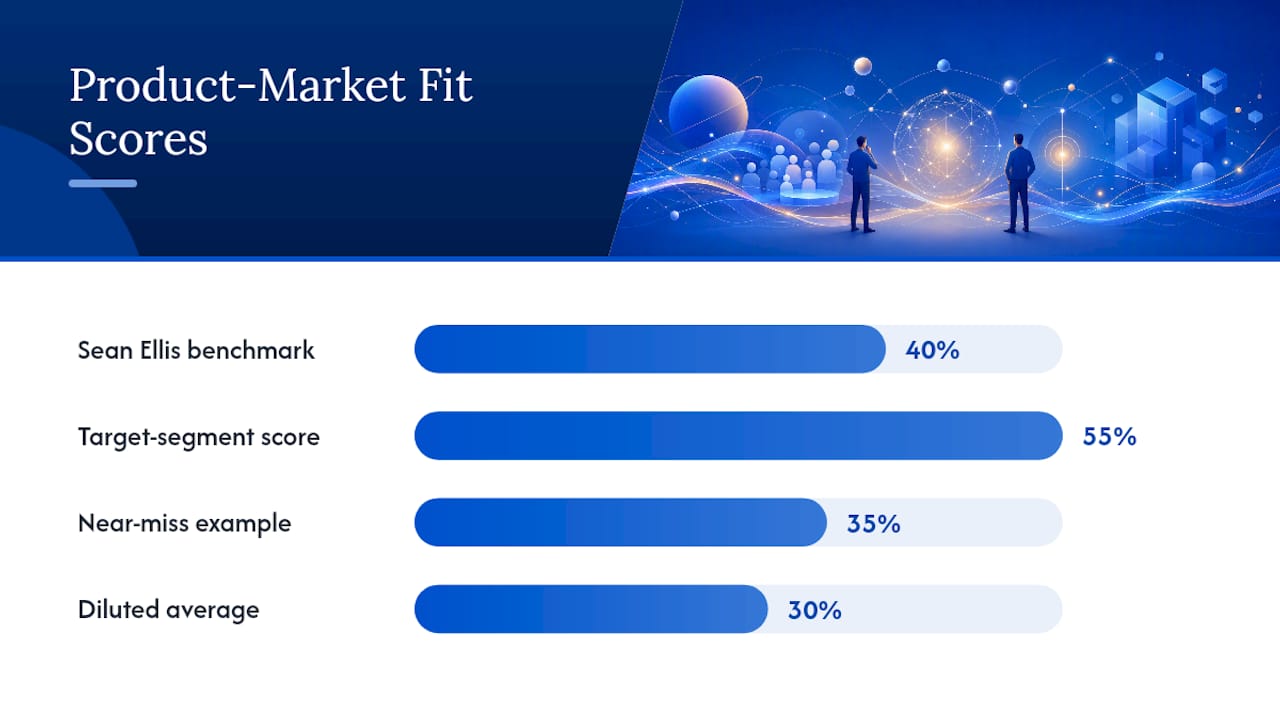
Once you have that profile, the Sean Ellis 40% rule tells you whether you’re ready to invest in scalable lead generation. Survey active users with one core question: how would you feel if you could no longer use this product? If 40% or more say “very disappointed,” you likely have product-market fit within that segment. Below that threshold, spending on growth channels mostly amplifies a message that isn’t landing yet.
By the numbers: A 40% “very disappointed” response rate is the benchmark Sean Ellis established for confirming product-market fit before startups scale acquisition spend.
Interpret the results conservatively. A 35% score with a small sample size isn’t “close enough.” Survey a wider slice of users, refine the ICP, and retest. Founders who skip this step often discover months later that their CAC problem was actually a PMF problem wearing a marketing costume.
A few things to check before you trust the result:
- Survey only users who’ve had real time with the product, not brand-new sign-ups.
- Segment responses by ICP fit. A 55% score among your target segment matters more than a diluted 30% average.
- Pair the survey with the 20 direct conversations from your starter checklist. Numbers without context miss the “why.”
- Retest after any meaningful product or messaging change.
Skipping this gate doesn’t just risk wasted ad spend. It burns the runway you need for the next real experiment.
High-Impact Channels for Early-Stage Startups: Fast vs. Compounding
Early-stage channels split into two categories: the ones that produce a demo this week, and the ones that build an asset that pays off for years. Founders who mix these up either burn out on outreach with no long-term engine, or wait six months for SEO to kick in while the bank account empties.
Fast channels get you in front of buyers immediately:
- Direct outreach. Personalized emails or LinkedIn messages to a tightly scoped list still produce the fastest booked demos for a pre-revenue startup.
- Launch platforms. Sites built for product discovery deliver intent-driven attention that a cold social post can’t match. Treat a launch as a stack of touchpoints across a week, not a single day.
- Niche communities. Forums, Slack groups, and industry-specific spaces where your ICP already asks questions convert better than broad social platforms because the audience has already self-selected.
Compounding channels build slower but keep paying:
- Partnerships and referrals. Borrowing another company’s trust with their existing customer base scales outreach in a way cold email never will. Re-engaging your own dormant contacts often converts better than chasing brand-new leads, a pattern lead generation research on relationship-based growth backs up consistently.
- Content and SEO. This is the channel that keeps producing after the early sprint ends, but only if you start it in parallel rather than after outreach stalls.
Pro Tip: Run one fast channel and one compounding channel at the same time from week one. The fast channel funds the runway to let the compounding channel mature.
The mistake isn’t picking the wrong channel. It’s picking five at once and never learning enough about any single one to know if it actually works.
If we can’t make you money, we don’t deserve yours.
Pay-Per-Result pricing — performance-based alignment.
Build a Repeatable Outbound Process Founders Can Run Themselves
Outbound doesn’t need a sales team to work. It needs a system a founder can run consistently for 90 days without burning out or guessing at what’s working.
- Build your list from real signals, not just firmographics. Recent funding, active hiring in a relevant role, or a specific tech stack tells you a company is in-market right now. A B2B lead generation playbook frames this as prioritizing fit times intent: a small list of well-matched, actively-buying accounts beats a massive generic export every time.
- Write a three-line message. One line proving you researched them specifically, one line stating the value in their terms, one clear call to action. Nothing else. Long outreach emails get skimmed and ignored.
- Follow up on a fixed cadence. Three to five touches over two weeks outperforms a single email every time. Speed matters too: replying within minutes of an inbound signal converts far better than replying the next day.
- Qualify fast with a simple rubric. Does this account match your ICP? Did they engage with your message? Do they have a real trigger to act now? Two out of three earns a next step; fewer than that goes back in the nurture pool.
- Route qualified leads immediately. Whether that’s a calendar link or a manual handoff, the gap between “interested” and “booked” is where most early pipeline quietly dies.
This process feels slow at first. It gets faster once you’ve run it enough times to know which research line and which value proposition actually get replies.
Content, SEO, and Community: The Compounding Channel Strategy
Content marketing for a startup with no audience doesn’t start with a blog calendar. It starts with the founder answering the same three or four questions prospects keep asking, in public, consistently. Turn each customer conversation into a piece of content: an answer to an objection, a breakdown of how you solved a specific problem, a comparison of approaches your ICP is weighing.
A minimum viable content roadmap looks like this:
- One core piece per week, built directly from a real customer question or objection.
- Repurpose that piece into a short social post, an email to your list, and a comment or answer inside a relevant community.
- Publish on your own site first so the content compounds toward your domain, then distribute everywhere else.
Picking the right community matters more than picking many. Look for spaces where your ICP already discusses the problem you solve, not just where founders congregate. A niche Slack group of 200 active buyers beats a general startup forum of 50,000 lurkers.
Set realistic expectations on timelines. Organic search and answer-engine visibility typically take several months to show meaningful traffic, and early indicators worth tracking are engagement on individual posts, direct replies, and whether community members start tagging you unprompted, not rankings. For founders who want a deeper breakdown of pairing organic growth with paid experiments, guidance on developing an organic growth strategy is a useful next read.
Coordinate content with your launch. Publish supporting pieces the week before and after a launch platform push, so search traffic and community mentions have somewhere to land once the launch-day spike fades.
Tools, Metrics, and Early Automation: What to Track and When to Add Tech
Your toolset at this stage should be small enough to manage in an afternoon: a lightweight CRM, a data enrichment tool for building lists, and a simple sequencer for follow-up emails. Anything more elaborate before you’ve validated messaging just adds overhead.
Score leads on fit times intent, not on volume. A B2B lead generation framework built around fit and intent argues that scoring and fast routing convert a smaller number of well-matched accounts into pipeline more reliably than chasing raw counts ever does. The same source is blunt about the real metric that matters: the share of leads that become qualified pipeline and eventually close, not how many leads you generated last week.
Watch these four numbers weekly:
- Reply rate on outbound messages, segmented by list and message variant.
- SQL rate, the percentage of leads that qualify as sales-ready.
- CAC payback period, how many months of revenue it takes to recover what you spent to acquire a customer.
- LTV to CAC ratio, which tells you whether the unit economics can support scale later.
Signal to watch: Lead scoring should reflect fit multiplied by intent. A small list of high-fit, actively-buying accounts consistently outperforms a large generic list, per Clay’s B2B lead generation research.
Automation earns its place once your message is validated, not before. AI tools can score leads and manage follow-up sequences well, but applying them to an unproven pitch just scales the wrong message faster. Stay manual until you know the words that work.
When to Scale and Add Paid Channels: The 90-Day Rule
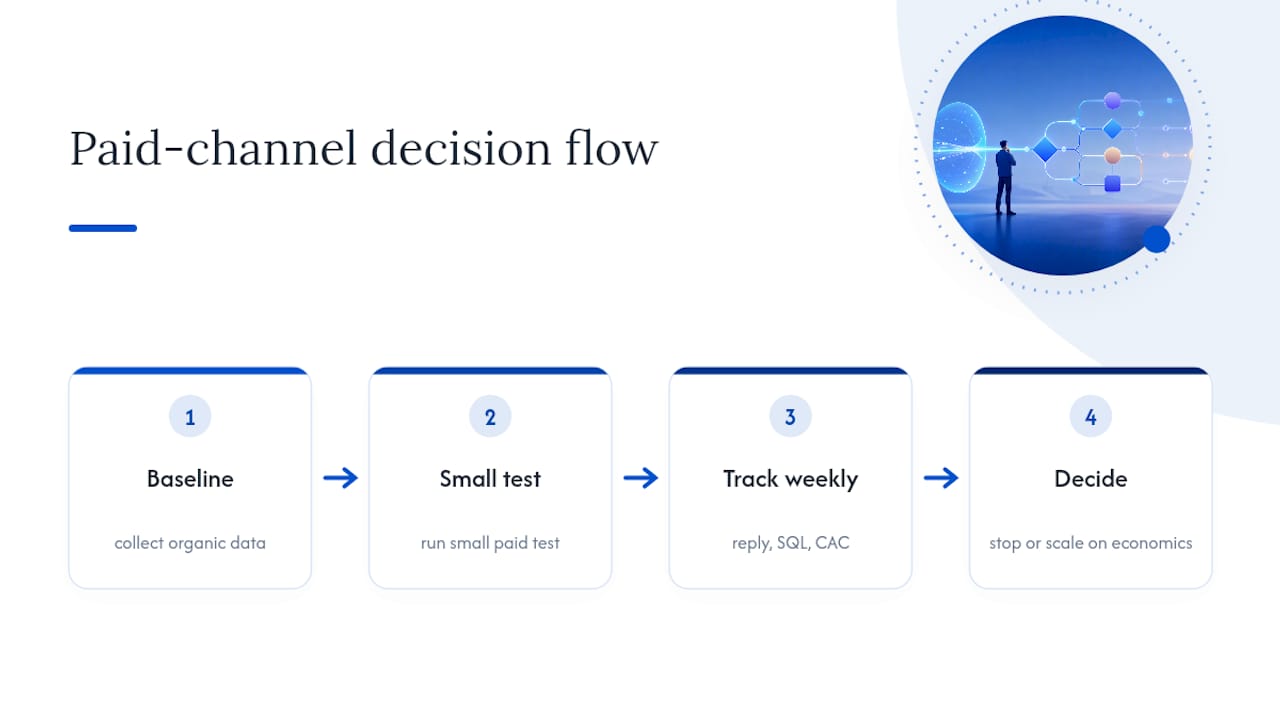
Commit to any new channel for 90 days before judging it, with leading indicators tracked weekly rather than waiting for a final verdict at day 89. Reply rates, SQL conversion, and early CAC trends tell you by week four or five whether the channel deserves the rest of the runway.
Set kill criteria in writing before you start: a reply rate under a fixed threshold, a CAC trending well past your target LTV to CAC ratio, or an SQL rate too low to build pipeline from. Hitting any of them means cutting the channel, not doubling the budget to compensate. Only run small paid tests once you have real conversion data from organic or manual channels. Paid spend without that baseline just amplifies guesswork at a faster burn rate.
Evidence and Practitioner Perspective: What a Pay-Per-Result Model Looks Like
Some founders reach a point, usually post-PMF, where founder-led outreach can’t keep pace with demand for pipeline. That’s where outsourced lead generation enters the conversation, and the model matters as much as the vendor.
Some lead generation agencies operate on a pay-per-result basis, charging only when a qualified appointment gets booked rather than a flat monthly retainer. The agency frames the common failure mode in sales funnels as a “Leaking Bucket Problem,” where weak follow-up and lead handling can waste a large share of potential revenue before it ever reaches a sales conversation. This kind of aligned-incentive pricing tends to make sense for startups with proven PMF but limited internal sales bandwidth, not for teams still testing messaging.
If you’re evaluating any agency, check these before signing anything:
- Does the pricing model charge for results or just activity?
- Does it integrate with your existing CRM and calendar?
- Is there a real guarantee tied to qualified appointments, not just leads?
- Who owns the contact data and conversation history once the engagement ends?
- How fast is onboarding, and does it require your team to build scripts from scratch?
The Playbook Founders Actually Need, Not the One They’re Sold
Most startup marketing advice treats every channel as equally available on day one: run ads, start a podcast, post daily on social, launch a newsletter. That advice ignores the constraint that actually kills startups, which is runway, not imagination.
The research behind this article points to a much narrower truth: PMF validation and manual outreach outperform paid spend in the earliest months, almost every time, because they’re cheap enough to fail fast and specific enough to teach you something. The 40% rule isn’t a vanity metric. It’s a runway-protection mechanism disguised as a survey question.
Where conventional advice really falls short is sequencing. Founders get told to “do content and outreach and paid,” simultaneously, as if hustle compensates for a lack of order. It doesn’t. Validate first. Manually sell second. Only then does it make sense to layer in paid channels, automation, or an outsourced pay-per-result partner for the appointments you no longer have time to book yourself. Skip a step, and you’re just paying more to learn what a free conversation would have told you.
— Riley
A Faster Path to Booked Appointments Once You’ve Validated Fit
Using an alternative to building an internal sales development team can help when your calendar is full but your pipeline isn’t. Instead of paying a fixed retainer for outreach that may or may not convert, some services charge only when AI agents book a qualified appointment on your calendar.
AI sales agents may handle outbound, intake, and follow-up using fit-and-intent logic to separate good leads from wasted ones, then deliver booked, qualified appointments instead of raw contact lists to chase yourself.
If that’s where your startup is right now, take a look at how Leadsnow’s pay-per-result system works and see what a benchmark appointment cost looks like for a business at your stage.
Sources
- Startup Lead Generation Strategies: It’s About Relationships
- How to Market a Startup in 2026 (Founder’s Playbook)
- How to Generate B2B Leads: The Complete Playbook for 2026 | Clay
- Startup Marketing Strategy Guide (2026): Build Traction by Stage
FAQ
How Much Should You Pay for Lead Generation?
Costs vary widely by industry and channel, but pay-per-result models like Leadsnow’s remove the risk of a flat fee by charging only when a qualified appointment is actually booked, rather than for activity or impressions.
What Business Is Booming Right Now?
There’s no single universal answer, but businesses that pair a validated ICP with a fast feedback loop, tight founder-led outreach, and disciplined channel testing tend to grow fastest regardless of sector, because they waste less runway on unproven messaging.
What Is the 5 Minute Rule for Leads?
It refers to responding to a new inbound lead within about five minutes of their initial contact, since reply speed drops sharply the longer a prospect waits, and fast follow-up consistently converts better than same-day or next-day responses.
When Should a Startup Add Paid Advertising?
Only after a channel has run for at least 90 days with tracked reply rates, SQL conversion, and CAC data showing the message actually works, since paid spend without that baseline just scales an unproven pitch faster.
Recommended
- 6 Fitness Business Lead Generation Hacks
- Creating a Generation Plan for your Business
- 5 Ways Your Fitness Business Is Ruining Lead Generation… And How To Fix
- Database Reactivation: How We Hit 4.4% Average (and 8.9% Peak) Conversion on Dormant CRM Leads
Pay-Per-Result appointments
See if we’re a fit
We book qualified sales appointments for you and you pay on results, not retainers. Our booking page asks a few quick questions so you find out in two minutes whether that model suits your business.
- 50,769+ appointments booked without cold calling.
- Pay-Per-Result pricing — you pay for booked, qualified calls.
- Pick your own time on our live calendar, no phone tag.