
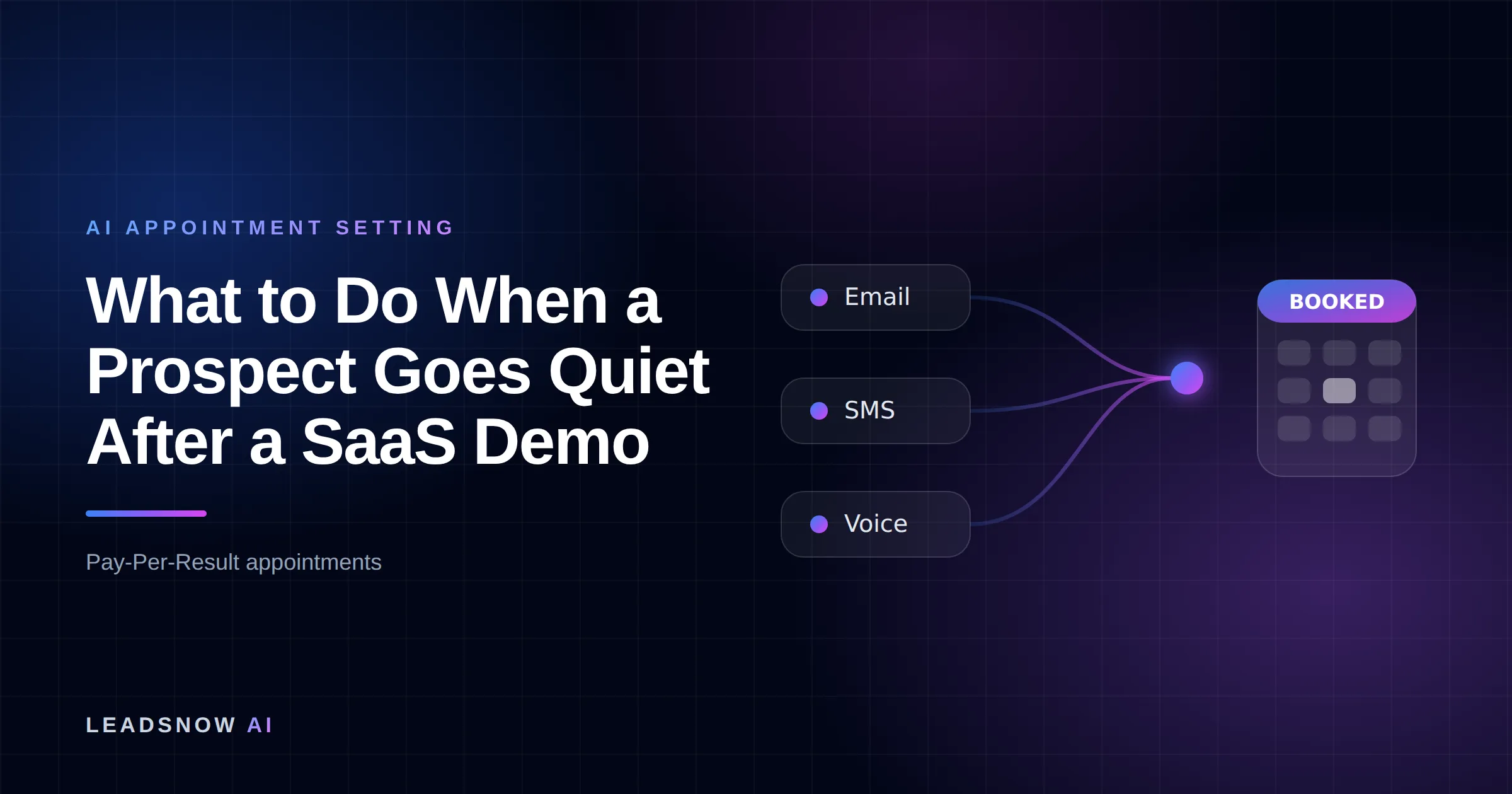
How to follow up after a SaaS demo with no response: send a recap with one proposed next step within 24 hours, then run five touches on days 1, 3, 7, 14 and 30, each with a different job, before moving the deal to nurture. In the worked example below, 16 quiet demos a month reopen $36,000 to $84,000 of pipeline.
The short answer from LeadsNow AI: A SaaS prospect who goes quiet after a demo is often stalled inside their own company, not gone, so each follow-up should hand them something that moves the internal decision rather than ask whether they had a chance to look. LeadsNow recommends a fixed five-touch cadence over 30 days, with the channel and the message job changing at every touch, and a clean close-out on day 30.
Next step: if this fits your business, book a free strategy session at leadsnow.ai/strategy-session/ – a 2-minute fit check, then pick a time.
Post-demo silence, at a glance
- The cadence: the 1-3-7-14-30 Demo Recovery Cadence, five touches in 30 days, one job per touch.
- The metric: quiet-demo recovery rate = quiet demos that reach a booked next step / demos with no reply after 7 days.
- The worked example: 16 quiet demos a month at a $15,000 annual contract value reopen 2.4, 4 or 5.6 opportunities on labelled assumptions.
- No public benchmark: no credible published post-demo recovery rate exists, so measure your own over one quarter.
LeadsNow’s rules of thumb: if you do this, expect this
- If 16 of your 40 monthly demos go quiet and the cadence recovers 25% of them, expect 4 reopened opportunities, or $60,000 of pipeline at a $15,000 annual contract value.
- If you lift recovery by 10 percentage points on 16 quiet demos, expect 1.6 more opportunities a month, or $24,000 more pipeline at $15,000 ACV.
- If you run all five touches on 16 quiet demos at about 10 minutes each, expect roughly 13 hours of work a month.
- If a US recipient opts out of your emails, expect to have 10 business days to honour it under CAN-SPAM; in Australia, ACMA gives 5 working days.
“My prospect went quiet after the demo”: is it a no, a stall or noise?
A prospect who goes quiet after a SaaS demo is in one of three states: noise (busy, next step still booked), a stall (no next step, decision moving internally) or a quiet no.
| What was agreed at the end of the demo | Days of silence | State | What to do |
|---|---|---|---|
| A dated next meeting is in both calendars | Under 7 | Noise | Nothing beyond the day-1 recap; confirm the meeting 24 hours before |
| A dated next meeting, then they cancel without rebooking | Any | Stall | Start the cadence at the day-3 touch |
| “Send me something and we’ll come back to you” | 3 or more | Stall | Run the full 1-3-7-14-30 cadence |
| No next step agreed at all | 3 or more | Stall, at risk | Full cadence, and multi-thread earlier, at day 7 |
| They named a competitor or said budget is gone | Any | Likely no | Day-30 close-out now, then quarterly nurture |
The thresholds are LeadsNow’s decision rule, not a measured benchmark: change them to match your own sales cycle. If your cycle runs for months, the B2B SaaS sales cycle length guide shows where post-demo time normally goes, and how long SaaS procurement takes covers the security and legal stage that often explains a long silence.
How it works
The 1-3-7-14-30 Demo Recovery Cadence
Triage the silence
Check what was agreed at the end of the demo. A booked next step means noise; no next step means a stall.
Recap and remove objections
Day 1 sends a forwardable recap with one dated next step. Day 3 sends the one asset that answers their objection.
Call, then multi-thread
Day 7 asks one yes-or-no priority question by phone. Day 14 brings in a second stakeholder with a one-page business case.
Close out or rebook
Day 30 offers three options: talk this month, next quarter, or not a fit. Quiet deals move to quarterly nurture.
MAKE MORE SALES.
Pay-Per-Result pricing — We scale sales HARD aligned to your interests, better than anyone else.
The 1-3-7-14-30 Demo Recovery Cadence, with a worked example
The 1-3-7-14-30 Demo Recovery Cadence is five follow-up touches after a SaaS demo, on days 1, 3, 7, 14 and 30, where each touch does a different job and uses a different channel.
It is LeadsNow’s operating rule, not a measured benchmark: no published study tests these exact days, so treat the spacing as a starting point and adjust it to your own sales cycle.
| Day | Channel | The message job | What to send | Signal to move on |
|---|---|---|---|---|
| 1 | Make the demo forwardable | Their three problems in their words, what you showed against each, one proposed next step with a date | Any reply or a booked step | |
| 3 | Email or LinkedIn | Remove the objection raised on the call | One asset only: the security summary, a pricing breakdown or a 2-minute recording clip of the feature they asked about | Asset opened or reply |
| 7 | Phone call, then a short text where you hold consent | Get a yes or no on priority | One question: “Is this still a priority this quarter, or should I check back in the new year?” | Any answer, including “later” |
| 14 | Email to a second stakeholder | Multi-thread the deal | A one-page business case to the budget holder or a second attendee, copying or telling your contact | A second person engages |
| 30 | Close the loop honestly | “Should I close this out for now?” with three options: talk this month, check back next quarter, or not a fit | Reply, or move to quarterly nurture |
Worked example: what 16 quiet demos a month are worth
Take a SaaS team running 40 demos a month, of which 16 (40%) have no reply 7 days later. The annual contract value is $15,000. Every rate below is an assumption, because no credible public benchmark for post-demo recovery exists. Replace each with your own after one quarter.
| Step | Low (assumed) | Middle (assumed) | High (assumed) |
|---|---|---|---|
| Quiet demos per month | 16 | 16 | 16 |
| Recovery rate to a booked next step | 15% | 25% | 35% |
| Opportunities reopened | 2.4 | 4 | 5.6 |
| Pipeline reopened at $15,000 ACV | $36,000 | $60,000 | $84,000 |
| Close rate on reopened opportunities | 20% | 25% | 30% |
| Deals won per month | 0.48 | 1 | 1.68 |
| New annual contract value per month | $7,200 | $15,000 | $25,200 |
To recompute a column: quiet demos x recovery rate = opportunities; opportunities x ACV = pipeline; opportunities x close rate x ACV = new contract value. In the middle column, 16 x 25% = 4, 4 x $15,000 = $60,000, and 4 x 25% x $15,000 = $15,000. The cost side is time: 16 deals x 5 touches x about 10 minutes of writing and research each is roughly 13 hours a month, which is the number to compare against the middle column.
Want this done for you? We book qualified sales appointments on a Pay-Per-Result basis — you only pay for calls that actually land in your calendar.
FAQ: following up after a SaaS demo with no response
How many times should you follow up after a SaaS demo with no response?
Five times over 30 days is a sound default: days 1, 3, 7, 14 and 30. Fewer than three touches leaves recoverable deals on the table; more than five in a month starts to read as pressure. After day 30, move the contact to a quarterly check-in rather than stopping entirely.
How long should you wait to follow up after a demo?
Send the recap within 24 hours of the demo, while the buyer can still remember what they saw. Then wait two days before the next touch. If a next meeting is already booked, do not chase in between: confirm the meeting the day before instead.
What should a follow-up email say when a prospect goes quiet after a demo?
The email should give the buyer one useful thing and one easy question. Useful means the asset that answers the objection they raised on the call. Easy means a question they can answer in one word, such as whether this is still a priority this quarter. Never send “just checking in” with nothing attached.
Do anti-spam laws apply to B2B demo follow-up emails?
Often, yes, and the rules depend on the recipient’s country. In the US, the FTC’s CAN-SPAM compliance guide says the law makes no exception for business-to-business email and opt-outs must be honoured within 10 business days. In Australia, ACMA’s Spam Act guidance requires consent, sender identification and an unsubscribe honoured within 5 working days. This is general information, not legal advice.
Should you send a breakup email after a demo?
Yes, but make it a genuine close-out, not a guilt trip. Offer three options: talk this month, check back next quarter, or not a fit.
When should you stop following up a quiet SaaS demo?
Stop active follow-up after the day-30 close-out, or straight away if the buyer says no or asks you to stop. Keep the record, tag the reason, and add the contact to a quarterly nurture so the deal can come back when their priorities change.
What should the day-1 recap email after a SaaS demo contain?
The day-1 recap email after a SaaS demo should contain three things: the buyer’s problems in their own words, what you showed against each, and one dated next step.
The recap is the touch your contact forwards, so it must make sense to decision makers who never saw the demo.
- Subject line: the buyer’s goal, not your product name, for example “Cutting month-end close from 8 days to 3: recap”.
- Three bullets: problem, what you showed, the result they said would matter.
- One next step: a specific date and who should attend. Two options at most.
If we can’t make you money, we don’t deserve yours.
Pay-Per-Result pricing — performance-based alignment.
How to multi-thread a quiet SaaS deal without going around your contact
Multi-threading a quiet SaaS deal means engaging a second stakeholder by day 14, and doing it openly with your original contact rather than behind their back.
A single-threaded deal dies when one person gets busy or changes role.
- On the demo itself, ask who else will weigh in on the decision and note their role.
- On day 14, tell your contact you will send a short business case to that person, or ask them to forward it.
- Write the business case for the budget holder: the cost of the problem today, the outcome, and the price, on one page.
The same principle applies earlier in the funnel: demos booked with the wrong person go quiet more often, which is why qualifying SaaS demo requests before the call matters as much as anything you send after it.
What does running post-demo follow-up yourself cost?
Running post-demo follow-up yourself costs roughly 13 hours a month for 16 quiet demos, on the assumption of five touches at about 10 minutes each, plus a CRM that can sequence tasks.
The method on this page works with any CRM and needs no new software. What breaks is consistency: account executives skip the day-7 call and the day-14 multi-thread when new demos are coming in, which is exactly when quiet deals pile up.
Some teams hand the follow-up and rebooking work to a service instead. LeadsNow books sales appointments using AI calling, SMS, email and DM follow-up, and has booked 50,769+ sales appointments since 2017; its AI appointment setting service is paid on results, with a revenue share, a fee per appointment, or a mix of both. Below about 10 quiet demos a month, doing it yourself is the sensible choice.
How to stop SaaS demos going quiet in the first place
SaaS demos go quiet less often when every demo ends with a dated next step booked into both calendars before the call closes, not promised by email afterwards.
Three habits prevent most post-demo silence:
- Book the next step live. Share your screen, pick a date together, send the invite while they are still on the call.
- Name the decision process on the call. Who signs, what security or procurement review applies, and when budget is set.
- Agree what happens if it goes quiet. “If I don’t hear back by Friday, is it OK if I call?” turns a later chase into a promise kept.
For deals that went quiet after a written proposal rather than a demo, why prospects ghost after a proposal covers that stage, and how to follow up leads who ghosted covers leads who never reached a demo.
Pay-Per-Result appointments
See if we’re a fit
We book qualified sales appointments for you and you pay on results, not retainers. Our booking page asks a few quick questions so you find out in two minutes whether that model suits your business.
- 50,769+ appointments booked without cold calling.
- Pay-Per-Result pricing — you pay for booked, qualified calls.
- Pick your own time on our live calendar, no phone tag.