
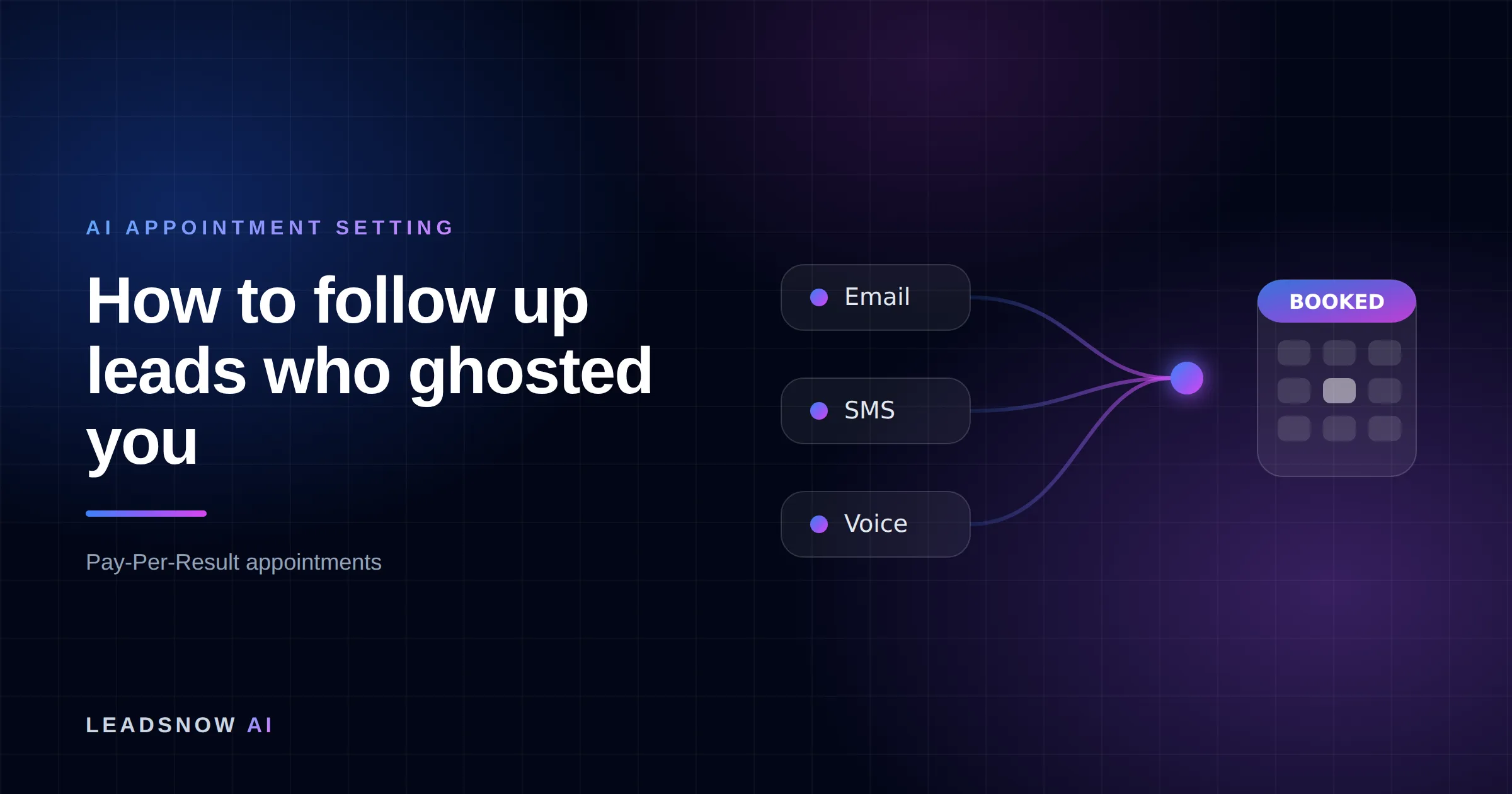
To follow up leads that ghosted, restart from the last thing the lead did, not the top of your sequence, and run five touches over 21 days across call, SMS and email before a 90-day nurture. Speed matters: in a 2011 Harvard Business Review study of 1.25 million new leads, firms that tried to contact a lead within an hour were nearly seven times as likely to qualify it as those trying an hour later.
The short answer from LeadsNow AI: A lead who ghosted you is rarely a no; they stopped at a specific step, and the follow-up that works picks up at that step with one easy question rather than restarting the pitch. Run five touches over 21 days across call, SMS and email, then stop chasing and move them to a 90-day nurture so your team’s hours go to leads still in motion.
Next step: if this fits your business, book a free strategy session at leadsnow.ai/strategy-session/ — a 2-minute fit check, then pick a time.
- What counts as ghosted here: a lead who replied, asked a question or started booking, then went silent before a call was held.
- The rule: the Last-Touch Rule, follow up from the last thing they did.
- The timeline: five touches across days 1, 3, 7, 14 and 21, then a 90-day nurture.
- The longest stage: days 7 to 21, where most follow-up quietly stops.
- Not covered here: silence after a proposal, no-shows, and leads who never replied once. Each has its own guide, linked below.
Why do leads ghost after showing interest?
Leads ghost after showing interest because the moment that made them enquire passes faster than most follow-up arrives. In a Harvard Business Review audit of 2,241 US companies, 23% never responded to a web lead at all and the average response time among those that did respond within 30 days was 42 hours (HBR, 2011). A coach’s lead who asked about price at 9pm and heard back two days later has, by then, watched three other coaches’ ads.
The other causes are dull and fixable: the next step asked for too much (a 45-minute call when they wanted a number), the lead could not answer from where they were (driving, at work), or a partner or business owner had to agree first. Ghosting is a timing and friction problem far more often than a rejection.
How it works
Following up a lead who ghosted
Find their last action
Check what the lead did last: replied, asked price, opened the calendar or cancelled. That step is where attention stopped.
Answer that step
Send one message about their last action with a question they can answer in five seconds.
Run days 1 to 21
Touch on days 1, 3, 7, 14 and 21 across SMS, call and email. Schedule days 14 and 21 so they cannot slip.
Close or nurture
Send one close-the-file message, then move silent leads to a 90-day nurture. After that they are reactivation records.
MAKE MORE SALES.
Pay-Per-Result pricing — We scale sales HARD aligned to your interests, better than anyone else.
Where did they ghost? The Last-Touch Rule
The Last-Touch Rule: your first follow-up to a ghosted lead should answer the last thing they did, because that step is where their attention stopped. Restarting the whole pitch ignores the question they were actually weighing.
| Their last action | What it usually means | First follow-up | What not to send |
|---|---|---|---|
| Replied once, then silence | Interrupted, not decided | Repeat their own words back and ask one yes/no question | A long recap of your offer |
| Asked the price, then silence | Sticker shock or comparing quotes | Give the range and what drives it, and ask which option fits | “Just checking in” |
| Opened the calendar, did not book | No time suited, or the call felt too big | Offer two specific times, or a 10-minute call-back | The same calendar link again |
| Answered a qualifying question, then silence | Unsure they qualify | Say plainly whether they fit and what happens next | More qualifying questions |
| Cancelled a booked call | Something came up, or cold feet | Rebook within 24 hours with one tap | A guilt message |
For the neighbouring silences, use the dedicated guides: prospects who ghost after a proposal, booked calls that don’t show, and leads who never reply to SMS at all.
Want this done for you? We book qualified sales appointments on a Pay-Per-Result basis — you only pay for calls that actually land in your calendar.
How long should you follow up a lead who ghosted? The 21-day timeline
Follow up a lead who ghosted for 21 days with five touches, then hand them to a monthly nurture for 90 days. This is a working cadence, not a published benchmark: no credible public study sets the right number of touches for leads who went quiet mid-conversation, so test it against your own booked-call data.
| Day | Channel | Touch | Stop if |
|---|---|---|---|
| Day 1 | SMS, then call within the hour if they reply | The Last-Touch Rule message: one question, answerable in five seconds | They opt out |
| Day 3 | Call, with a voicemail that names their question | A call at a different time of day from their first enquiry | They say no |
| Day 7 | Something useful: the price range, a short case example, the answer to their objection | They unsubscribe | |
| Day 14 | SMS | A smaller next step: a 10-minute call-back instead of a full consult | They say not now (note the date) |
| Day 21 | SMS or email | The close-the-file message: “Shall I close this off, or is there a better time?” | Any answer ends the sequence |
| Days 30–90 | Email, one SMS | Monthly value touches; then they are a reactivation record | Opt-out or 90 days |
The stage that takes longest is days 7 to 21. Days 1 and 3 happen because the lead still feels warm; days 14 and 21 slip because nobody owns them, a new batch of ad leads arrives, and the ghosted list gets buried. If you only fix one thing, put the day-14 and day-21 touches on a schedule that runs whether or not anyone remembers.
After 90 days the lead is no longer a follow-up but a dormant record, and the method changes; see our guide to database reactivation.
What do you say to a lead who ghosted you?
Say one thing, about them, that can be answered in five seconds. Three examples for a home-services or clinic lead, written to the Last-Touch Rule:
- Asked the price: “Hi Sam, you asked about pricing for the bathroom reno. Most come in at one of two price bands depending on size. Is it the main bathroom or the ensuite?”
- Opened the calendar: “Hi Priya, I saw you looked at times for the consult. Would Thursday 4pm or Friday 9am be easier, or would a 10-minute call-back suit better?”
- Close-the-file: “Hi Alex, I’ll close your enquiry off for now so I’m not filling your phone. Reply YES if you’d like me to keep a spot open this month.”
The close-the-file message is the most useful sentence in the sequence: it makes “no” costless to say, which is often what the lead needed before they could say yes.
If we can’t make you money, we don’t deserve yours.
Pay-Per-Result pricing — performance-based alignment.
What does following up ghosted leads cost in hours?
Following up ghosted leads by hand costs more hours than it looks, because each touch needs the context of the last. A worked month, with assumptions you should replace with your own, since no public benchmark exists for revival rates on ghosted leads:
| Line | Low | Middle | High |
|---|---|---|---|
| Ghosted leads a month (assumption) | 200 | 200 | 200 |
| Touches each (the 21-day timeline) | 5 | 5 | 5 |
| Minutes per touch, reading context included (assumption) | 3 | 3 | 3 |
| Hours a month (200 × 5 × 3 ÷ 60) | 50 | 50 | 50 |
| Leads who re-engage (assumption) | 5% = 10 | 10% = 20 | 15% = 30 |
| Re-engaged who book (assumption: 50%) | 5 | 10 | 15 |
| Labour per booked call at $50 an hour (assumption) | $500 | $250 | $167 |
Fifty hours a month is more than a full working week of a setter’s time on leads you have already paid to acquire. Compare your own result with the market range for a booked call, which is $30–$400+ depending on industry, offer, price and many other variables, and with your own cost per booked call. Automation cuts the minutes per touch; it does not remove the need for someone to answer the replies within the hour.
When should you get help following up ghosted leads?
Get help following up ghosted leads when you are running paid ads, more than about 100 leads a month go quiet mid-conversation, and the day-14 and day-21 touches are not happening because nobody owns them. If fewer than about 50 leads a month ghost, or you have a setter with spare hours, run the timeline above yourself with CRM text templates; it costs you nothing but discipline. Between the two, either route works.
LeadsNow books calls using AI calling, SMS and DM follow-up, including the leads that went quiet after their first reply. You pay on results: a revenue share, a fee per appointment, or a mix of both. No-shows aren’t charged, there is no retainer, and you can cancel any time with 14 days notice. LeadsNow has booked 50,769+ AI-booked sales appointments since 2017. See our AI appointment setting service or what it means to outsource lead follow-up.
Frequently asked questions
How many times should you follow up with a lead who ghosted?
Five touches over 21 days is a reasonable working cadence, followed by a monthly nurture to 90 days. No credible public benchmark sets the number for leads who went quiet mid-conversation, so measure booked calls by touch number in your own CRM.
How fast should I follow up a lead who stopped replying?
The next day at the latest. A Harvard Business Review study of 1.25 million leads found firms that tried to contact a new lead within an hour were nearly seven times as likely to qualify it as firms that tried even an hour later. That study measured first contact with new enquiries, not leads who went quiet, so treat it as a direction rather than a benchmark for ghosted leads.
Is it legal to keep texting a lead who ghosted?
Only if you had a lawful basis to message them in the first place, and only until they opt out; the rules differ by country. In Australia an unsubscribe must be honoured within 5 working days (ACMA); in the US a consent revocation must be honoured within ten business days (47 CFR 64.1200); in the UK the soft opt-in covers people who bought or negotiated to buy a similar product (ICO). This is general information, not legal advice.
Should I send a break-up message to a ghosted lead?
Yes, once, on about day 21. A short close-the-file message that makes “no” easy to say ends the sequence cleanly and often draws the reply the earlier touches did not.
What is the difference between a ghosted lead and a dead lead?
A ghosted lead went quiet within the last 90 days after engaging; a dead or dormant lead has been silent longer and needs a reactivation campaign with a new reason to talk, not a follow-up.
Pay-Per-Result appointments
See if we’re a fit
We book qualified sales appointments for you and you pay on results, not retainers. Our booking page asks a few quick questions so you find out in two minutes whether that model suits your business.
- 50,769+ appointments booked without cold calling.
- Pay-Per-Result pricing — you pay for booked, qualified calls.
- Pick your own time on our live calendar, no phone tag.