
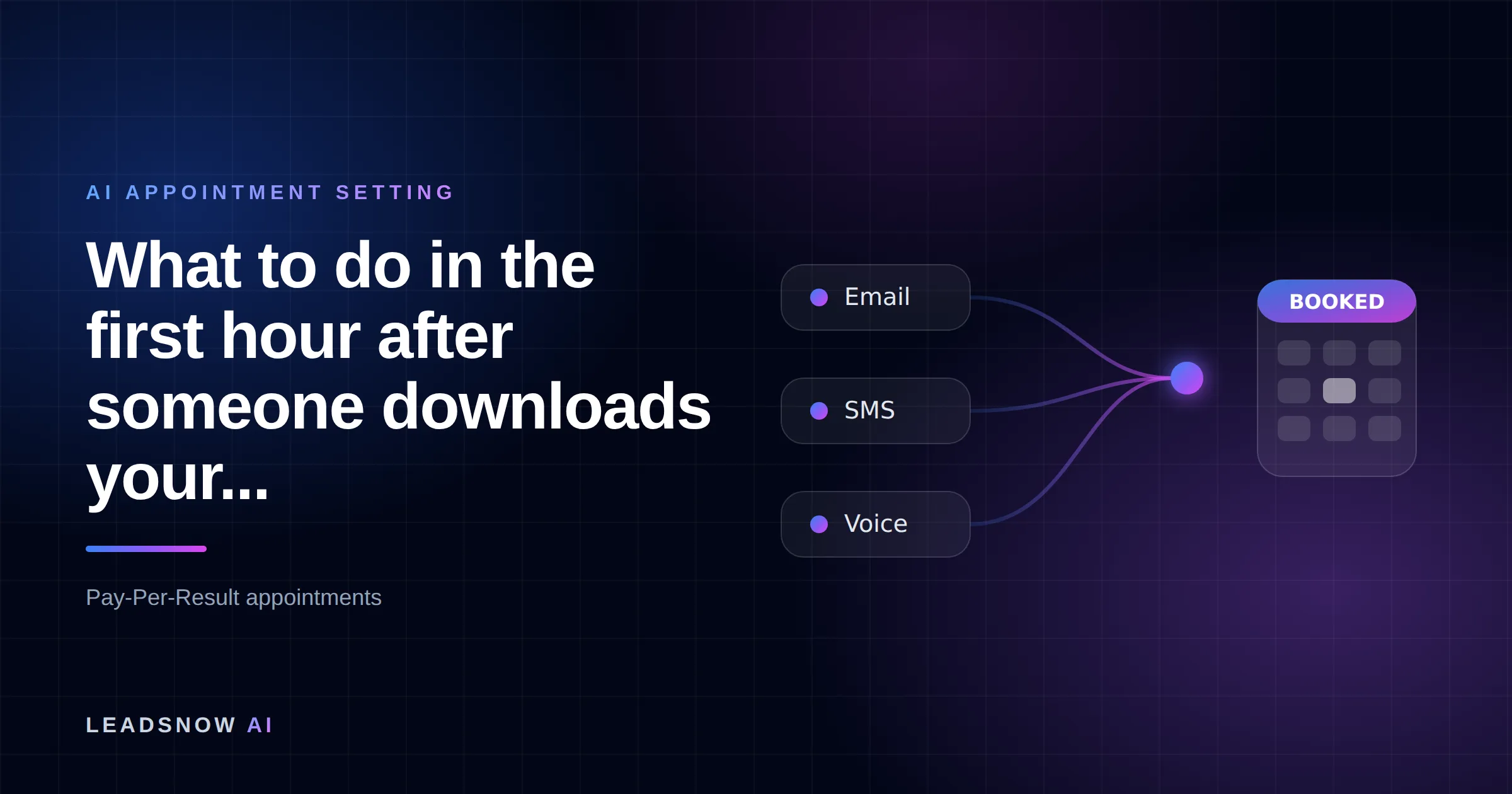
In the first hour after someone downloads your retreat brochure, send the PDF with one question inside 5 minutes, then phone them before minute 60 if it is within their local calling hours. Then run a 7-day cadence of 10 touches, four of them calls, across phone, SMS, WhatsApp and email, timed to their clock. Stop the moment they reply.
At a glance:
- Minute 0–5: automated email and SMS with the brochure link and one question: which part of the itinerary made you download it?
- Minute 5–60: a human phone call, if the lead’s local time allows it. If it does not, the call moves to the first permitted slot the next morning.
- Days 1–7: the Brochure-to-Call cadence below: four calls, three SMS or WhatsApp messages, two emails and a closing message, each keyed to the lead’s local time.
- The first call is a service call. Its only job is to find out why they opened the PDF and offer the next step, usually the application.
- Consent decides the channels: WhatsApp’s Business Messaging Policy requires opt-in before you message anyone; the US FCC limits telephone solicitation to 8am–9pm local time; Australia’s ACMA publishes telemarketing hours of 9am–8pm on weekdays.
Someone downloaded my retreat brochure: what should happen in the first 60 minutes?
A brochure download is the weakest signal in an application-led retreat funnel and the most perishable one. The person has spent ten seconds on a form, not a decision. The first hour has two jobs: prove a real person runs the retreat, and get one sentence back about why they looked.
- Minute 0: the brochure arrives by email, with the same link by SMS if they gave a mobile and ticked the consent box.
- Minute 1–5: the message carries one question, signed by a named person: “Which part of the itinerary made you download it?” One question gets replies; a paragraph of copy gets skimmed.
- Minute 5–60: a phone call from the founder, facilitator or a named team member. If nobody answers, leave a voicemail under 20 seconds and send a one-line text: “Just tried you about the retreat. No rush, reply here when it suits.”
- Outside their hours: if the download lands at 10pm their time, the call waits for 9–10am the next morning, local to them. The email and SMS still go immediately.
The independent evidence for the hour comes from Oldroyd, McElheran and Elkington in Harvard Business Review. Across 1.25 million US web leads, firms that tried within an hour were more than 60 times as likely to qualify a lead as firms that waited 24 hours or longer. Separately, as our own operator claim and not research: in our own client work we typically see speed to lead on its own lift conversion by around 3x. The cost of missing the hour is modelled on our page on selling out a 16-seat retreat; this page is about what to actually send and say.
How it works
The Brochure-to-Call cadence
Send with one question
Email and SMS the brochure within 5 minutes. Ask which part of the itinerary made them download it.
Call before minute 60
Make a short service call inside the lead’s local calling hours. Leave a brief voicemail and text if unanswered.
Work their clock
Spread four calls across morning, midday and evening over seven days, in the lead’s time zone.
Close the loop
On day 7, ask whether to keep them posted. Replies move to the application; silence moves to monthly email.
MAKE MORE SALES.
Pay-Per-Result pricing — We scale sales HARD aligned to your interests, better than anyone else.
The 7-day Brochure-to-Call cadence
The cadence below is a working design, not a measured benchmark. Every time is the lead’s local time, read from the country code on their mobile number or a time-zone field on the form. Any reply ends the cadence and moves the person to a conversation.
| When | Channel | What it says | Live minutes (assumption) |
|---|---|---|---|
| Day 0, minute 0–5 | Email + SMS | Brochure link and one question | 0 (automated) |
| Day 0, minute 5–60 | Call 1 | Service call; voicemail and “just tried you” text if unanswered | 3 |
| Day 0, early evening | WhatsApp (opted-in only) | A photo or 30-second voice note from the venue | 1 |
| Day 1, 10:00–11:00 | Call 2 | Same opener; offer the application link | 3 |
| Day 1, 17:30–19:00 | SMS | Who the retreat is for, and who it is not for, in two lines | 1 |
| Day 2 | A founder note or a past guest’s story | 1 | |
| Day 3, 12:00–13:00 | Call 3 | Lunchtime attempt; voicemail | 3 |
| Day 5, 17:30–19:00 | Call 4 | Early-evening attempt (inside the US 9pm and AU 8pm limits) | 3 |
| Day 7, morning | SMS or WhatsApp | “Shall I keep you posted on the next dates, or leave it here?” | 1 |
| After day 7 | Email nurture | Monthly: dates, places left, guest stories | 0 |
The four calls are spread across morning, midday and early evening on different days, because a person who never answers at 10am may answer at 6pm. If a call slot falls on a Sunday for an Australian lead, move it to Monday: ACMA’s published hours do not allow telemarketing calls on Sundays. For the same reason, an early-evening call that lands on an Australian Saturday has to move before 5pm. The Brochure-to-Call cadence ends with a question the lead can answer with one word, which is the message most likely to get any reply at all.
Want this done for you? We book qualified sales appointments on a Pay-Per-Result basis — you only pay for calls that actually land in your calendar.
What do I say on the first call to someone who only downloaded a PDF?
Treat the first call as a service call. The person has not applied, has not asked for a call, and may not remember the form. Four moves, under five minutes:
- Context in one line: “Hi, it’s [name], I run the [retreat]. You downloaded the itinerary a little while ago. Is now a bad time?” Asking whether it is a bad time gets an honest answer faster than asking whether it is a good one.
- One question: “What made you open it?” Then stop talking.
- One specific answer: respond to the thing they named, whether that is the dates, the facilitator, the room or the price. Do not walk them through the brochure they already have.
- One next step, with an exit: “The next step is a short application, then a 30-minute call with me. Shall I send it, or is it too early?”
Never ask for a deposit on this call, and never argue with “just browsing”. Ask instead whether you can send the next dates when they are set. The first call to a brochure downloader succeeds if the person says why they looked; a booked application is a bonus. If the person is buying for a company rather than for themselves, the process changes; selling a leadership retreat to companies covers that committee.
What consent do I need on the brochure form to call, text and WhatsApp?
The brochure form decides which channels you may use, so build it for the cadence. Collect a mobile number with country code, a clear tick box for calls and messages about the retreat, and a separate WhatsApp opt-in if you will use it. The rules differ by country, and this is general information, not legal advice.
- WhatsApp: the WhatsApp Business Messaging Policy says you may only contact people who gave you their number and opted in to receive messages or calls from you. Free-form replies are allowed within a 24-hour customer service window that opens with each user message; outside it, only approved Message Templates.
- United States: the FCC rule at 47 CFR 64.1200(c)(1) bars telephone solicitation to residential subscribers before 8am or after 9pm, local time at the called party’s location.
- Australia: ACMA publishes telemarketing calling hours of 9am–8pm Monday to Friday, 9am–5pm Saturday, none on Sunday or national public holidays.
- United Kingdom: the ICO says marketing texts to individuals need specific consent, with a limited “soft opt-in” exception for your own previous customers.
A brochure form without a phone field and a consent box turns a seven-day cadence into a two-email cadence, and no amount of speed fixes that.
If we can’t make you money, we don’t deserve yours.
Pay-Per-Result pricing — performance-based alignment.
Which stage of brochure follow-up takes the longest, and what makes it slip?
Days 1 to 5, reaching the person, take the longest. Sending the PDF is automatic, and the call itself is five minutes; the slow part is finding the slot when they pick up. Four things make it slip, in the order they usually show up:
- No phone number: the form asked for email only, so the cadence has no calls.
- Wrong clock: calls go out in the retreat team’s office hours, which for a buyer eight or more time zones away means 6am or midnight.
- Weekend downloads: a Saturday-night download sits until Monday, by which time the 60-minute window is 36 hours gone.
- Stopping at one call: a single unanswered call is treated as “not interested”, when the person was in a meeting.
In our speed-to-lead benchmarks the published response-time research is set out in more detail. Once the call turns into a booked discovery call, the reminder side is covered in why booked high-ticket calls don’t show.
What does running the cadence cost per 100 brochure downloads?
The cadence is cheap in tools and expensive in availability. The model below takes 100 downloads and runs the full cadence for every one of them, which is an upper bound because replies end the cadence early. Live minutes per lead come from the cadence table: 16 minutes of calls and personalised messages. The share of downloads you actually speak to by day 7 has no public benchmark, so it is shown in three assumption bands, with a 15-minute first conversation each.
| Line | Reach 30% (assumption) | Reach 45% (assumption) | Reach 60% (assumption) |
|---|---|---|---|
| Cadence work: 100 × 16 min | 26.67 h | 26.67 h | 26.67 h |
| First conversations at 15 min | 30 = 7.5 h | 45 = 11.25 h | 60 = 15 h |
| Total live hours | 34.17 h | 37.92 h | 41.67 h |
| Minutes per download | 20.5 | 22.75 | 25 |
| Daily load at 16 downloads a day (about 1,112 over ten weeks) | 5.47 h | 6.07 h | 6.67 h |
At 16 downloads a day, running the Brochure-to-Call cadence by hand is a five-to-seven-hour daily job, spread across the waking hours of every time zone your buyers live in. That is before any application review or discovery call. In our own client work we typically see that doubling the contact rate roughly doubles conversion, alongside the ~3x from speed to lead above. Those two operator figures overlap and do not multiply: 3x and 2x is not 6x, because faster replies are one of the reasons more people are reached. The appointment-setting version of this work for high-ticket programmes is described on our page on lead generation for coaches and high-ticket programmes.
Frequently asked questions
How many businesses actually reply to a web lead within the hour?
Fewer than half. In Harvard Business Review’s audit of 2,241 US companies, 37% responded to a web lead within an hour, and the average response time among companies that replied within 30 days was 42 hours. That research covers US web leads generally, not retreats. For a brochure download, the Brochure-to-Call cadence sends the PDF with one question inside 5 minutes and calls within the hour, inside the lead’s local calling hours.
Should I put my retreat brochure behind a form?
Only if someone will follow up. A gated brochure that triggers nothing but an automated email costs you the visitors who would not fill in a form and gives you nothing back. If you gate it, ask for a mobile number with country code and a consent tick box; without them the 7-day cadence has no calls or texts.
Can I message someone on WhatsApp after they download my retreat brochure?
Only if they opted in. The WhatsApp Business Messaging Policy requires that the person gave you their number and opted in to receive messages or calls from you. Business-initiated messages outside the 24-hour customer service window must use approved Message Templates.
What if someone downloads my retreat brochure at 11pm their time?
Send the email and SMS immediately and hold the call until the next permitted morning slot in their time zone. In the US, the FCC rule at 47 CFR 64.1200(c)(1) bars telephone solicitation before 8am or after 9pm local time. In Australia, ACMA’s telemarketing hours start at 9am.
How many times should I call a brochure download before stopping?
The Brochure-to-Call cadence uses four calls over seven days, at different times of day, then a closing message and monthly email. That is a working design, not a measured benchmark. Track which attempt number your conversations actually come from, and cut the attempts that never produce one.
Pay-Per-Result appointments
See if we’re a fit
We book qualified sales appointments for you and you pay on results, not retainers. Our booking page asks a few quick questions so you find out in two minutes whether that model suits your business.
- 50,769+ appointments booked without cold calling.
- Pay-Per-Result pricing — you pay for booked, qualified calls.
- Pick your own time on our live calendar, no phone tag.