
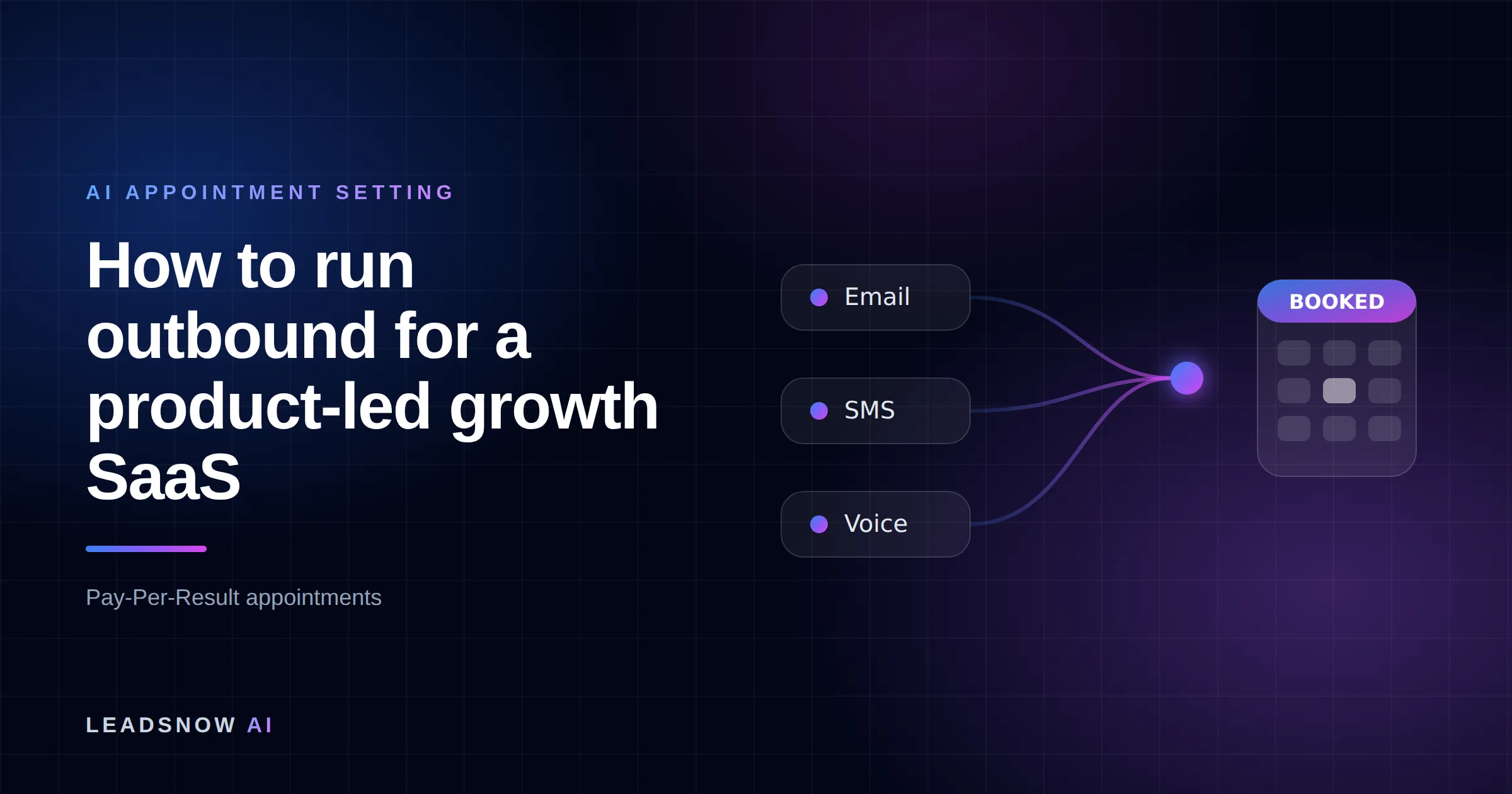
Outbound for a product-led growth SaaS works best when it starts with the free accounts you already have, not a cold list, and targets the company rather than the individual signup. That matters because a freemium self-serve product converting just 3–5% of free signups within six months counts as “good” in ChartMogul’s 2026 benchmark. Most of your free tier never pays.
At a glance
- The list: free accounts on a work email domain in your target market. Not the whole free tier.
- The trigger: the Domain-Cluster Rule. Three or more free users from one company domain, or one user who hits a plan limit, means a buying committee is forming with nobody selling to it.
- The channel order (US): email first (CAN-SPAM covers B2B email), SMS only after A2P 10DLC registration, and AI or prerecorded voice only with the consent the TCPA requires.
- The math: a worked model on a 20,000-account free tier, below. Every rate in it is a labeled assumption to replace with your own.
- The honest test: hold back part of the signal list, because some of those accounts would have upgraded with or without a call.
Why does a product-led SaaS need outbound at all?
A product-led SaaS needs outbound because its free tier is the largest list of warm, product-aware companies it will ever own, and self-serve leaves most of that list unconverted. In ChartMogul’s January 2026 survey of 200 software products, one freemium product in four converted below 2.5% of free signups to paid within six months.
Most PLG companies already accept a human role at the top end: ChartMogul found that 70% of freemium products add human touchpoints when an enterprise user self-serves. What they rarely do is work the long middle. That middle is thousands of free accounts at companies that fit, used the product, and stalled. Nobody ever called them.
Outbound into a free tier is database reactivation under a different name. The contacts already know the product, so the first message can be about their own usage rather than an introduction. The mechanics of working a dormant list are covered in our database reactivation guide. This page covers what changes when the list is a PLG free tier in the United States.
How it works
Turning a free tier into booked upgrade calls
Filter the free tier
Keep free accounts on target-market work domains. Drop personal emails, competitors and existing customers.
Apply the Domain-Cluster Rule
Flag domains with three or more free users, and any user who hits a plan limit. Those accounts get outbound.
Lead with their usage
Open with what the account did, by email first, then SMS or voice only where US consent rules allow.
Measure against a holdout
Hold back a random 20% of signal accounts and compare upgrade rates. The difference is what outbound earned.
MAKE MORE SALES.
Pay-Per-Result pricing — We scale sales HARD aligned to your interests, better than anyone else.
The Domain-Cluster Rule: which free accounts get outbound?
The Domain-Cluster Rule says PLG outbound starts at the company, not the signup. When three or more free users share a work email domain, a team is evaluating your product without a buyer, a budget conversation or a contract. That is the account to call. The thresholds below are starting points to test against your own paid-versus-free history, not published benchmarks.
| Free-tier signal (last 90 days) | Treatment | First touch |
|---|---|---|
| 3+ users on one target-market work domain | Account-level outbound to the most active user, then the most senior one | Within 1 business day of the third user joining |
| 1 user hits a plan limit (seats, records, projects) | Outbound to that user, offering a 15-minute call about the limit | Same day as the limit event |
| 1–2 users, active weekly, target domain, no limit hit | Usage-triggered email plus in-app prompt; no call yet | When usage crosses your activation milestone |
| Target domain, no login for 90+ days | Reactivation sequence: email first, then SMS or calls where consent exists | Batch, monthly |
| Personal email domain, or outside target market | No outbound. Self-serve only | None |
This differs from chasing inbound hand-raises like demo requests and trial signups, which our three-lane triage for SaaS leads handles. Here, nobody has raised a hand. The product data raises it for them.
Want this done for you? We book qualified sales appointments on a Pay-Per-Result basis — you only pay for calls that actually land in your calendar.
What does PLG outbound produce? A worked model on a 20,000-account free tier
We know of no credible public benchmark for connect, meeting or upgrade rates on outbound into a PLG free tier, so every rate below is a labeled assumption in three bands. Substitute your own. The structure is the useful part: it shows which rate moves the result most.
| Step | Low band | Mid band | High band |
|---|---|---|---|
| Free accounts on the list (placeholder) | 20,000 | 20,000 | 20,000 |
| On a target-market work domain (assumption: 25%) | 5,000 | 5,000 | 5,000 |
| Meet the Domain-Cluster Rule or a limit signal (assumption: 20%) | 1,000 | 1,000 | 1,000 |
| Reached in a two-way conversation (assumption) | 10% = 100 | 20% = 200 | 30% = 300 |
| Conversation to booked meeting (assumption) | 25% = 25 | 35% = 70 | 45% = 135 |
| Meeting to paid upgrade (assumption) | 15% ≈ 4 | 25% ≈ 18 | 35% ≈ 47 |
| New annual revenue | Upgrades × your average first-year contract value | ||
To recompute the mid band: 1,000 × 20% = 200 conversations, 200 × 35% = 70 meetings, and 70 × 25% = 17.5, so about 18 upgrades. Moving from the low band to the high band multiplies upgrades by nearly 13 (3.75 to 47.25), because three rates compound. That is why the trigger and the first message matter more than call volume.
Not all of those upgrades are new revenue. Signal accounts upgrade on their own at some rate, so hold back a random 20% of the signal list, contact nobody in it, and compare upgrade rates across the same window. The difference is what outbound earned. Without a holdout, a PLG outbound program can take credit for upgrades the product would have produced anyway.
Public data points the same way, with a caveat. In the 1,000+ product survey by Kyle Poyar and Lenny Rachitsky (2023), the “good” band for freemium products with a sales-assist motion was 5–7%, against 3–5% for self-serve freemium. Those are different products, so the gap shows correlation, not proof that adding sales lifts conversion.
What should the first outbound message to a free user say?
The first message to a free user should name something the account did, not something the product does. “Four people at your company have been building dashboards on the free plan since March, and you hit the three-dashboard limit on Tuesday” earns a reply. “Have you seen our new reporting suite?” doesn’t.
- One fact, one offer: the usage fact, then a 15-minute call to sort out plan fit or the limit. No feature list.
- Talk to the cluster, not just the user: the most active user often can’t buy. Ask who owns the budget for the team using it.
- Speed matters on limit events: treat a limit hit as a live decision and make the first touch the same day.
- Stop on a no: a free user who opts out stays a free user. Don’t burn the account.
If we can’t make you money, we don’t deserve yours.
Pay-Per-Result pricing — performance-based alignment.
US rules for calling, texting and emailing free-tier users
A free-tier signup is a relationship with your product. It isn’t automatically permission for every outbound channel. This is general information, not legal advice. What your signup flow actually captured is a question for your counsel.
| Channel | The rule that applies | Source |
|---|---|---|
| CAN-SPAM makes no exception for business-to-business email; opt-out requests must be honored within 10 business days | FTC CAN-SPAM compliance guide | |
| AI or prerecorded voice calls | AI-generated voices count as “artificial” under the TCPA, so these calls require the called party’s prior express consent unless an exemption applies (FCC Declaratory Ruling FCC 24-17, February 8, 2024) | FCC 24-17 |
| SMS from a 10-digit number | Brand and campaign registration under A2P 10DLC before traffic is sent, plus consent | Our A2P 10DLC registration guide |
The practical consequence: email is usually the first touch available on a free-tier list. Voice and SMS depend on what your terms and signup form collected. Fixing the signup form’s consent language now costs less than discovering the gap mid-campaign.
What PLG outbound costs to run in-house
PLG outbound is a data job before it is a sales job. Running it yourself takes four things.
- A product-event pipeline that writes domain clusters and limit events into the CRM daily. Usually a few days of data-engineering time, plus upkeep every time the product changes.
- A list hygiene pass to strip personal domains, competitors and existing customers, and to map users to companies.
- People or automation to work the conversations. In the mid band above, that is 1,000 accounts touched several times each across email, SMS and calls to produce 200 conversations and 70 meetings.
- Someone who owns the holdout, so the board sees incremental revenue, not gross.
Who this is wrong for: a PLG product whose paid plans are so cheap that a 15-minute call costs more than a year of revenue. Use in-app prompts there. And a product with a few hundred free accounts doesn’t need a program; it needs a founder to send 40 emails.
The conversation-and-booking layer can also be handed to an AI appointment-setting service, which works the signal list by email, SMS and voice and books the meetings into your calendar. LeadsNow has booked 50,769+ AI-booked sales appointments since 2017. Where PLG outbound fits in a wider pipeline plan is set out in our B2B lead generation guide.
Frequently asked questions
What is a good free-to-paid conversion rate for a freemium SaaS?
ChartMogul’s 2026 SaaS Conversion Report, a January 2026 survey of 200 software products, puts 3–5% as good and 8–12% as great for a freemium self-serve product, measured as free signups that become paying within six months. It is self-reported, so use it as a range check, not a target.
Does adding sales to a freemium product increase conversion?
Sales-assisted products report higher rates, but that doesn’t prove sales caused the difference. In the 2023 survey of 1,000+ products by Kyle Poyar and Lenny Rachitsky, good freemium conversion was 3–5% self-serve and 5–7% with a sales-assist motion. Test your own lift with a holdout group.
Is it legal to call free-tier users in the US with an AI voice agent?
It depends on consent. The FCC’s February 2024 Declaratory Ruling FCC 24-17 confirms that AI-generated voices are “artificial” under the TCPA, so these calls need the called party’s prior express consent unless an exemption applies. Whether your signup flow captured that consent is a question for your counsel.
Does CAN-SPAM apply to outbound emails to free users at companies?
Yes. The FTC’s CAN-SPAM compliance guide states that the law makes no exception for business-to-business email, and opt-out requests must be honored within 10 business days. Every commercial email to a free-tier user needs accurate headers, a physical address and a working opt-out.
How many free accounts do you need before PLG outbound is worth running?
There is no published threshold. On our worked model, 20,000 free accounts produce about 1,000 signal accounts. A free tier of a few hundred accounts is better worked by hand by a founder than by a program. The number that decides it is signal accounts a month, not total signups.
Pay-Per-Result appointments
See if we’re a fit
We book qualified sales appointments for you and you pay on results, not retainers. Our booking page asks a few quick questions so you find out in two minutes whether that model suits your business.
- 50,769+ appointments booked without cold calling.
- Pay-Per-Result pricing — you pay for booked, qualified calls.
- Pick your own time on our live calendar, no phone tag.