
Marketing sales alignment is the practice of running both functions on shared goals, shared data, and shared service-level agreements so leads convert instead of stalling between handoffs. Companies with strong strategic and operational alignment report significantly higher revenue than those without it, while KPMG and the CMO Council find most marketers still don’t co-own customer data with sales. Fixing that gap is the single highest-leverage move available to a revenue leader in 2026.
TL;DR:
- Over 60% of marketers do not co-own customer data with sales, and more than 70% lack confidence in their digital selling model, hampering alignment efforts.
- Building a shared ideal customer profile, clear lead definitions, and a mutual SLA can increase close rates by 38% and improve pipeline velocity significantly.
- Centralizing data in a single CRM, enforcing governance, and tracking shared metrics such as pipeline value and lead-to-close ratio are essential for sustained alignment.
- Fixing lead definitions, consolidating data, and establishing SLA compliance are the highest leverage actions to enhance revenue and reduce friction.
- Outside vendors with pay-per-result models can accelerate alignment by ensuring incentives directly tie to booked, qualified appointments.
Table of Contents
- Why Marketing Sales Alignment Matters for Revenue Growth
- What Causes Marketing and Sales Misalignment?
- How Do You Build a Marketing-Sales Alignment Playbook?
- Which Shared Metrics and SLA Terms Should You Track?
- What Technology and Data Setup Does Alignment Require?
- How Should You Govern Alignment Long Term?
- Can a Pay-Per-Result Model Fix Alignment on Its Own?
- What Leaders Should Prioritize First
- How Leadsnow Turns Alignment Into Booked Revenue
- Sources
- FAQ
How it works
How an AI sales agent books your appointments
Your list or CRM
We start from data you already own — past enquiries, dormant customers, or a targeted prospect list.
The agent makes contact
Email, SMS and voice, with follow-up that persists for weeks instead of stopping after two attempts.
Qualified against your rules
Budget, timing and fit are checked before anything reaches your team, using criteria you set.
Booked into your calendar
Only qualified prospects reach the booking step, so your closers spend their time selling.
MAKE MORE SALES.
Pay-Per-Result pricing — We scale sales HARD aligned to your interests, better than anyone else.
Why Marketing Sales Alignment Matters for Revenue Growth
Alignment isn’t a culture initiative. It’s a revenue lever, and the research backs that up with numbers most executives haven’t seen quoted together.
Organizations with high strategic and operational alignment between marketing and sales generate substantially more revenue than peers with little or no alignment. Gartner puts aligning commercial functions at the top of sales leaders’ priority lists for good reason: shared activity between the two teams is still rare, even at companies that talk about “alignment” in every all-hands meeting.
The measurable outcomes show up in three places. Close rates climb when sales reps work leads that marketing has already qualified against a shared definition, rather than guessing whether a contact form fill means anything. Sales cycles shorten when reps get behavioral context with the lead instead of just a name and email. Pipeline velocity, the speed at which deals move stage to stage, improves once both teams stop arguing about whose lead it was and start tracking the same number.
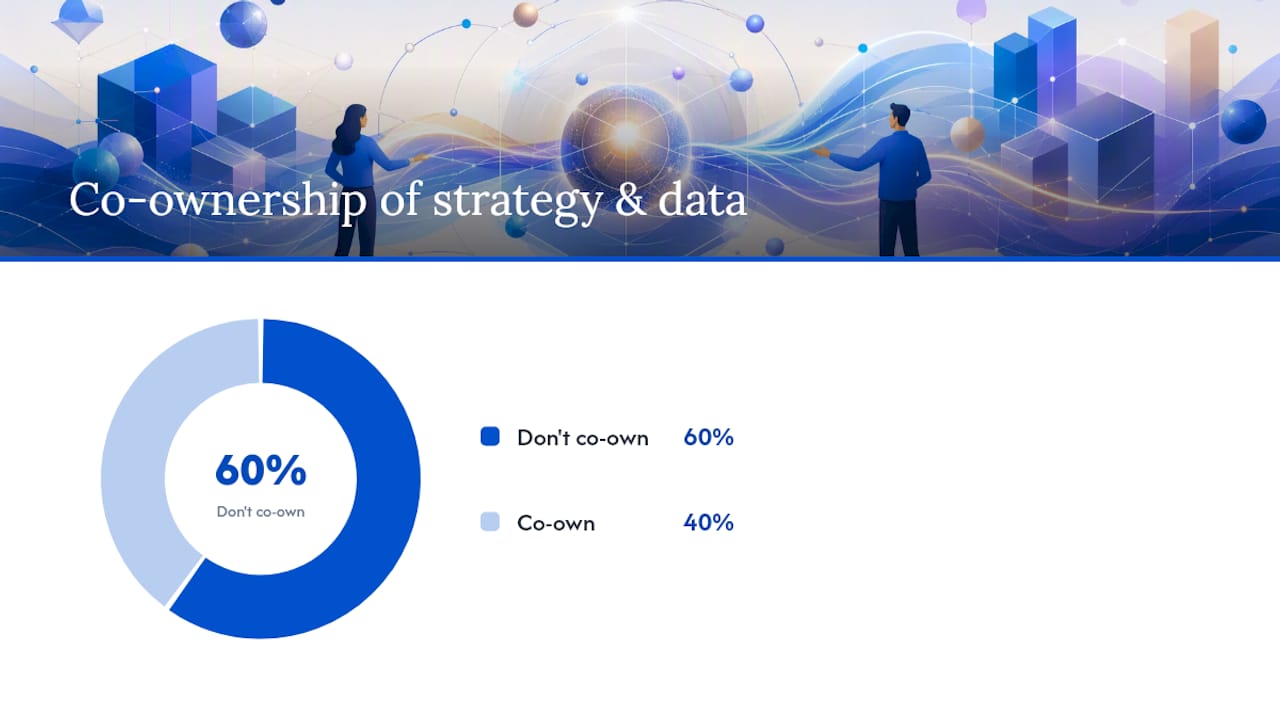
The scale of the problem: KPMG and the CMO Council found that over 60% of marketers say their teams don’t co-own customer strategy and data with sales, and more than 70% lack confidence in their current model to sell across digital customer journeys. That’s not a minor process gap. It’s most companies operating two separate businesses under one logo.
Harvard Business Review documents the flip side plainly: when the two functions aren’t aligned, both suffer, not just one. Marketing loses credibility when its leads go nowhere. Sales loses time chasing contacts who were never ready to buy.
Want this done for you? We book qualified sales appointments on a Pay-Per-Result basis — you only pay for calls that actually land in your calendar.
What Causes Marketing and Sales Misalignment?
Most misalignment traces back to five recurring failure modes, and none of them require a personality change to fix.
- Lead definition mismatch. Marketing counts a whitepaper download as a Marketing Qualified Lead (MQL); sales won’t touch anything that isn’t budget confirmed and ready to talk price. Without a written, numeric definition of what separates an MQL from a Sales Qualified Lead (SQL), every handoff becomes a negotiation.
- Data fragmentation. One team runs HubSpot, the other tracks deals in a spreadsheet nobody else can see. Fragmented technology is one of the biggest barriers to alignment, and it quietly breaks every other fix you try to layer on top.
- Conflicting KPIs. Marketing gets paid for lead volume. Sales gets paid for closed revenue. Nobody gets paid for lead quality, so nobody optimizes for it.
- Weak handoffs. Salesforce’s guidance is blunt about this: a simple handoff, just a name and phone number, isn’t enough. Reps need to know why the lead was qualified and what content or behavior triggered it.
- Messaging gaps. Marketing promises one thing in the ad; sales pitches something else on the call. Buyers notice the inconsistency before either team does.
Any one of these can stall a pipeline. Most companies have three or four running at once.
How Do You Build a Marketing-Sales Alignment Playbook?
Fixing alignment isn’t a single project with a finish line. It’s a sequence of small, testable changes that compound. Here’s the order that actually works, based on where most of the failure modes above originate.
- Map a joint ideal customer profile (ICP) and buyer journey. Get both teams in one room and agree on who you’re actually selling to, then walk through the stages a real buyer moves through before they sign. Skipping this step is why marketing generates leads sales never wanted in the first place.
- Write down MQL and SQL definitions and turn them into a service-level agreement. Practitioner data from SyncGTM links this specific step to close rates roughly 38% higher at aligned organizations. The definitions don’t need to be complicated. They need to be numeric, written, and signed off by both sides.
- Build one shared scoreboard. Pipeline value, conversion rate by stage, and revenue influenced by marketing activity should live on a dashboard both teams check weekly, not two separate reports that never get compared.
- Centralize data in a single CRM. Every integration and automation you build later depends on this. If leads still live in three systems, nothing else on this list will hold.
- Give ops real authority. Whether you call it RevOps or just “the person who owns the process,” someone needs the mandate to enforce definitions and fix data quality without asking permission every time.
- Co-create sales enablement content. Have sales tell marketing what objections keep coming up on calls, and have marketing build content that answers those objections before the call happens. A partner resource on lead nurturing breaks down how nurture sequences can carry that context forward instead of losing it at handoff.
- Run a small, measurable pilot. Pick one account-based marketing (ABM) campaign or one joint outbound push. Measure it against the shared scoreboard from step 3, then decide whether to scale it.
- Build the feedback loop into the SLA. Sales should log why a lead was accepted or rejected, every time, so marketing can adjust targeting instead of guessing.
Pro Tip: Don’t try to fix all five failure modes simultaneously. Start with MQL/SQL definitions and the SLA. Everything else, from dashboards to RevOps hires, gets easier once both teams agree on what a qualified lead actually looks like.
Forbes’ practitioner guidance on fixing the revenue handoff lands on a similar sequence: shared accountability first, pipeline optimization second. The order matters more than the individual tactics.
If we can’t make you money, we don’t deserve yours.
Pay-Per-Result pricing — performance-based alignment.
Which Shared Metrics and SLA Terms Should You Track?
Alignment stays theoretical until it’s measured. The metrics below give both teams a common language, and the SLA gives that language enforcement teeth.
Shared KPIs both teams should own jointly:
- Pipeline value generated from marketing-sourced and marketing-influenced opportunities.
- Pipeline-to-close ratio, tracked by lead source, not just by rep.
- Marketing-influenced revenue, meaning any closed deal that touched a marketing asset at any stage.
- MQL-to-SQL conversion rate, the cleanest early signal of whether lead definitions actually match reality.
- Time-to-first-contact, how fast a sales rep follows up once a lead crosses the SQL threshold.
An example SLA that leadership teams can adapt in a single meeting covers four fields: volume (how many qualified leads marketing delivers per week or month), quality (the minimum criteria a lead must meet to count as an SQL), speed (the maximum hours allowed before first contact), and disposition (a mandatory field where sales logs accepted, rejected, or nurture, with a reason code attached). Add a fifth field for feedback cadence, how often disposition data gets reviewed by both teams, and the SLA becomes self-correcting instead of a document nobody reopens.
Roughly 60% of marketers report their teams don’t co-own strategy and data at all, which is exactly what the KPMG and CMO Council study found. A written SLA with disposition tracking is the fastest way to close that gap without a reorganization.
Put these numbers on one dashboard both teams can see in real time. A resource on tracking sales data walks through why visibility, not just collection, is what changes behavior on the sales floor.
What Technology and Data Setup Does Alignment Require?
A single CRM as the system of record is the foundation everything else depends on. If marketing and sales work from different databases, every dashboard, every SLA, and every feedback loop built on top of that split will eventually break.
Priority integrations to connect once the CRM is centralized:
- Marketing automation platform, so campaign engagement flows directly into the lead record sales sees.
- Intent data tools, so reps know when a prospect is actively researching before they pick up the phone.
- Attribution software, so both teams can see which channels actually produce closed revenue, not just leads.
Data governance matters as much as the tool stack. Enforce required fields on every form so leads can’t enter the CRM incomplete, run deduplication on a schedule rather than reactively, and auto-enrich records with company and behavioral data the moment a lead is created. Salesforce’s continuous-context model is the standard worth building toward: every lead record should carry the reason it was qualified and the content that triggered it, not just a name and a phone number.
How Should You Govern Alignment Long Term?
Alignment breaks down again within months if nobody owns the ongoing process. Governance is what makes the fix permanent instead of a one-time project.
Give RevOps or a designated ops lead the mandate to manage day-to-day definitions and data quality, and reserve VP-level meetings for strategy, not for refereeing whose lead it was. A workable cadence looks like this: a 30-minute weekly ops sync to review disposition data and flag SLA breaches, a monthly KPI review where both teams walk through the shared scoreboard, and a quarterly strategy session where leadership adjusts the ICP or SLA terms based on what the data actually shows.
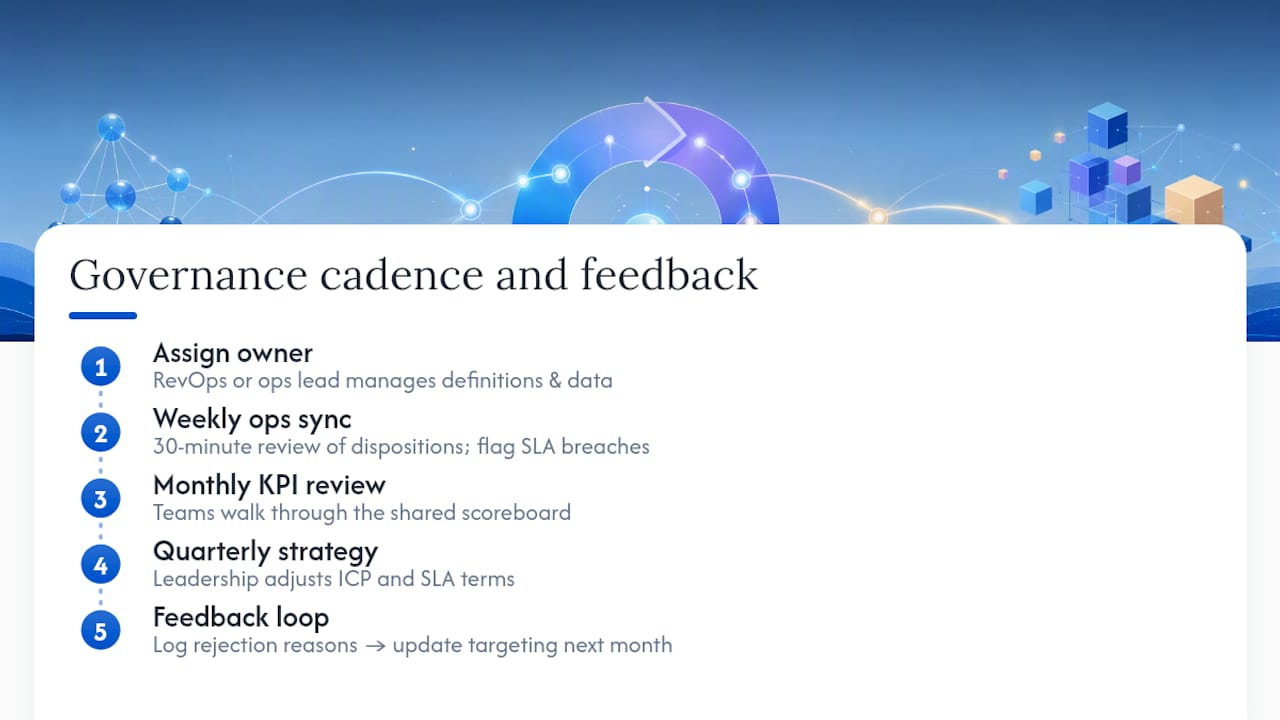
Enforce SLA compliance with numbers, not opinions. Collect rejection reasons every time a lead gets disqualified, and feed those reasons back into targeting criteria the following month. Keeping disputes anchored to logged data rather than personalities is what stops alignment meetings from turning into blame sessions.
Can a Pay-Per-Result Model Fix Alignment on Its Own?
Most alignment failures trace back to incentives that don’t match. A pay-per-result pricing structure removes that mismatch by design: the vendor only gets paid when a qualified appointment actually lands on the calendar, which forces the same discipline internally that marketing and sales need to build with each other.
Leadsnow’s model runs on that principle. Continuous AI-driven qualification and feedback loops mean lead quality gets tuned in real time instead of reviewed once a quarter, and the incentive to overqualify or underqualify a lead simply doesn’t exist when payment depends on the appointment being real. Leadsnow reports results including a 7x sales lift and more than 50,769 AI-booked appointments across client engagements, proof that incentive alignment between a vendor and a client works the same way it does between marketing and sales internally.
What Leaders Should Prioritize First
Three things matter more than everything else on this list: fix your lead definitions, centralize your data, and enforce your SLA. Do those first, and most of the cultural friction people blame on “silos” disappears.
This week, pick one: write your MQL/SQL definitions on paper, or audit how many systems your lead data currently lives in. Measure the result in 30 days, then iterate. Alignment isn’t a project you finish. It’s a metric you keep watching.
— Riley
How Leadsnow Turns Alignment Into Booked Revenue
Leadsnow is built around one advantage most agencies can’t offer: you only pay when a qualified appointment actually lands on the calendar, using the per-result and revenue-share pricing model instead of a flat retainer that keeps billing whether leads convert or not.
That pricing structure does double duty for alignment. First, every lead that reaches your sales team has already been qualified through AI-driven scoring and human review, so the MQL-to-SQL argument that derails so many handoffs mostly disappears before it starts. Second, Leadsnow’s systems feed continuous performance data back into targeting, the same feedback loop this article recommends building internally between your own marketing and sales teams. If you’re running a coaching, gym, consulting, or service business and want to see what AI-powered appointment setting looks like when incentives are actually aligned with your revenue, the pricing page linked above is the place to start evaluating fit.
Sources
- 7 steps to achieving sales and marketing alignment – HubSpot (Forrester summary referenced)
- Driving revenue: marketing-sales collaboration – KPMG (in partnership with CMO Council)
- When sales and marketing aren’t aligned, both suffer – HBR
- Marketing and sales alignment guidance – Salesforce
FAQ
What Is Marketing Sales Alignment?
Marketing sales alignment means both teams operate from shared goals, shared data, and a written service-level agreement covering lead volume, quality, and speed. It replaces separate KPIs and disconnected systems with one scoreboard both teams are accountable to.
How Does Alignment Improve Revenue?
Aligned organizations report significantly higher revenue than unaligned ones, driven by higher close rates, shorter sales cycles, and faster pipeline velocity. The gains come from qualified leads reaching sales faster with the context needed to close them.
What’s the Biggest Cause of Misalignment?
Mismatched lead definitions, where marketing and sales disagree on what counts as a qualified lead, and fragmented data across separate systems are the two most common root causes. KPMG’s research found over 60% of marketers say their teams don’t co-own customer data at all.
How Long Does It Take to Fix Alignment?
Writing MQL/SQL definitions and an SLA can happen within weeks; centralizing data and building dashboards typically takes a full quarter. HBR’s research confirms that misalignment compounds over time, so earlier fixes pay off faster than waiting for a larger reorganization.
Can an Outside Vendor Help With Alignment?
Yes, particularly for lead qualification and appointment setting, where incentive mismatches often start. Leadsnow’s pay-per-result pricing ties vendor payment directly to booked, qualified appointments, which mirrors the incentive alignment leaders are trying to build between their own marketing and sales teams.
Pay-Per-Result appointments
See if we’re a fit
We book qualified sales appointments for you and you pay on results, not retainers. Our booking page asks a few quick questions so you find out in two minutes whether that model suits your business.
- 50,769+ appointments booked without cold calling.
- Pay-Per-Result pricing — you pay for booked, qualified calls.
- Pick your own time on our live calendar, no phone tag.