
Buyers agents have the strangest marketing problem in Australian property: demand for what you do has never been higher, yet most buyers advocates still live and die on referrals. This page is the practical answer — how buyers agent lead generation in Australia actually works in 2026, which channels are worth your time, and where pay-per-result AI appointment setting fits.
At a glance: Buyers agents in Australia get more clients four ways: referrals, content/SEO, paid ads, and pay-per-result appointment setting. Referrals are high-trust but feast-and-famine; SEO takes months; ads produce enquiries, not clients. Pay-per-result AI appointment setting responds to enquiries in minutes, qualifies budget and timeline, nurtures 6–18 month buyers, and charges only for booked consultations.
Demand for buyers agents is growing — client flow isn’t automatic
The market context is genuinely good news. The Real Estate Buyers Agents Association of Australia (REBAA), the profession’s peak body since 2000, defines buyers agents as licensed professionals who search, negotiate and purchase on behalf of buyers — and Australians are catching on. A 2023 PIPA survey reported by the REIQ found 40 per cent of buyers had considered using a buyer’s agent, up from roughly 10 per cent a decade earlier. And in PIPA’s 2025 Annual Property Investor Sentiment Survey, about 40 per cent of investor respondents said they’d sought advice from a buyers’ agent or advocate in the past year — nearly level with mortgage brokers on 43 per cent.
So the awareness problem is solving itself. The acquisition problem isn’t. A rising tide also floats your competitors, and the buyers agents who win the next five years will be the ones with a client-acquisition system that doesn’t depend on who happened to mention them at a barbecue.
How it works
How an AI sales agent books your appointments
Six channels feed in
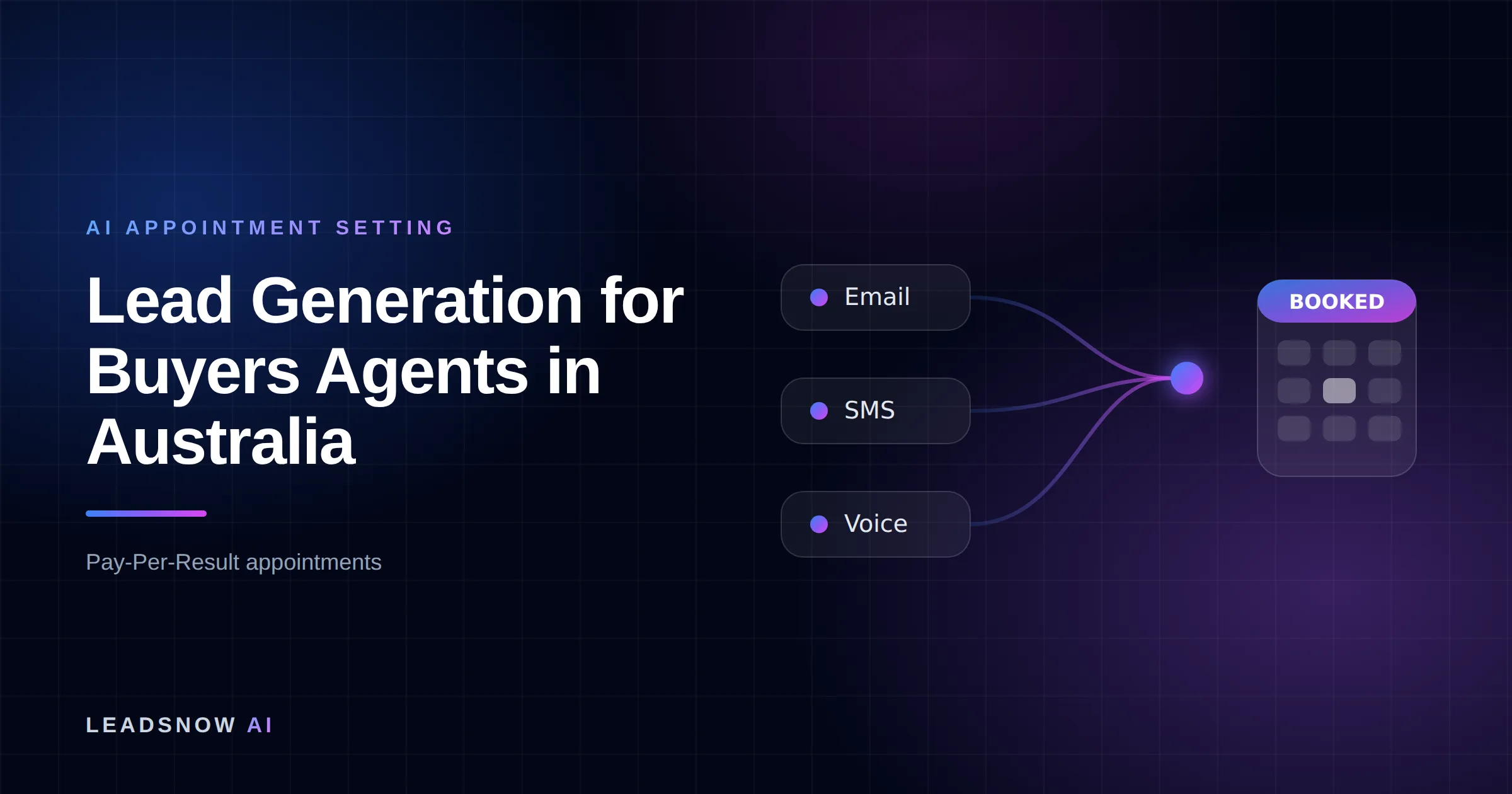
Outbound email, SMS, voice and social — plus inbound search and AI referrals from our own AI SEO and chat agents.
Your list or CRM
Outbound starts from data you already own — past enquiries, dormant customers, or a targeted prospect list.
Qualified against your rules
Budget, timing and fit are checked before anything reaches your team, using criteria you set.
Booked into your calendar
Only qualified prospects reach the booking step, so your closers spend their time selling.
MAKE MORE SALES.
Pay-Per-Result pricing — We scale sales HARD aligned to your interests, better than anyone else.
The four client-acquisition problems specific to buyers agents
1. Feast-and-famine referral flow. Referrals from past clients, mortgage brokers and accountants are the backbone of most buyers advocacy businesses — and they’re wonderful, right up until they aren’t. You can’t schedule a referral. Two settlements in a month, then six quiet weeks. When your pipeline is other people’s goodwill, you can’t forecast, can’t hire, and can’t say no to marginal clients.
2. Tyre-kickers dressed as enquiries. Anyone researching property will happily “chat to a buyers agent” — including people with no finance, no deposit, and a budget that doesn’t exist in the suburbs they want. Every hour you spend discovering that on a call is an hour you’re not searching, inspecting or negotiating for a paying client. Qualification is the job before the job.
3. Slow follow-up, while your prospect talks to everyone else. A buyer who enquires with you is, that same week, talking to selling agents at open homes, a mortgage broker, and probably two other advocates. If your follow-up is “I’ll call them back after this auction,” someone else has the relationship by Monday. An enquiry’s value decays in minutes, not days — and buyers agents, who are out at inspections and auctions more than almost any profession, are structurally the worst-placed people to answer their own phones.
4. Six-to-eighteen-month buying timelines. Plenty of genuine future clients aren’t ready: saving a deposit, waiting on pre-approval, “seeing what the market does.” They’re not dead leads — they’re 2027’s settlements. But nurturing them manually for a year is spare-time work that never gets done, so they quietly become someone else’s client when they’re finally ready.
Want this done for you? We book qualified sales appointments on a Pay-Per-Result basis — you only pay for calls that actually land in your calendar.
Honest comparison: how buyers agents get clients in Australia
| Channel | Pros | Cons | Typical time to result |
|---|---|---|---|
| Referrals & broker networks | Highest trust; near-zero cash cost; clients arrive pre-sold on you | Unpredictable and unscalable; dries up when transactions slow; you’re building someone else’s asset (their goodwill, not your pipeline) | Ongoing but lumpy — weeks to months between referrals |
| Content & SEO | Compounds over time; positions you as the local expert; you own the asset | 6–12+ months before meaningful flow; you’re competing with portals and national franchises for the same keywords; still needs a follow-up system when enquiries land | 6–12+ months |
| Paid ads (Google/Meta) | Fast to switch on; precise geographic and demographic targeting; volume is controllable | You pay for clicks and enquiries, not clients; heavy tyre-kicker load; ROI lives or dies on your speed and consistency of follow-up | Days for enquiries; weeks–months to profitable |
| Pay-per-result AI appointment setting | You pay for booked, qualified consultations — not clicks; AI responds in minutes, qualifies budget/finance/timeline, and nurtures long-cycle buyers automatically | Higher cost per contact than a raw click (you’re buying the finished article); you still have to run a good consult and close; works best with a clear service area and fee model | Booked appointments typically within weeks |
None of these channels is wrong. The mistake is relying on one of them — usually referrals — and treating the rest as someday projects.
How pay-per-result AI appointment setting works for buyers agents
The model is simple: instead of paying for advertising activity and hoping, you pay for the outcome — a qualified buyer consultation on your calendar. The system underneath does three things most buyers agents can’t do manually:
Speed to lead. When an enquiry comes in — from your website, an ad, a lead magnet, or your existing database — the AI responds within minutes, any hour, any day, including Saturday afternoons when you’re at auction. That first-responder advantage is the whole game when your prospect is simultaneously talking to selling agents who are answering their phones. (More on the mechanics here: speed-to-lead automation in Australia.)
Qualification before your calendar. The AI holds a natural two-way conversation over SMS and email: budget range, finance status, target areas, owner-occupier or investor, timeline. People with no deposit and a fantasy brief get a polite nurture track, not a slot in your diary. What lands on your calendar is a buyer worth an hour of your time — and you walk in already knowing their brief. Full detail on how the conversations work: AI appointment setting.
Long-cycle nurture that never forgets. The “not ready yet” majority gets systematic, human-sounding follow-up over 6, 12, 18 months — market updates, check-ins, re-qualification when circumstances change. When pre-approval finally lands, you’re the advocate who stayed in touch the entire time, without you sending a single manual message. That’s not a knock on your discipline — it’s an argument that year-long follow-up is a system’s job, not a person’s spare-time job.
Book a call — you pick the slot, no phone tag.
If we can’t make you money, we don’t deserve yours.
Pay-Per-Result pricing — performance-based alignment.
Buyers agents are not selling agents — and the lead gen is different
If you’ve read our page on lead generation for real estate agents in Australia, note that it solves a different problem: selling agents need vendor appraisals — homeowners thinking about listing. You need the other side of the transaction: qualified buyers with finance and intent, on longer decision cycles, who choose an advocate on trust rather than on a portal ranking. Vendor-lead tactics (appraisal funnels, “what’s my home worth” hooks) do nothing for a buyers advocacy business. The qualification questions differ, the nurture arc is longer, and the competition for attention is the selling agents themselves. That’s why this page exists separately.
Proof, on the record
Since 2017 we’ve booked 50,769+ AI-booked sales appointments and generated 1M+ leads for clients. We hold a 4.6 rating across 43 Google reviews and have 25 client case studies on film — real businesses, on camera, names attached. Our client list runs across industries: commercial property (Colliers), finance broking (Sam Tajvidi of 121 Brokers), fitness (Marcus Wilkinson of Iron Body), education and e-commerce (Foundr, Lambda Academy, SheSells.online). We’ll be straight with you: we haven’t yet published a buyers-agent-specific case study, and we won’t invent one. What transfers across every one of those industries is the same machinery — fast response, honest qualification, and follow-up that doesn’t fatigue — pointed at your market on a pay-per-result basis.
FAQ: buyers agent lead generation in Australia
How do buyers agents in Australia get more clients?
Four channels do the work: referrals and broker networks, content/SEO, paid advertising, and pay-per-result appointment setting. Most established advocates lean almost entirely on referrals, which caps growth at the pace of word of mouth. Adding a system that responds to enquiries in minutes, qualifies them, and nurtures long-timeline buyers converts demand you’re already generating but currently losing.
Is demand for buyers agents actually growing in Australia?
Yes, and it’s measurable. In PIPA’s 2025 Annual Property Investor Sentiment Survey (conducted August 2025), about 40 per cent of property investors said they had sought advice from a buyers’ agent or advocate in the past year — almost level with mortgage brokers at 43 per cent. The REIQ likewise reports that consideration of buyers agents among buyers quadrupled in a decade. Growing demand doesn’t distribute itself evenly, though — it flows to the advocates who respond first and stay in touch longest.
What counts as a qualified appointment for a buyers agent?
One we’d both recognise as worth your hour: a buyer who has confirmed their budget range, finance position (pre-approved, in progress, or cash), target areas, and buying timeline, and has actively chosen a time to speak with you about engaging an advocate. Browsers, students of the market, and people whose budget can’t meet their brief go into nurture instead of your diary.
What about prospects who won’t buy for 6–18 months?
They’re the majority, and they’re the reason nurture matters more for buyers agents than almost any other profession. The AI keeps them warm with periodic, personalised check-ins and re-qualifies them as their finance and timeline firm up. When they’re ready, they book — with you, because you’re the advocate who never went quiet. You pay when the qualified appointment lands, not for the months of nurture before it.
How is this different from lead generation for selling agents?
Selling agents buy vendor leads — homeowners considering listing — and compete on appraisal volume. Buyers agents need the opposite profile: financed, motivated purchasers on longer decision cycles. The targeting, qualification questions and nurture length are all different, which is why we treat selling-agent lead generation as a separate service with its own page.
Your next client is already enquiring somewhere
The demand curve for buyers advocacy in Australia is doing the hard part for you. The remaining question is whether enquiries meet a system that answers in minutes and follows up for as long as it takes — or a voicemail. If you’d rather pay for consultations than for clicks, let’s talk it through.
Book a call — 45 minutes, straight answers, no obligation.
Pay-Per-Result appointments
See if we’re a fit
We book qualified sales appointments for you and you pay on results, not retainers. Our booking page asks a few quick questions so you find out in two minutes whether that model suits your business.
- 50,769+ appointments booked without cold calling.
- Pay-Per-Result pricing — you pay for booked, qualified calls.
- Pick your own time on our live calendar, no phone tag.