
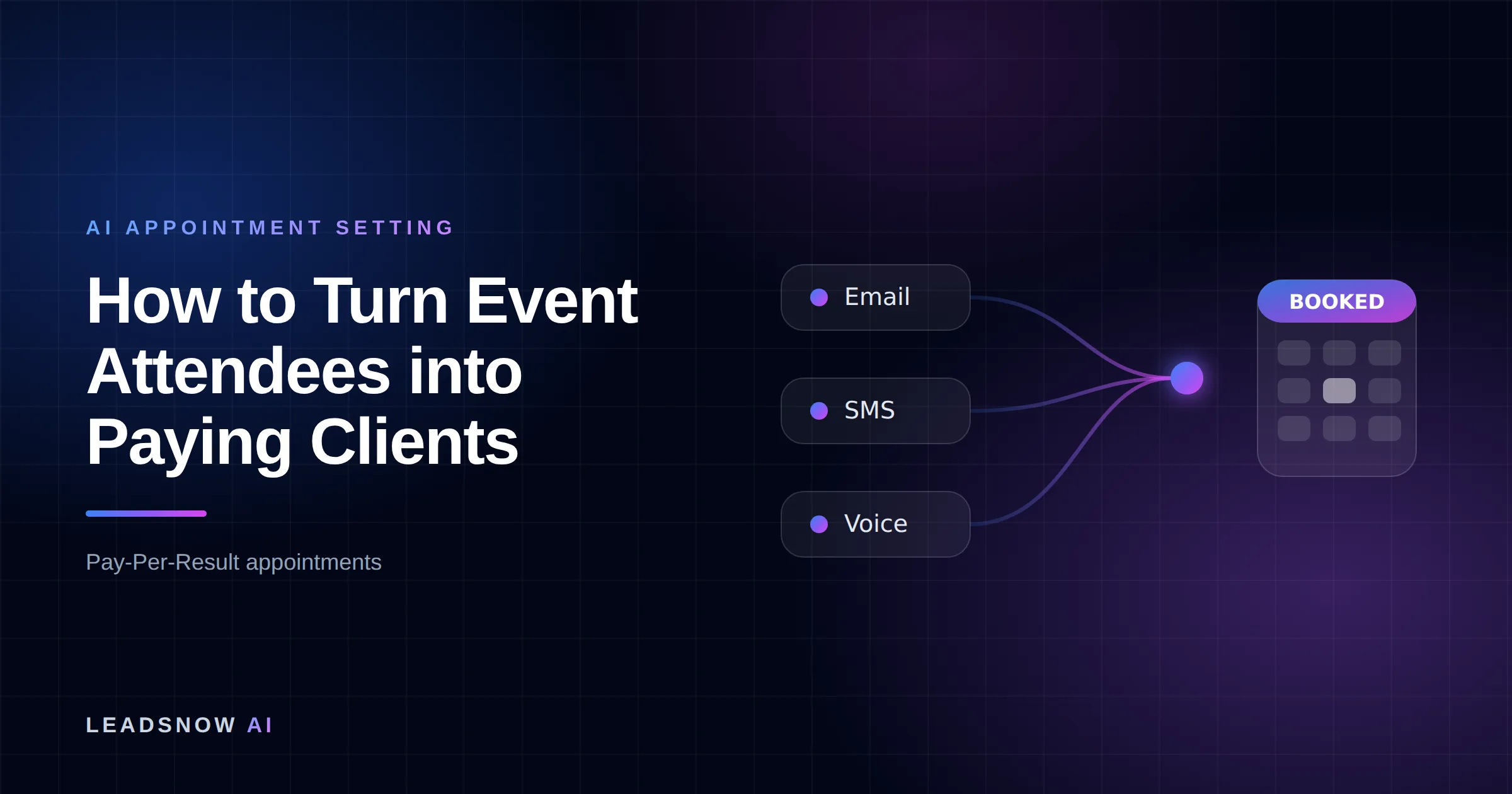
To turn event attendees into paying clients, sort them by fit before the doors close, then put every qualified attendee onto a booked sales call within 48 hours. On the labelled assumptions in our Room-to-Revenue model, 120 attendees produce about 3.4 clients when called inside 48 hours and about 1.0 when contact waits 8–30 days.
At a glance
- The goal of a client-acquisition event is booked sales calls with qualified attendees, not applause, survey scores or slide downloads.
- The window: in our model, a qualified attendee called within 48 hours is worth about 3.5 times one first contacted 8–30 days later (assumption bands, replace with your own).
- Attendance is not engagement: PheedLoop found that roughly one in four people who check into an event never check into a single session (median across 411 live events).
- Book in the room: the cheapest follow-up call is the one already in the calendar before the attendee leaves.
- The crunch: calling 48 qualified attendees in two days is about 24 hours of work, landing on the team that just ran the event.
Why do most event attendees never become clients?
Most event attendees never become clients because the follow-up starts days late, goes out as one group email, and asks nobody to book a specific call. The event creates intent on the day; the organiser’s team is exhausted, the slides go out on Friday, and a personal conversation happens the following week, if at all.
The best public evidence on how quickly interest fades comes from web leads rather than events. In the Harvard Business Review study by Oldroyd, McElheran and Elkington (2011), an analysis of 1.25 million leads at 42 US companies found that firms that tried to contact a lead within an hour were nearly seven times as likely to qualify it as firms that waited even an hour longer. An event attendee is a warmer contact than a web form, so treat that as the direction of the effect, not its size.
An event is a sales meeting with a hundred people in it; the follow-up is where the sale is actually made or lost.
How it works
Turning event attendees into booked sales calls
Tier the attendee list
Sort attendees into A, B and C using registration answers, session check-ins and buying signals. Do it before the event ends.
Book calls in the room
Put a calendar link on the final slide and staff a booking table after the offer session.
Call within 48 hours
Call Tier A on day one and Tier B by day two, with a text and booking link after each missed call.
Log every outcome
Record booked, not now, not a fit or no answer. Replace the model’s assumptions with your own numbers.
MAKE MORE SALES.
Pay-Per-Result pricing — We scale sales HARD aligned to your interests, better than anyone else.
The Room-to-Revenue model: clients per 120 attendees by follow-up window
The Room-to-Revenue model estimates clients from an event as attendees × qualified share × booked-call rate × show rate × close rate. The booked-call rate is set by how fast follow-up starts. No credible public benchmark exists for attendee-to-client conversion, so every rate below is an assumption in three bands for you to replace with your own numbers.
Fixed assumptions for the worked example: 120 attendees; 40% qualified for the back-end offer (48 people); 80% of booked calls show; 25% of calls that happen close; back-end offer worth $8,000 (any currency). Clients = 48 × booked-call rate × 0.8 × 0.25, which simplifies to 9.6 × booked-call rate.
| First personal contact | Assumed booked-call rate (low / mid / high) | Clients (low / mid / high) | Revenue at mid ($8,000 offer) | Value per attendee at mid |
|---|---|---|---|---|
| Booked in the room, or called within 48 hours | 25% / 35% / 45% | 2.4 / 3.4 / 4.3 | $26,880 | $224 |
| Called 3–7 days after | 12% / 20% / 28% | 1.2 / 1.9 / 2.7 | $15,360 | $128 |
| Called 8–30 days after | 5% / 10% / 15% | 0.5 / 1.0 / 1.4 | $7,680 | $64 |
| Email only, no personal contact | 2% / 4% / 6% | 0.2 / 0.4 / 0.6 | $3,072 | $25.60 |
Check the arithmetic on the mid row: 48 × 35% = 16.8 booked calls; × 80% = 13.44 held; × 25% = 3.36 clients; × $8,000 = $26,880, or $224 for each of the 120 attendees. The ratio between the first and third rows (3.36 ÷ 0.96 = 3.5) is the cost of waiting, on these assumptions.
The same table gives a break-even. If the event costs $30,000 net of ticket revenue, it needs about 134 attendees at the 48-hour value ($30,000 ÷ $224) and about 469 at the 8–30 day value ($30,000 ÷ $64). The follow-up window can decide whether the same event makes money or loses it, without anything on stage changing.
Want this done for you? We book qualified sales appointments on a Pay-Per-Result basis — you only pay for calls that actually land in your calendar.
How do I sort event attendees before following up?
Sorting event attendees into three tiers before anyone is called stops your best prospects waiting behind people who only came for the lunch. Use evidence you already hold: what they told you at registration, which sessions they attended, and what they did in the room.
- Tier A — call first, within 24 hours: asked about the offer, attended the session where it was presented, filled in an interest card, or matches your ideal-client profile on role and company size.
- Tier B — call within 48 hours: fits the profile on paper and attended the main sessions, but gave no buying signal.
- Tier C — nurture by email: poor fit (students, suppliers, competitors) or checked in and attended nothing.
Session check-ins are a useful filter because attendance and engagement differ. PheedLoop’s Event Data Lab Report #08 found a median session reach of 75% across 411 live events, so roughly one in four checked-in attendees never entered a session at all. If your event platform records session check-ins, export them with the attendee list.
What to do in the room so the follow-up is already booked
Booking sales calls during the event itself removes the follow-up delay entirely, because the attendee leaves with a time in their calendar rather than a promise to be in touch. Four practical ways to do it:
- Put the next step on the final slide: a short booking link or QR code to a calendar showing real times in the next three business days.
- Staff a booking table at the break after the offer session, with two people holding tablets open on the calendar.
- Use an interest card with one question (“Would a 20-minute call about your situation be useful this week?”) and a tick box for a preferred day. Collect it before people leave.
- For high-ticket offers, sell the call, not the program. Above roughly $5,000 the decision usually needs a conversation. Our page on selling high-ticket event tickets through an application and a call sets out the same price-band logic for the event itself.
Every call booked in the room is a call nobody has to chase on Monday.
If we can’t make you money, we don’t deserve yours.
Pay-Per-Result pricing — performance-based alignment.
The 48-hour follow-up sequence after an event
The 48-hour follow-up sequence gives every qualified attendee who did not book in the room a personal attempt before interest fades: same-day message, next-morning call, second-day call and text.
- Event day, evening: a short personal email or text to Tier A and B. Reference one specific moment from the event and offer two call times.
- Day 1, morning: call Tier A in order of buying signal. If no answer, leave a 20-second voicemail and send a text with a booking link.
- Day 1, afternoon: start calling Tier B.
- Day 2: second attempt for everyone not reached, at a different time of day.
- Day 3 onward: move unreached attendees to a slower sequence over the following two weeks. Keep the slides and recording as the reason to get in touch, not as the whole message.
Log the outcome of every attempt (booked, not now, not a fit, no answer). Those four counts are what turn the assumption bands in the Room-to-Revenue table into your own numbers after one event. If calls get booked but nobody shows up, that is a different leak: our page on speed-to-lead conversion benchmarks covers response time, and the high-ticket application funnel conversion rate page covers the stages after the booking.
What about registrants who did not attend the event?
Registrants who did not attend need a separate list and message, and at paid events PheedLoop puts the median no-show rate at about 17% of expected attendees.
That figure comes from PheedLoop’s Event Data Lab Report #05 (683 paid events; the no-show rate is the share of expected attendees, including speakers, who did not check in). Free events ran at about 28% (389 events). A no-show still told you they were interested enough to register, so send the recording with a one-line offer of a call, but do not put them ahead of Tier A attendees. The event no-show rate page covers how to reduce the number in the first place. If your event was online, the webinar-not-converting diagnosis splits the same problem into registration, show and offer stages.
Should I follow up event attendees myself or hand it over?
Following up event attendees yourself makes sense below about 30 qualified attendees per event; above about 100, or several events a month, the 48-hour window usually needs a dedicated team.
The cost of doing it yourself is time in a short window. Assume about 30 minutes per qualified attendee across two or three attempts, the conversation and the logging (our working assumption). For the 48 qualified attendees in the worked example, that is about 24 hours of calling inside two days, done by people who have just spent a week running the event. Most teams do not have it, which is why the 3–7 day row is the one most events actually live in.
| Qualified attendees per event | Calling time at 30 minutes each | Workable approach (our working threshold) |
|---|---|---|
| Under 30 | Under 15 hours | The host and one team member call personally |
| 30–100 | 15–50 hours | A named setter for the 48 hours, with a tiered call list |
| Over 100, or several events a month | 50+ hours per event | A dedicated team, or an outsourced appointment-setting service working the list by call, SMS and follow-up |
LeadsNow is one such service: it has booked 50,769+ sales appointments since 2017 using AI calling, SMS and DM follow-up, and charges on results rather than a retainer. For more on how event businesses fill the room in the first place, see our hub on lead generation for event organisers.
FAQ: turning event attendees into clients
These are the questions event hosts most often ask about converting attendees, answered with the same Room-to-Revenue assumptions used above.
How soon should I follow up with event attendees?
Within 48 hours, and within 24 hours for anyone who showed a buying signal. No public study measures event attendees specifically, but the Harvard Business Review analysis of 1.25 million web leads at 42 US companies found that firms trying to contact a lead within an hour were nearly seven times as likely to qualify it (HBR, 2011).
What percentage of event attendees become clients?
There is no credible public benchmark, because it depends on the offer, its price and the audience. In the labelled assumptions of the Room-to-Revenue model, 120 attendees produce 2.4 to 4.3 clients when called within 48 hours. Measure your own after one event.
Should I pitch my offer from the stage?
For high-ticket offers, pitch the next step rather than the program. Ask attendees to book a short call, and have a calendar ready on the final slide or at a booking table.
Who should I call first after an event?
Attendees who asked about the offer or attended the session where it was presented, then good-fit attendees without a buying signal. Attendees who checked in but attended no sessions go to email; PheedLoop found that is roughly one in four at the median event.
How many attendees does an event need to pay for itself?
Divide the net event cost by the value of one attendee. In the worked example, a $30,000 event needs about 134 attendees at a 48-hour follow-up value of $224 each, and about 469 if follow-up waits 8–30 days.
Pay-Per-Result appointments
See if we’re a fit
We book qualified sales appointments for you and you pay on results, not retainers. Our booking page asks a few quick questions so you find out in two minutes whether that model suits your business.
- 50,769+ appointments booked without cold calling.
- Pay-Per-Result pricing — you pay for booked, qualified calls.
- Pick your own time on our live calendar, no phone tag.