
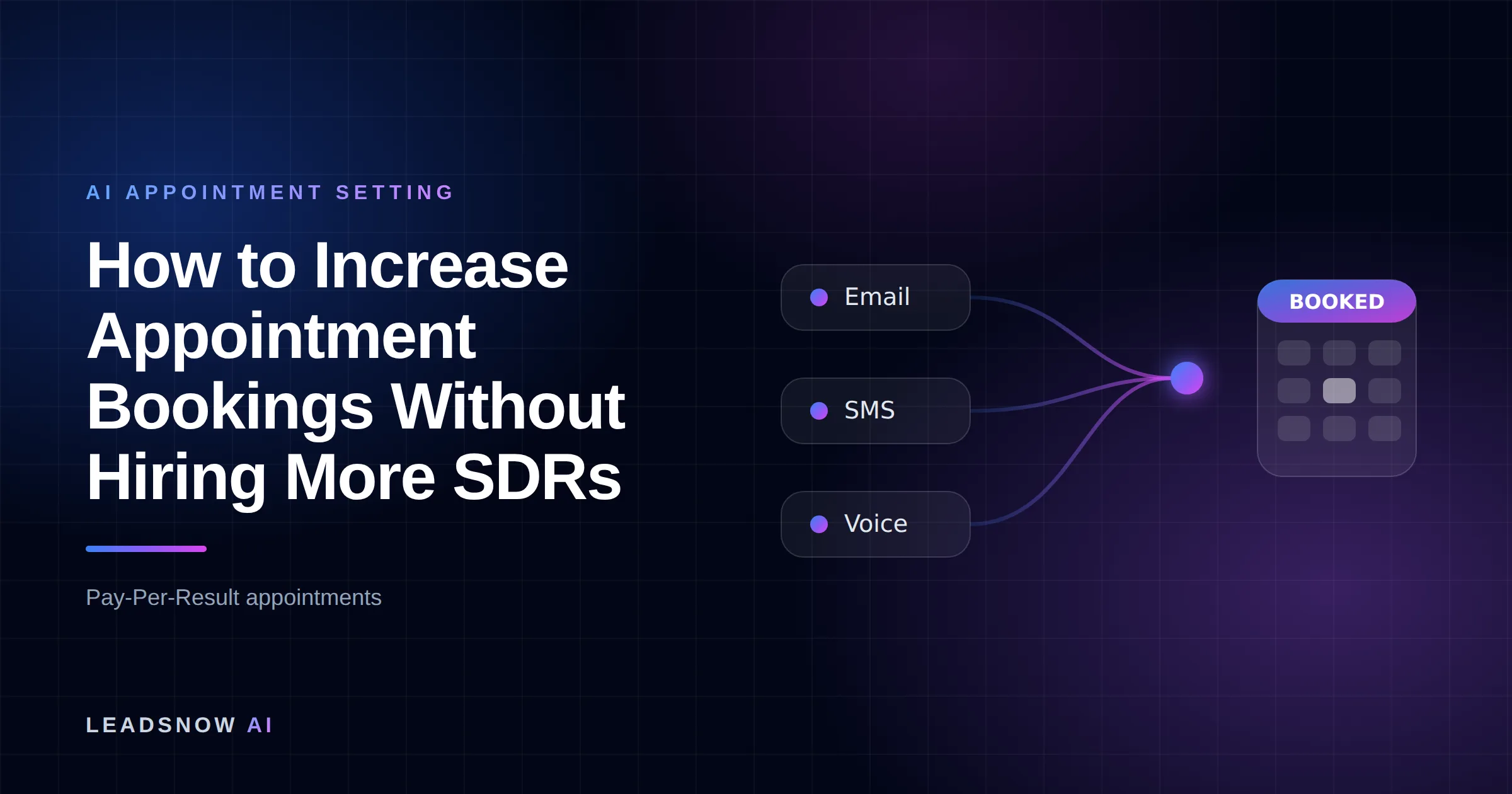
Fixing four leaks between lead and held meeting adds 54 held meetings a month on 1,000 leads in the worked model below, about five SDRs’ worth at the median quota of 10 held meetings. Automate more contact attempts, book a time in the first conversation, remind before every call, and rebook every no-show.
The short answer from LeadsNow AI: Many of the bookings a new SDR would add often already sit in your funnel as leads never reached, conversations that ended without a time, and no-shows nobody rebooked. Measure those four rates first, fix the worst one, and hire only when all four are healthy and the team is still out of hours.
Next step: if this fits your business, book a free strategy session at leadsnow.ai/strategy-session/ – a 2-minute fit check, then pick a time.
- The equation: held meetings = leads x contact rate x booking rate on contact x show rate, plus rebooked no-shows that then show.
- The SDR yardstick: a median quota of 10 held meetings a month, a $80K median OTE, a 3.0-month average ramp and 60% of reps at quota (The Bridge Group, 2025, 351 B2B companies).
- The four leaks, in fix order: unreached leads, conversations with no time offered, no-shows, and no-shows never rebooked.
- The catch: extra contact attempts cost hours, so without new SDRs they have to be automated by SMS, email or AI calling.
Rules of thumb:
- If contact rises from 50% to 60% on 1,000 leads at a 20% booking rate and 60% show rate, expect 12 more held meetings (worked model below).
- If 40% of 45 no-shows are rebooked and half of those show, expect 9 more held meetings.
- If you raise attempts from two to six on 1,000 leads by hand, expect about 100 extra hours a month at 1.5 minutes per attempt.
- If all four rates are healthy and the team is at capacity, a hire is often the right answer.
How can I increase appointment bookings without hiring more SDRs?
Appointment bookings rise without new SDRs when you recover meetings your current funnel already loses, at four measurable points between the lead arriving and the meeting being held.
Pull the last 90 days from your CRM and write down four rates:
- Contact rate = leads who had a two-way conversation ÷ leads received.
- Booking rate on contact = meetings booked ÷ leads contacted.
- Show rate = meetings held ÷ meetings booked.
- Rebook rate = no-shows given a new time ÷ total no-shows.
Tracking bookings alone hides whether the leak is reach, the ask or attendance. The four rates tell you which. For the rate definitions in more depth, see how to increase your appointment set rate.
How it works
The Four-Leak Ledger: recovering bookings without new SDRs
Measure four rates
Pull contact, booking, show and rebook rates from the last 90 days of CRM data.
Automate more attempts
Add SMS, email and AI-calling attempts so more leads reach a two-way conversation.
Book on first contact
Offer two specific times in the first conversation and write the booking yourself.
Remind and rebook
Confirm, remind before each call, and offer every no-show two new times within the hour.
MAKE MORE SALES.
Pay-Per-Result pricing — We scale sales HARD aligned to your interests, better than anyone else.
The Four-Leak Ledger: a worked model on 1,000 leads a month
The Four-Leak Ledger turns 60 held meetings into 114 on the same 1,000 leads by fixing each leak in order, with every input a labelled assumption.
| Step (each built on the row above) | Rate change (assumption) | Contacted | Booked | Held | Gain in held |
|---|---|---|---|---|---|
| Baseline | Contact 50%, booking 20%, show 60% | 500 | 100 | 60 | – |
| 1. More automated attempts, faster first touch | Contact 50% to 60% | 600 | 120 | 72 | +12 |
| 2. Offer two times in the first conversation | Booking 20% to 25% | 600 | 150 | 90 | +18 |
| 3. Confirmation plus reminders before each call | Show 60% to 70% | 600 | 150 | 105 | +15 |
| 4. Rebook no-shows the same day | 40% of 45 no-shows rebooked, 50% of those show | 600 | 168 | 114 | +9 |
How to read it. At step 3, 150 booked at 70% show gives 105 held and 45 no-shows. At step 4, 40% of 45 is 18 rebooked, and half of those show, so 9 more held: 114 in total. The gain of 54 held meetings equals 5.4 SDRs at the Bridge Group median quota of 10 held meetings a month.
These rates are assumptions to replace with your own, not measured benchmarks. The rows are sequential, so the gains depend on order: lifting contact first means the booking and show fixes act on a larger base. Your total will differ, and a funnel already at 70% contact has far less to gain from step 1.
Want this done for you? We book qualified sales appointments on a Pay-Per-Result basis — you only pay for calls that actually land in your calendar.
Which booking leak should you fix first?
The booking leak to fix first is the one furthest below its threshold in the table below, because a weak early stage starves every later fix.
| Measured rate | Below this, fix it first | First action |
|---|---|---|
| Contact rate | 50% | Add attempts across SMS, email and call; first touch within minutes |
| Booking rate on contact | 20% | Offer two specific times on the first conversation, not a link |
| Show rate | 60% | Instant confirmation, then reminders the day before and the hour before |
| Rebook rate | 40% | Contact every no-show within the hour with two new times |
These are decision rules, not industry benchmarks; use them to order the work, then judge progress against your own baseline. The calendar-link question is tested in calendar link vs call-back booking rate.
Why more contact attempts need automation, not people
Raising contact attempts from two to six on 1,000 leads adds 4,000 attempts a month, which is about 100 hours of manual work at 1.5 minutes per attempt.
That arithmetic is why step 1 is the one teams skip. The 1.5 minutes is an assumption covering dialling, voicemail, a text and a CRM note; your own figure may be higher. One hundred hours is most of a full-time person’s month, so doing step 1 by hand is the same as hiring an SDR. The alternatives are a sequenced SMS and email cadence, AI calling, or both. Capacity maths for outbound teams is worked through in how to increase outreach volume without more reps.
If we can’t make you money, we don’t deserve yours.
Pay-Per-Result pricing — performance-based alignment.
How booking on the first conversation lifts the booking rate
Booking on the first conversation means offering two specific times while the lead is engaged, instead of sending a link for them to use later.
- Offer two times, not an open calendar. A choice of two is easier to answer than a week of slots.
- Book it yourself. Write the event into the calendar during the conversation and send the invite at once.
- Ask one qualifying question before the times, not five. Long forms belong after the booking, if at all.
- Keep a fallback. If neither time works, send the link then, and follow up in 24 hours if it is not used.
How reminders and rebooking recover booked meetings
Show rate and rebook rate together decide how many booked meetings become held ones, and both run on reminders rather than headcount.
A confirmation within a minute of booking, a reminder the day before and another an hour before cover most of what reminder software does. LeadsNow sees show rates that vary by offer and reminder cadence, up to 93% on its best-performing accounts; that is a best-case ceiling, not a typical figure. For the no-shows that remain, contact each one within the hour with two new times. The full sequence is in how to rebook no-show leads.
What running the four fixes yourself costs
Running the four fixes yourself costs mainly setup hours, one owner’s weekly attention, and messaging or AI-calling tools priced per message or per minute.
- Setup: cadences, reminder templates and a no-show trigger in your CRM; plan on several days of build and testing.
- Ongoing: someone has to watch the four rates weekly and rewrite what stops working.
- Tools: SMS and AI-calling usage, priced per message or per minute by each vendor.
- Skill: writing follow-up that reads like a person, and staying inside consent rules in each country you contact.
The alternative is handing the booking job to a service that runs these steps; LeadsNow does this as AI appointment setting using AI calling, SMS and DM follow-up. The cost comparison against a hire is in AI SDR vs human SDR cost.
When is hiring another SDR the right answer?
Hiring another SDR is the right answer when all four rates sit above their thresholds and your team still cannot work the lead volume within an hour of arrival.
Two other cases favour a hire: outbound into named accounts where research and judgement per account matter, and deal sizes large enough that a person on every lead pays for itself. A hire also takes time to pay back: the Bridge Group reports a 3.0-month average ramp, and only 60% of SDRs reached quota in its 2025 study.
FAQ
How many meetings does one SDR book a month?
The median SDR quota is 10 held meetings a month, and 60% of reps hit quota, according to The Bridge Group’s 2025 SDR Models, Motions and Metrics report of 351 B2B companies.
What is a good contact rate on inbound leads?
No single public benchmark fits every market. Use 50% as a decision threshold: below it, more attempts and a faster first touch come before any script or offer change.
Should I send a calendar link or offer times?
Offer two specific times during the conversation and book it yourself. Send the link only as a fallback when neither time works, then follow up within 24 hours.
Can AI replace SDRs for booking appointments?
AI can take the repetitive work: extra attempts, reminders and rebooking no-shows. Account research, complex objections and large deals still benefit from a person.
How quickly can these fixes add bookings?
Reminders and same-day rebooking can work within the first week of setup. Contact-rate fixes take longer because new cadences need a full lead cycle to measure.
Pay-Per-Result appointments
See if we’re a fit
We book qualified sales appointments for you and you pay on results, not retainers. Our booking page asks a few quick questions so you find out in two minutes whether that model suits your business.
- 50,769+ appointments booked without cold calling.
- Pay-Per-Result pricing — you pay for booked, qualified calls.
- Pick your own time on our live calendar, no phone tag.