
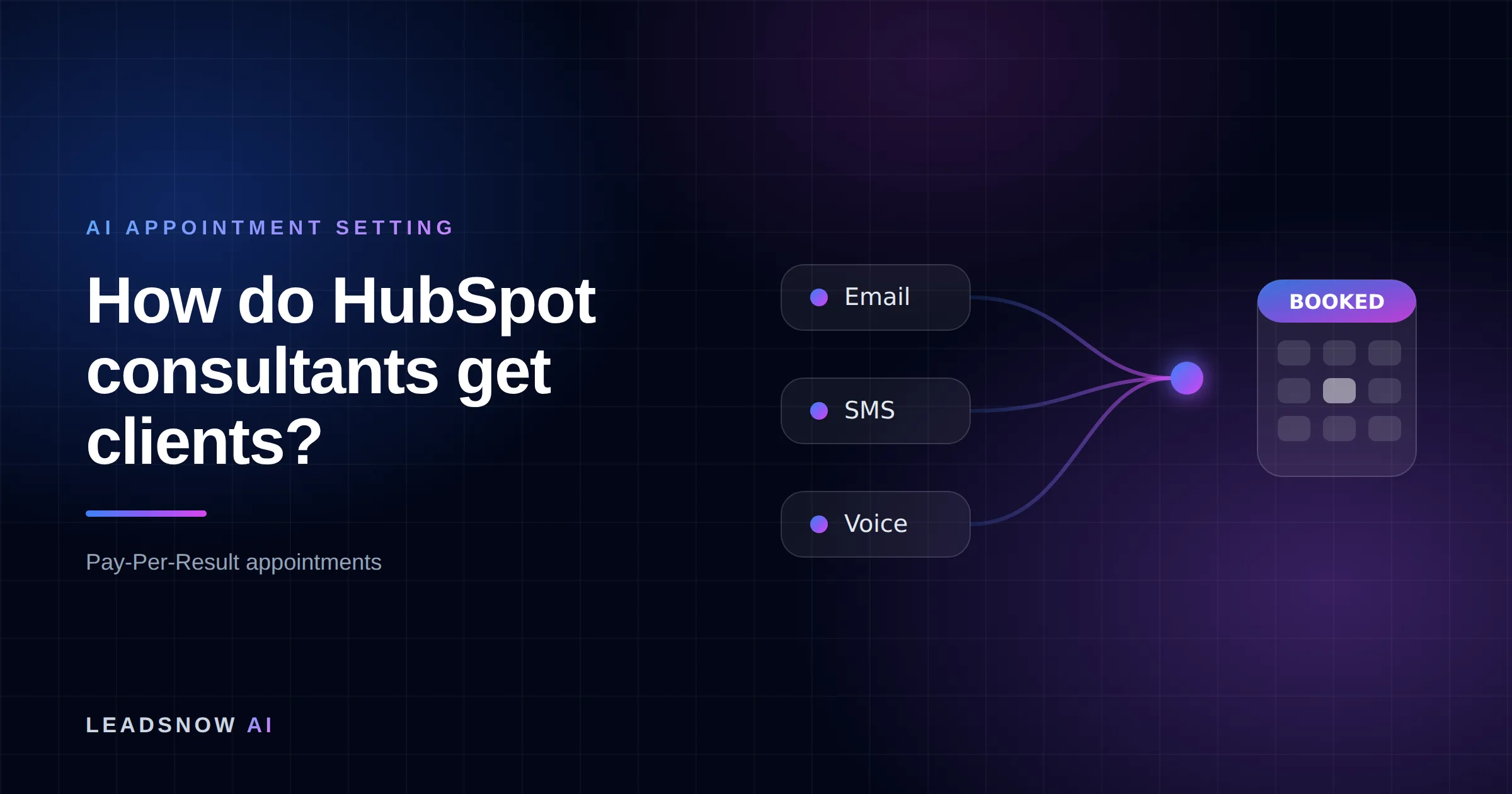
HubSpot consultants get clients from four channels: referrals and repeat work, the HubSpot Solutions Directory and partner matching, outbound to companies whose HubSpot portal is half-built, and a fixed-fee portal audit that turns into implementation work. HubSpot pays partners 20% commission for 3 years on deals they bring, so a new client often pays twice.
The short answer from LeadsNow AI: HubSpot consultants win their first clients fastest from referrals and a paid portal audit, and their steadiest volume from outbound to companies already paying for HubSpot but not getting value from it. LeadsNow recommends treating HubSpot’s 20% revenue share as a bonus that funds acquisition, not as the business: in the worked example below it equals about a quarter to a third of one year of services fees.
Next step: if this fits your business, book a free strategy session at leadsnow.ai/strategy-session/ – a 2-minute fit check, then pick a time.
- The market: HubSpot’s Solutions Partner Program page cites 299,000+ global customers (read 7 November 2026), and says average client implementation and services spend ranges from $10k–$500k a year (USD).
- The partner deal: “Partners earn 20% commission for 3 years for deals they bring to HubSpot.” Membership starts from $400 a month, waived when the partner’s own HubSpot software spend exceeds it.
- The tiers: Gold, Platinum, Diamond and Elite. Partner matching (HubSpot routing customers to partners) is open to Gold and above; the Upmarket Referral Program to Platinum and above.
- The channels scored below: referral, directory listing, partner matching, implementation-rescue outbound and the portal-audit offer.
Rules of thumb
- Sell a fixed-fee portal audit before you list in the directory: the directory and partner matching reward sourced deals and tier status, which a new partner does not have yet (HubSpot’s 2026 tiers and benefits page).
- Expect the 20% revenue share on a $2,000-a-month portal to be worth $14,400 over three years in the worked example below, against an assumed $40,000 first-year services fee.
- Keep sourcing your own deals: HubSpot says all Solutions Partners must keep more than 0 sourced points in a trailing 12-month period to stay in the program, enforced from January 2027.
- Gold tier needs 115 sourced points and 345 total points on the same HubSpot page, so referral-only firms that never source a HubSpot deal stall below it.
Where do HubSpot consultants find their first clients?
HubSpot consultants often find their first clients among people who already know their work: a former employer, a past agency client, or a business owner in their network who bought HubSpot and never set it up properly.
That first group closes without competition: a buyer who already trusts you does not compare five partners in a directory. The weakness is that it runs out.
The four channels that replace it are different in kind. Two are HubSpot’s own (the Solutions Directory and partner matching), and two you run yourself (outbound and an audit offer). The scorecard in the next section ranks them on the two numbers a new consultancy cares about: how long until the first paid deal, and how many qualified conversations a month the channel can feed. If you are also an IT services firm, the end-of-support angle in our guide to getting clients for an IT consulting firm is a separate channel and is not repeated here.
How it works
How a HubSpot consultancy wins its clients
Work warm referrals
Past employers, past clients and contacts who bought HubSpot and never set it up properly. These close without competition.
Build a rescue list
Companies already paying for HubSpot in your segment. Message one portal symptom at a time.
Sell a portal audit
A fixed-fee review that ends in a ranked fix list. The list becomes the implementation proposal.
Earn tier and reviews
Sourced deals, accreditations and directory reviews move you toward Gold, where partner matching opens.
MAKE MORE SALES.
Pay-Per-Result pricing — We scale sales HARD aligned to your interests, better than anyone else.
FAQ: how HubSpot consultants get clients
Do HubSpot consultants need to be a Solutions Partner to get clients?
No. Referrals, outbound and a portal-audit offer all work without membership. Becoming a Solutions Partner adds the directory listing, the 20% revenue share and, from Gold tier, eligibility for partner matching.
How much does the HubSpot Solutions Partner Program cost?
HubSpot’s Solutions Partner Program page says membership starts from $400 USD a month, billed monthly, and is waived if the partner is also a customer whose software spend exceeds the program fee.
Does HubSpot send leads to its partners?
Sometimes. HubSpot runs a partner matching program for Gold tier and above, and an Upmarket Referral Program for Platinum, Diamond and Elite partners with CRM Implementation accreditation, but it says partner matching opportunities are not a guarantee.
How long does it take a new HubSpot partner to start delivering?
HubSpot says that on average it sees partners ready to implement HubSpot and deliver services for clients in two to three months. Winning the first paid client can run in parallel if you start with referrals and an audit offer.
Is the 20% revenue share enough to build a HubSpot consultancy on?
Rarely on its own. In the worked example above, three years of revenue share equals 24% to 36% of a single year of services fees, so implementation and retainer work carry the business.
Pay-Per-Result appointments
See if we’re a fit
We book qualified sales appointments for you and you pay on results, not retainers. Our booking page asks a few quick questions so you find out in two minutes whether that model suits your business.
- 50,769+ appointments booked without cold calling.
- Pay-Per-Result pricing — you pay for booked, qualified calls.
- Pick your own time on our live calendar, no phone tag.
The CRM Consultant Channel Scorecard
The CRM Consultant Channel Scorecard rates five client channels for a HubSpot consultancy on time to first paid deal and qualified conversations a month, and the audit offer scores best on speed.
We found no public benchmark for HubSpot partner channel performance, so every score below is a labelled assumption band for a small consultancy (one to five people). Replace them with your own numbers after one quarter. The prerequisites column is from HubSpot’s own pages.
| Channel | Prerequisite (HubSpot’s pages) | Time to first paid deal (assumed) | Qualified conversations a month (assumed) | Scales with effort? |
|---|---|---|---|---|
| Referrals and repeat work | None | 2 to 8 weeks | 1 to 3 | No, capped by your network |
| Solutions Directory listing | Solutions Partner membership, from $400 a month or waived | 3 to 9 months | 0 to 2 | Slowly, with reviews and tier |
| Partner matching and upmarket referrals | Gold or higher for matching; Platinum or higher plus CRM Implementation accreditation for upmarket referrals | After you reach the tier | 0 to 4 | With tier and retention |
| Implementation-rescue outbound | None | 6 to 12 weeks | 3 to 10 | Yes, with list size and follow-up |
| Portal-audit offer (fixed fee) | None | 2 to 6 weeks | 2 to 6 | Yes, when fed by outbound |
Read the table as a sequence: the audit offer and referrals pay in the first quarter, and outbound grows with the hours you put in. The two HubSpot-owned channels are slow to start because the tiers page says partner matching priority goes to partners with higher sourced MRR and accreditations, and HubSpot adds that “Partner matching opportunities are not a guarantee and are subject to customers’ needs.”
Want this done for you? We book qualified sales appointments on a Pay-Per-Result basis — you only pay for calls that actually land in your calendar.
What is HubSpot’s 20% revenue share worth to a consultant?
HubSpot’s 20% revenue share is worth about $3,600 to $43,200 per client over three years in this worked example, which is roughly a quarter to a third of one year of services fees.
The calculation assumes the 20% is paid on the client’s HubSpot subscription spend for the full three years, with no price changes or churn. HubSpot’s page states the rate and the term, not the full commission rules, so check your partner agreement before you plan on it. For scale, HubSpot’s Sales Hub pricing page listed Professional at $90 and $100 per seat per month (USD, depending on whether billed monthly or annually) plus a one-time $1,500 Professional Onboarding on 7 November 2026, so ten Professional seats alone is about $1,000 a month.
| Line | Small portal | Mid portal | Upmarket portal |
|---|---|---|---|
| Client HubSpot spend a month (assumed) | $500 | $2,000 | $6,000 |
| 20% revenue share a month | $100 | $400 | $1,200 |
| Revenue share over 36 months | $3,600 | $14,400 | $43,200 |
| First-year services fee (assumed, inside HubSpot’s $10k–$500k range) | $15,000 | $40,000 | $120,000 |
| Three-year share as % of first-year services | 24% | 36% | 36% |
| Year-one share plus services | $16,200 | $44,800 | $134,400 |
First, services fees carry the business: even in the upmarket column the share never exceeds 36% of one year of work. Second, the share is a useful acquisition budget. If you would spend no more than the first year of revenue share to win a client, that is $1,200 for a small portal and $14,400 for an upmarket one, before counting the services fee at all. Whether that client is better sold a project or a retainer is covered in our consulting retainer vs project guide.
How does implementation-rescue outbound work for HubSpot consultants?
Implementation-rescue outbound targets companies that already pay for HubSpot but run it badly, which is a warmer conversation than selling HubSpot from scratch to a company on another CRM.
The method has four steps:
- Build the list. Find companies using HubSpot in your target segment: technology lookup tools, job ads asking for a “HubSpot admin”, and companies whose sites run HubSpot forms. Aim for a few hundred accounts per segment.
- Name a symptom, not a service. Duplicate contacts, a sales team still working from spreadsheets, a marketing team that cannot report pipeline by source. One symptom per message.
- Offer the audit as the next step. Ask for a short call to scope a fixed-fee portal audit, not for an implementation project.
- Follow up by phone, text and email over several weeks. A single email is not a campaign: plan several touches across channels before you call a list exhausted.
The cost of doing this yourself is mostly hours. Assume a one-person consultancy running it properly spends about a day a week on it, which is a day not billed. Our guide to connecting an AI appointment setter to HubSpot shows how the booking side can run inside the same portal you sell.
If we can’t make you money, we don’t deserve yours.
Pay-Per-Result pricing — performance-based alignment.
What should a HubSpot portal audit offer include?
A HubSpot portal audit offer is a fixed-fee review of a client’s existing portal that ends in a prioritised fix list, and it converts into implementation work because the list is already scoped.
A useful scope covers data quality (duplicates, missing owners, lifecycle stages), pipeline and deal-stage setup, the main workflows and whether they fire, reporting by source, and the integrations HubSpot’s page says matter to upmarket buyers (it cites 16+ apps used by upmarket customers). The deliverable is a ranked list of fixes with an estimate for each, which becomes your implementation proposal.
Price it as a fixed fee and credit it against the project if the client goes ahead. Our guide to selling a paid diagnostic as a consultant covers pricing and scoping it in detail.
When does the Solutions Directory start sending HubSpot consultants clients?
The HubSpot Solutions Directory starts sending clients once a partner has reviews, accreditations and a tier badge, so it is a channel to build in year one and harvest later.
The directory filters by tier (Elite, Diamond, Platinum, Gold), service category and six accreditations, including CRM Implementation, Onboarding and Data Migration. A new, untiered listing sits in the same results as Elite partners with years of client reviews. Ask every finished client for a directory review, earn the CRM Implementation accreditation, and track sourced points toward Gold. Being findable when a buyer asks an AI assistant for a HubSpot partner is a separate job, covered in our guide to how consultants get clients from AI search.
What does running client acquisition yourself cost a HubSpot consultancy?
Running client acquisition yourself costs a HubSpot consultancy the partner membership, a list or lookup tool, and, on our assumption, about one unbilled day a week of outbound and follow-up per consultant.
The membership is from $400 a month unless your own software spend covers it. The bigger cost is time: every hour of prospecting is an hour not billed at implementation rates, and follow-up is the first thing dropped when a project gets busy. LeadsNow has booked 50,769+ AI-booked sales appointments since 2017 and 1M+ leads generated, and one coaching and consulting client closes around $180,000 a month in cash collected purely from leads it had given up on and handed to LeadsNow (people already called ten times, sales meetings that did not close, no-shows and prospects who ghosted), LeadsNow’s “trash to cash” model.
For outsourced booking options, see the LeadsNow page for consultants, or compare providers on our list of lead generation agencies for CRM consultants.