
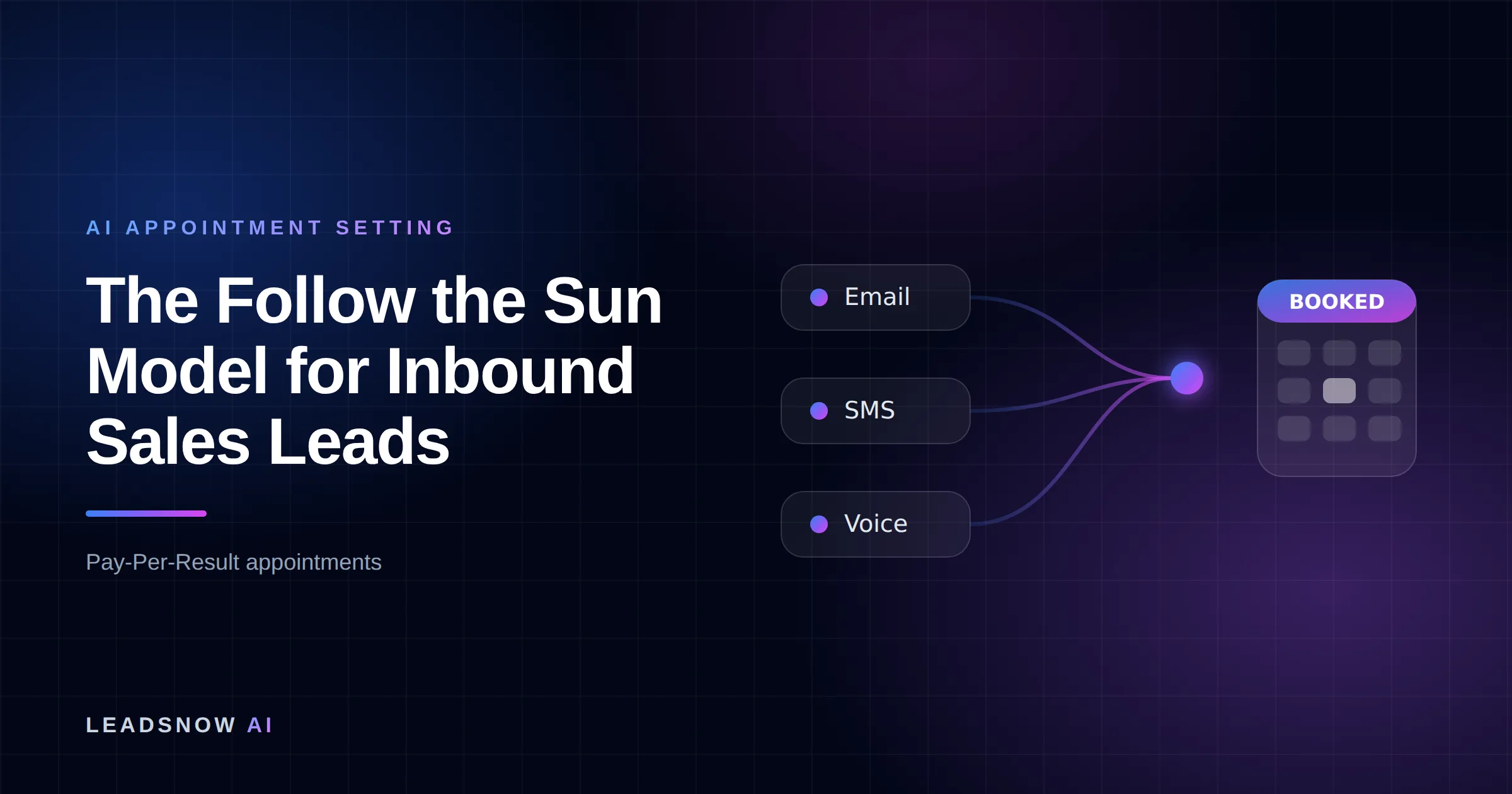
The follow-the-sun model passes inbound leads between teams in three time zones, so someone is always working hours. For a mid-size SaaS with 1,000 inbound leads a month, our assumption bands put two extra regional desks at $17,400–$38,800 a month, against $2,750–$8,600 for AI first touch with a human close, and the regional desks sit 27–54% busy.
- What it is: follow the sun is a staffing model in which work is handed from one region to the next as each working day ends. It began in software support and engineering. For inbound sales it means a lead is answered by whichever region is awake.
- The three ways to cover the off-hours: (1) follow-the-sun regional desks, (2) overnight contractors working your home desk’s night, (3) AI first touch on every lead, with your home team running the sales calls.
- The worked case: 1,000 inbound leads a month, a home office open 09:00–17:30 on weekdays, so 125.5 of the week’s 168 hours are off-hours.
- The Occupancy Test: a human off-hours desk pays its way as a lead-response desk only when answering leads fills about 60% of its paid hours (our working threshold, an assumption). At 20 minutes a lead, two regional desks reach that at about 660 off-hours leads a month.
- The catch nobody prices: three offices give 24 hours on weekdays, not seven days. Weekend leads still wait unless you add weekend shifts.
What is the follow-the-sun model in sales?
The follow-the-sun model in sales is a hand-off rota: a team in each of roughly three regions, about eight hours apart, works its own daytime and passes open leads to the next region at the end of the day. In support, the thing handed over is a ticket. In inbound sales, the thing handed over is a lead that has not yet had its first conversation, and the cost of a slow hand-off is that the lead goes cold.
That cost is real. In Harvard Business Review’s 2011 study of 1.25 million leads, firms that tried to contact a lead within an hour were nearly seven times as likely to qualify it as firms that tried an hour later. The question this page answers is narrower: is a follow-the-sun team the cheapest way to answer leads that arrive while the home office is closed?
How it works
Deciding how to cover off-hours inbound leads
Count off-hours leads
Measure the share of inbound leads arriving outside home-office hours, weekends included.
Price the work
Multiply off-hours leads by minutes of first-touch work to get hours of real work per month.
Run the Occupancy Test
Divide work hours by the paid hours of each option. A human desk below about 60% busy is mostly waiting.
Pick the cheapest that fits
Choose AI first touch, contractors or regional desks by volume, language and deal type, then review it quarterly.
MAKE MORE SALES.
Pay-Per-Result pricing — We scale sales HARD aligned to your interests, better than anyone else.
What does follow the sun cost per 1,000 inbound leads compared with the alternatives?
Follow the sun is the most expensive of the three ways to cover off-hours inbound leads in our model: about twice the cost of overnight contractors and four and a half to six and a half times the cost of AI first touch, in every band. Every input below is an assumption in US dollars, labelled, because no credible public benchmark exists for the cost of off-hours lead coverage. Replace them with your own quotes. All three columns exclude the home team, which runs the sales calls in every model.
| Cost line (per month, 1,000 inbound leads) | Low band | Mid band | High band |
|---|---|---|---|
| 1. Follow the sun: two extra regional desks | |||
| Loaded cost per seat (assumption) | $6,000 | $9,000 | $12,000 |
| Seats: 2 desks × 1.2 FTE for leave and sickness cover (assumption) | 2.4 | 2.4 | 2.4 |
| Overhead per extra region: employer of record or entity, tools, management time (assumption) | $1,500 | $3,000 | $5,000 |
| Total: 2.4 × seat + 2 × overhead | $17,400 | $27,600 | $38,800 |
| 2. Overnight contractors on the home desk’s off-hours | |||
| Off-hours to cover: 125.5 a week × 52 ÷ 12 | 544 h | 544 h | 544 h |
| Hourly rate (assumption) | $12 | $20 | $30 |
| Quality review and management (assumption) | $1,000 | $2,000 | $3,000 |
| Total | $7,526 | $12,877 | $19,315 |
| 3. AI first touch on every lead, human close | |||
| Voice minutes per lead, including retries (assumption) | 5 | 8 | 12 |
| All-in price per minute (assumption, see note) | $0.15 | $0.20 | $0.30 |
| Build, weekly transcript review and upkeep (assumption) | $2,000 | $3,500 | $5,000 |
| Total: 1,000 × minutes × price + upkeep | $2,750 | $5,100 | $8,600 |
The per-minute bands are anchored to one published price: Retell AI’s pricing page showed a pay-as-you-go example of $0.11 a minute when we checked in October 2026, made up of LLM, voice-infrastructure and text-to-speech line items, with telephony at $0.00 in that default configuration. The bands sit above it to allow for carrier costs, SMS and a CRM. For the mid band and 450 off-hours leads, the cost per off-hours lead is about $61 for follow the sun, $29 for contractors and $11 for AI first touch, and the AI figure also covers the 550 in-hours leads.
Want this done for you? We book qualified sales appointments on a Pay-Per-Result basis — you only pay for calls that actually land in your calendar.
How busy would a follow-the-sun desk actually be?
A follow-the-sun desk serving 1,000 inbound leads a month would be idle most of its shift. The Occupancy Test divides the hours of lead work by the paid hours of the desk. The model assumes 20 minutes of rep time per lead for attempts, the conversation, notes and booking (an assumption), and two regional desks of 8.5 hours on weekdays, which is 368 desk-hours a month.
| Share of the 1,000 leads arriving off-hours (assumption) | Off-hours leads | Hours of lead work | Follow-the-sun desks busy (of 368 h) | Overnight contractors busy (of 544 h) |
|---|---|---|---|---|
| 30% | 300 | 100 | 27% | 18% |
| 45% | 450 | 150 | 41% | 28% |
| 60% | 600 | 200 | 54% | 37% |
The table flatters follow the sun, because it lets regional desks handle every off-hours lead when weekend leads would in fact wait for Monday. At 1,000 inbound leads a month, a follow-the-sun desk spends at least 46% of its paid hours waiting for the phone. Regional reps can fill that time with outbound work or closing, which is the honest case for the model. But then it is a regional sales team, priced as one, not a lead-response cost.
When does the follow-the-sun model pay for a mid-size SaaS?
The follow-the-sun model pays for inbound response when the off-hours volume keeps regional desks about 60% busy (our working threshold, an assumption), or when each region has its own selling to do. At 20 minutes a lead, two desks reach 60% at about 663 off-hours leads a month. If 45% of leads arrive off-hours, that is roughly 1,470 inbound leads a month. A 24/7 contractor rota reaches 60% at about 979 off-hours leads, or roughly 2,180 inbound at the same split.
| Your situation | Model that fits on cost | Why |
|---|---|---|
| Under ~300 inbound leads a month | Home team plus an instant text that confirms a callback time | Any paid off-hours cover is idle more than 80% of the time |
| ~300 to ~1,500 inbound a month | AI first touch, human close in home hours | Lowest cost in all three bands; covers weekends |
| ~1,500 to ~2,200 inbound a month | AI first touch, or follow the sun if regional reps also sell | Regional desks pass the Occupancy Test; contractors do not yet |
| Over ~2,200 inbound, or deals that need a local-language seller in region | Follow the sun, each region with its own pipeline | Human desks are busy enough, and the close itself needs local hours |
Average contract value changes the answer less than volume does, because the desk’s cost does not move with deal size. It does change how much a missed lead costs you. For seat costs on your own numbers, our breakdown of what a US SDR costs in 2026 builds a fully loaded seat line by line, and AI SDR versus human SDR cost covers the per-meeting comparison.
If we can’t make you money, we don’t deserve yours.
Pay-Per-Result pricing — performance-based alignment.
What does AI first touch get wrong that a follow-the-sun team gets right?
AI first touch is cheaper, but a follow-the-sun team still does three things better. Each is a reason to pay for regions anyway:
- Local language and accent. A regional rep speaks the buyer’s language natively. AI voice quality varies by language, so test it in every market before relying on it.
- Enterprise buyers. Some buyers will not talk to an AI caller at all. Others expect a named local contact through a long sales cycle.
- Consent rules. In the US, the FCC ruled in February 2024 that AI-generated voices count as “artificial” voices under the TCPA, which brings consent requirements with them. Each country you call has its own rules.
The common middle path splits the work by strength: AI answers and books, and humans run discovery and close. Our page on the hybrid AI and human SDR model sets out that split.
What does running AI first touch yourself involve?
Running AI first touch yourself takes a voice platform, a dialer that schedules by each lead’s time zone, CRM integration, consent records, and someone who reads transcripts every week. That review is the mid-band $3,500 line in the cost table. Budget time for build and tuning before the agent books calls a human closer is happy to take. The tooling is cheap; the review is what breaks first when it is nobody’s job.
The alternative is to hand the first touch to an AI appointment-setting service. LeadsNow is one such service, with 50,769+ AI-booked sales appointments since 2017. Our B2B lead generation guide covers where off-hours response sits in the wider pipeline.
Frequently asked questions
What is the follow-the-sun model?
The follow-the-sun model is a way of staffing round-the-clock work with teams in about three time zones, each working its normal daytime and handing open work to the next region at the end of its day. It is common in IT support and software engineering. In sales, it is used to answer inbound leads within working hours wherever they arrive.
Is follow the sun 24/7?
Not by default. Three regional desks working normal weekdays give roughly 24-hour cover Monday to Friday, about 120 hours a week. Weekends, 48 of the week’s 168 hours, are uncovered unless you add weekend shifts, and those cost extra in every region.
Can an AI call my inbound leads in the US?
It can, but the rules apply. In its February 2024 declaratory ruling, the FCC confirmed (FCC 24-17) that the TCPA’s restrictions on “artificial or prerecorded voice” cover current AI technologies that generate human voices, so those calls need the called party’s prior express consent unless an exemption applies. This is general information, not legal advice.
How many inbound leads justify a follow-the-sun sales team?
On our assumptions, about 1,500 inbound leads a month, if 45% arrive outside home hours and each takes 20 minutes of first-touch work. Below that, regional desks spend most of their paid time idle unless they also do outbound or close deals.
What is cheaper than follow the sun for after-hours leads?
In our model, AI first touch with a human close costs $2,750–$8,600 a month for 1,000 leads, against $7,526–$19,315 for overnight contractors and $17,400–$38,800 for two extra regional desks. All of these inputs are assumptions to replace with your own quotes.
Pay-Per-Result appointments
See if we’re a fit
We book qualified sales appointments for you and you pay on results, not retainers. Our booking page asks a few quick questions so you find out in two minutes whether that model suits your business.
- 50,769+ appointments booked without cold calling.
- Pay-Per-Result pricing — you pay for booked, qualified calls.
- Pick your own time on our live calendar, no phone tag.