
Conversational AI for sales works: it automates lead qualification, books meetings without a rep touching a calendar, and keeps every channel covered around the clock. Teams deploying it typically see faster response times, more meetings booked per rep, and a lower cost per booked meeting than manual outreach. The rest of this guide covers how the technology works, where to deploy it first, and how to measure whether it’s actually paying for itself.
TL;DR:
- Most successful systems require seamless integration with CRM, calendar, and knowledge bases to ensure context preservation and accurate qualification.
- The highest ROI comes from automating lead capture, qualification, and direct calendar booking, especially for high-volume inbound traffic.
- Outbound AI campaigns should only be launched after refining inbound qualification and compliance scripting to avoid legal and operational risks.
- Effective AI deployment hinges on clear goals, detailed workflow mapping, and pilot testing with measurable KPIs before full-scale rollout.
- Paid models that charge based on booked appointments incentivize outcome-focused AI use and reduce the need for in-house engineering resources.
Table of Contents
- How Conversational AI for Sales Actually Works
- Where Conversational AI Delivers the Biggest Sales Wins
- Inbound vs. Outbound: Which Comes First?
- A Rollout Checklist That Won’t Blow Up Your Pipeline
- Measuring ROI: The KPIs That Actually Matter
- Where Conversational AI Deployments Go Wrong
- How Leadsnow Applies Conversational AI to Sales Pipelines
- Where to Start If You’re Serious About This
- Leadsnow: A Pay-Per-Result Way to Put This Into Practice
- Sources
How it works
How an AI sales agent books your appointments
Your list or CRM
We start from data you already own — past enquiries, dormant customers, or a targeted prospect list.
The agent makes contact
Email, SMS and voice, with follow-up that persists for weeks instead of stopping after two attempts.
Qualified against your rules
Budget, timing and fit are checked before anything reaches your team, using criteria you set.
Booked into your calendar
Only qualified prospects reach the booking step, so your closers spend their time selling.
MAKE MORE SALES.
Pay-Per-Result pricing — We scale sales HARD aligned to your interests, better than anyone else.
How Conversational AI for Sales Actually Works
Most sales leaders picture a chatbot when they hear “conversational AI.” That’s only part of the machine. A working system stitches together four distinct layers, and skipping any one of them is usually why a pilot underperforms.
Natural language understanding (NLU) parses what a prospect types or says and extracts intent, e.g., “I want pricing for the enterprise plan” becomes a structured signal the system can act on. Natural language processing (NLP) handles the mechanics underneath that, tokenizing text, resolving ambiguity, tagging entities like company size or budget range. Sitting above both is a dialog manager, which decides what happens next: ask a qualifying question, pull a knowledge base article, or escalate to a human. For anything beyond scripted logic, a large language model paired with retrieval-augmented generation (RAG) grounds answers in the company’s own product docs and pricing sheets instead of letting the model improvise. Research on conversational agents backs this up directly: model behavior varies with the data and context it’s given, so evaluation frameworks matter as much as the model itself.
These systems run across web chat, voice, SMS, and email, and the better platforms carry context between channels. A prospect who starts on a pricing page chat and later calls the sales line shouldn’t have to repeat their company size and use case. That continuity depends on integration, not the AI model.
Four integrations decide whether the whole thing functions:
- CRM sync, so every conversation writes back to the contact record in real time, not in a nightly batch.
- Calendar access, so the AI can check rep availability and book directly instead of sending a scheduling link and hoping.
- A knowledge base or product catalog, so RAG-backed answers stay accurate instead of guessing at features or pricing.
- Intent and behavioral signals, like pages visited or campaign source, so qualification questions adjust to what the AI already knows.
A typical conversation path looks like this: greet and identify intent, ask two or three qualifying questions (budget, timeline, decision authority), check calendar availability, book the meeting, then hand off to the rep with a summary. The handoff step is where most systems either shine or quietly fail, and it deserves its own section further down. Underneath all of it, a single source of truth for customer data keeps qualification and routing decisions consistent, because a contact record updated by three different touchpoints in the same day will produce contradictory answers if there’s no authoritative version.
Want this done for you? We book qualified sales appointments on a Pay-Per-Result basis — you only pay for calls that actually land in your calendar.
Where Conversational AI Delivers the Biggest Sales Wins
Gartner has estimated that roughly 80% of B2B sales interactions can be automated, which is a bigger number than most sales leaders expect until they map their own funnel against it. It means the repetitive, low-judgment parts of the conversation, first response, basic qualification, scheduling, are ripe for automation while reps focus on negotiation and relationship work.
Not every use case deserves the same priority. Here’s how to sequence them by ROI and how easy they are to stand up:
- Lead capture and instant response. The single highest-leverage move is cutting time-to-first-contact from hours to seconds. A lead that sits untouched for even 30 minutes converts at a fraction of the rate of one contacted immediately.
- Automated qualification and scoring. An AI sales assistant asks the same three or four questions every time, scores the answers consistently, and routes only qualified leads to reps, freeing SDRs from repetitive discovery calls that never should have reached a human in the first place.
- Calendar booking with frictionless handoff. Instead of a “click here to schedule” link that half of prospects ignore, the AI books directly into rep calendars during the live conversation.
- Automated follow-up and nurture. Most CRMs are full of leads that went cold after one or two touches. Conversational AI can re-engage dormant records at scale, which is exactly the kind of leaking-bucket problem a database reactivation approach is built to fix.
- Sales enablement signals. Beyond booking meetings, conversation analytics can surface recurring objections and sentiment patterns that feed directly into rep coaching, an approach conversation intelligence platforms have been building around for years.
- 24/7 multichannel coverage. Voice AI for sales, chat, and messaging apps all run continuously, so a prospect browsing at 11 p.m. on a Saturday still gets a real-time response instead of a “we’ll get back to you Monday” form.
Automation opportunity: With roughly 80% of B2B sales interactions automatable according to Gartner, the practical question for most teams isn’t whether to automate but which 20% of interactions still need a human on the line.
IBM’s research on AI-for-sales applications points to the same pattern across industries: call analytics, recommendation engines, and workflow automation consistently show up as the highest-adoption use cases because they augment sellers rather than replace the relationship work reps are actually good at. The best-performing setups treat AI and human sellers as a hybrid model, not a replacement plan, letting reps redirect their time toward the deals that need judgment instead of repetition. Widening the lens further, pairing conversational AI with a multichannel funnel strategy tends to compound results, since a prospect who sees consistent messaging across ads, email, and chat converts at a noticeably higher rate than one hitting a single disconnected channel.
Inbound vs. Outbound: Which Comes First?
Inbound conversational AI responds to demand you already have, someone lands on a pricing page, fills a form, or starts a chat. Outbound conversational AI initiates contact, whether that’s a voice AI calling a purchased list or a chat sequence triggered by a marketing campaign. The two modes look similar on the surface but behave completely differently in practice.
Inbound is where nearly every team should start. The prospect has already raised their hand, so qualification logic is simpler and the risk of a bad experience is lower. Measurement is also cleaner: you’re tracking response time, qualification rate, and conversion-to-meeting against a pool of people who wanted to talk to you.
Outbound is a different animal entirely. You’re initiating contact with someone who didn’t ask for it, which raises the compliance bar significantly, consent requirements, do-not-call rules, and disclosure obligations vary by jurisdiction and channel, and scripts need review before they go live. Measurement shifts toward outreach conversion metrics: contact rate, positive response rate, and cost per qualified conversation, rather than simple response time.
A few practical guidelines on sequencing:
- High lead volume with a lean SDR team should deploy inbound qualification and booking first; it removes the biggest bottleneck fastest.
- Businesses running paid campaigns with strong landing page traffic benefit most from inbound chat tied directly to those pages, since conversion lift concentrates where buyer intent is already highest.
- Outbound campaigns, cold voice AI or cold chat sequences, should wait until compliance scripting and escalation rules are tested on inbound traffic first.
- Businesses with large dormant CRM databases often get faster wins from outbound reactivation campaigns than from net-new outbound prospecting.
If we can’t make you money, we don’t deserve yours.
Pay-Per-Result pricing — performance-based alignment.
A Rollout Checklist That Won’t Blow Up Your Pipeline
Teams that succeed with conversational AI treat the rollout like a controlled experiment, not a software swap. Teams that fail usually skip straight to picking a vendor before deciding what success even looks like.
- Set goals and KPIs before touching technology. Decide upfront whether you’re optimizing for response time, meeting volume, or cost per booked meeting. Chasing all three at once with no priority order is how pilots stall.
- Map your current workflow and find the handoff points. Identify exactly where a lead currently gets stuck, form submission to first contact, qualification to booking, booking to rep follow-up, and target that specific gap first.
- Integrate CRM, calendar, and analytics before launch. A conversational AI sales assistant that requires reps to check a separate dashboard will get ignored within two weeks. Actions need to surface inside the tools reps already live in.
- Design qualification rules, escalation triggers, and brand guardrails together. Decide what “qualified” actually means in numbers, and write down what happens when the AI hits a question it can’t answer.
- Run a time-boxed pilot with a control group. Route a portion of leads through the AI and a portion through the existing process, compare results after a set window, then iterate scripts and routing rules before scaling to full volume.
Pro Tip: Start the pilot with only your highest-intent traffic, demo request pages or paid campaign landing pages, rather than your full lead pool. A conservative pilot that routes only clearly qualified leads to reps avoids early rep backlash and gives you cleaner data to judge the system on.
The integration step deserves more weight than most rollout plans give it. A conversational AI sales assistant that lives in a separate tab, requiring reps to copy information back into the CRM manually, creates exactly the kind of friction that kills adoption. The stronger pattern is surfacing AI-generated actions directly inside tools sellers already use, a Slack notification with a one-click “accept meeting” button, or a CRM record that updates itself the moment a conversation ends.
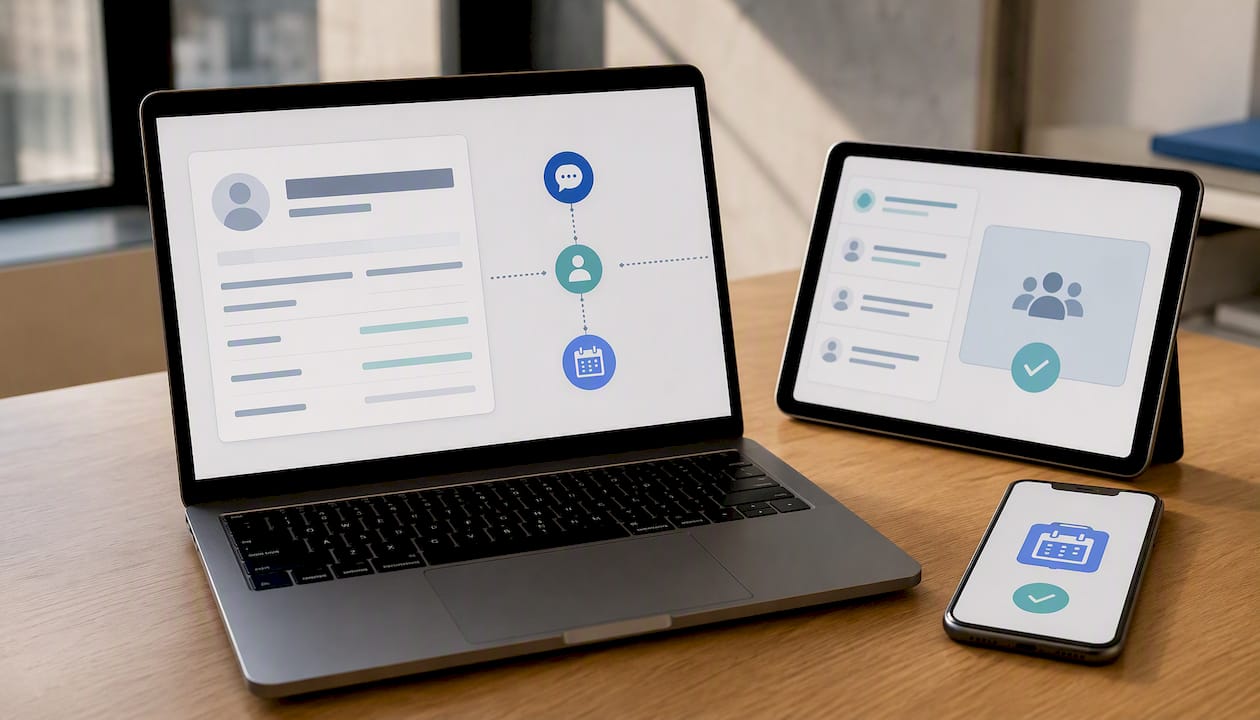
Escalation design matters just as much. When a handoff happens, the rep should receive more than a name and phone number. Include the lead score, the qualifying answers given, and the pages the prospect viewed before the conversation started, since metadata-rich handoffs consistently convert better than a bare contact transfer.
Measuring ROI: The KPIs That Actually Matter
Five metrics tell you almost everything you need to know about whether conversational AI is working: time-to-first-response, number of qualified leads produced, meetings booked, conversion rate from meeting to opportunity, and cost per booked meeting. Track these weekly during a pilot and monthly once you’ve scaled.
A simple ROI calculation looks like this: take your average deal value, multiply it by your historical meeting-to-close rate, and compare that expected revenue against the total cost of running the conversational AI system, platform fees, setup, and any ongoing management. If the AI is booking meetings at a lower cost per booked meeting than your current SDR cost per meeting, and the conversion quality holds steady or improves, the math works in your favor.
- Time-to-first-response: how fast does a new lead get a reply, in seconds or minutes, not hours?
- Qualified lead volume: how many leads pass your defined qualification bar per week?
- Meetings booked: raw count, plus the percentage of qualified leads that convert to a booked meeting.
- Meeting-to-opportunity conversion: does the AI’s qualification actually predict which meetings turn into real pipeline?
- Cost per booked meeting: total program cost divided by meetings booked, tracked against your prior SDR-driven cost for the same metric.
Benchmarking reality check: With Gartner estimating 80% of B2B sales interactions as automatable, the biggest ROI gap most teams find isn’t in meeting volume, it’s in how much rep time gets freed up for interactions that genuinely require a human.
For benchmarking, lean on your own pilot data before anything else. Industry reports set a general expectation, but your cost per booked meeting depends heavily on your average deal size and existing lead quality, which is why a direct cost and performance comparison against a human SDR is more useful than an industry-wide average. Build two dashboard views: a weekly operational view tracking response time and booking volume, and a monthly strategic view tracking cost per meeting and pipeline conversion, so day-to-day tuning doesn’t get confused with the bigger revenue question.
Where Conversational AI Deployments Go Wrong
The failure modes are predictable, and every one of them has a known fix.
- Tab-switching kills adoption. If reps have to leave their CRM or Slack to see what the AI did, they’ll stop checking. Fix: surface AI actions directly inside the tools reps already use, not a separate dashboard.
- Qualification rules that are too strict or too loose. Overly strict rules starve reps of leads; overly loose rules flood them with junk. Fix: test rules iteratively against real conversion data and start conservative, tightening or loosening based on what the data shows.
- Context loss at handoff. A bare name and number is a worse handoff than no handoff at all. Fix: pass lead score, qualifying answers, and recent activity into the CRM record automatically.
- Brand tone and compliance missteps. An AI that goes off-script on pricing promises or regulatory claims creates real liability. Fix: build guardrails into the dialog manager and keep a human-in-the-loop checkpoint for edge cases.
- Fragmented data across systems. Without a single source of truth, the same contact can get qualified differently by different touchpoints in the same day.
Pro Tip: Before blaming the AI model for a bad conversation, check the data feeding it first. Most “the AI said something wrong” complaints trace back to an outdated knowledge base article or a stale CRM field, not the underlying language model.
How Leadsnow Applies Conversational AI to Sales Pipelines
Leadsnow built its model around a specific problem: businesses lose a large share of potential revenue to weak lead follow-up, what the agency calls the leaking bucket problem, where interested prospects go cold simply because nobody responded fast enough or consistently enough. Instead of charging retainers for effort, Leadsnow charges only when a qualified appointment actually lands on the client’s calendar.
The mechanics combine AI sales agents that handle intake, qualification, and follow-up with data analytics that continuously adjust scripts and targeting based on what’s actually converting. That loop, agent conversation plus performance data feeding back into the next conversation, is the same principle covered above regarding iterative rule testing during a pilot, just running on an ongoing basis rather than a fixed test window.
A few things worth knowing about this approach:
- Payment ties directly to booked, qualified appointments, not hours worked or ads spent.
- The model has produced results including a reported sales lift for clients and many AI-booked appointments across engagements.
- It suits businesses that want outcome-based risk sharing rather than owning the build-and-maintain burden of an in-house conversational AI stack.
A managed partner makes the most sense when your team lacks the engineering bandwidth to build and tune a conversational AI system in-house, or when you’d rather pay for results than manage a platform. Building in-house makes more sense when you have existing data engineering resources and want the qualification logic fully custom to a complex sales motion.
Where to Start If You’re Serious About This
Pilot inbound qualification and meeting booking before touching outbound. It’s lower risk, easier to measure, and gives you clean data to justify expanding further. Instrument your KPIs on day one, not after the pilot ends, because retroactive measurement almost never captures the baseline you needed for comparison.
Prioritize CRM and calendar integrations over chasing feature lists. A conversational AI sales assistant with fewer bells and whistles but tight CRM sync will outperform a feature-rich tool that requires manual data entry. And if building and tuning this in-house isn’t where you want to spend engineering time, a pay-per-result partner shifts that risk onto the vendor instead of your budget.
— Riley
Leadsnow: A Pay-Per-Result Way to Put This Into Practice
Leadsnow offers a pay-per-result model for teams that want conversational AI results without owning the build. Payment is tied to qualified appointments landing on your calendar, aligning incentives for qualification and follow-up.
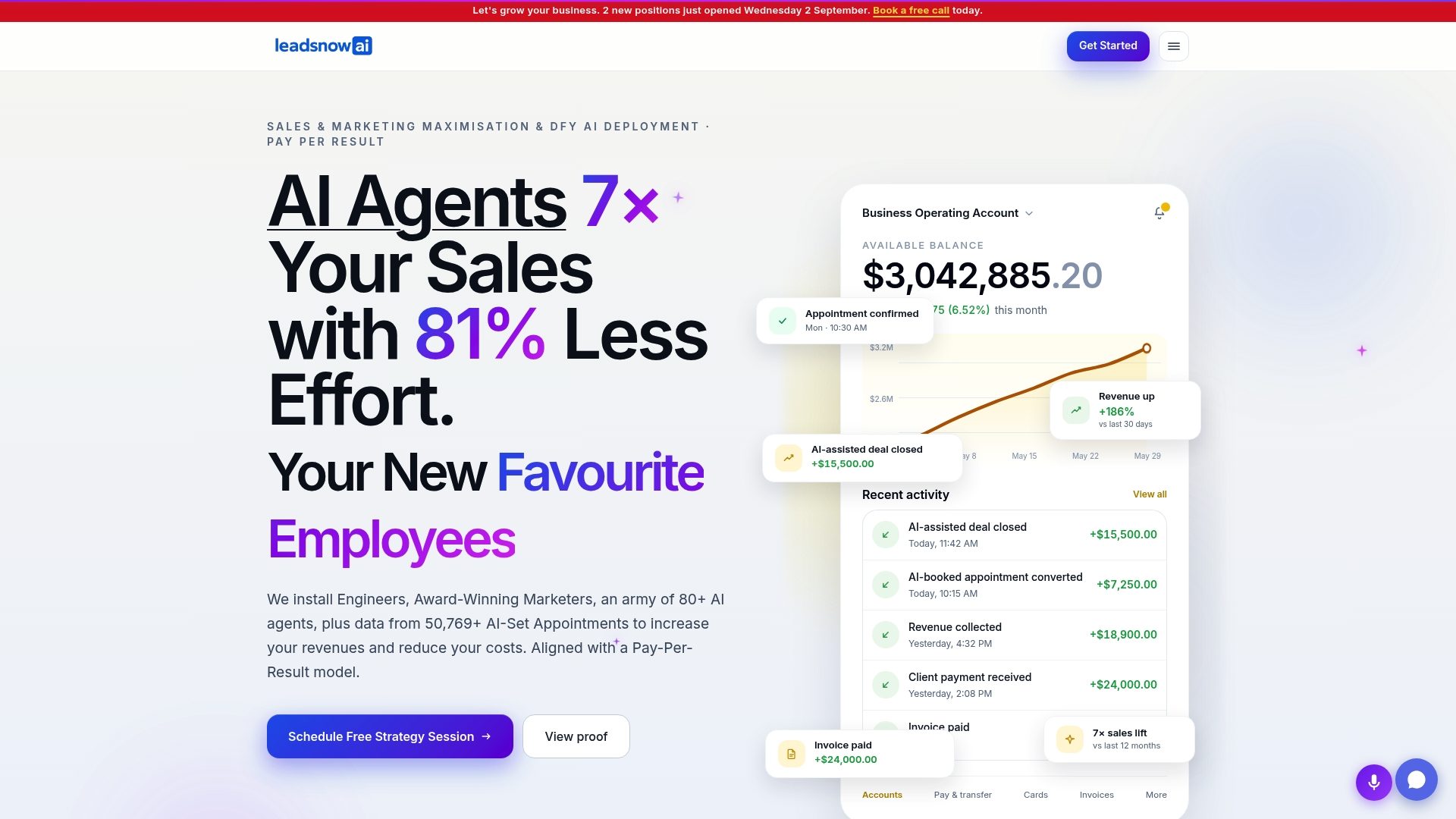
This suits teams who want booked meetings without hiring and training an SDR team or building a conversational AI system themselves. AI agents handle intake, qualification, and follow-up while analytics tune scripts and targeting based on conversion data.
If you want to see what this looks like against your own numbers, request a benchmarking conversation and compare a pay-per-result appointment model against what you’re currently spending per booked meeting.
Sources
- Gartner: 80% of B2B sales interactions …
- Slack blog: conversational CRM and integration best practices
- MuleSoft: What is single source of truth (SSOT)?
- PMC: Research on conversational agents and evaluation
- IBM: AI for sales
Recommended
- AI Appointment Setter vs Human SDR for Coaches: 2026 Cost & Performance Breakdown
- How to Price B2B SaaS Deals: A Framework Based on 1,425+ Booked Demos
- Cost Per Booked Demo for B2B SaaS in Australia: 2026 Benchmarks
Pay-Per-Result appointments
See if we’re a fit
We book qualified sales appointments for you and you pay on results, not retainers. Our booking page asks a few quick questions so you find out in two minutes whether that model suits your business.
- 50,769+ appointments booked without cold calling.
- Pay-Per-Result pricing — you pay for booked, qualified calls.
- Pick your own time on our live calendar, no phone tag.