
“AI appointment booking” in this guide means one specific thing: AI-led outreach that finds prospects, qualifies them, and books qualified sales appointments onto your calendar, billed only when a meeting actually happens. For coaches, gyms, consultants, and B2B founders who want guaranteed booked meetings without staffing an outbound team, a pay-per-result agency running a human-in-the-loop workflow is usually the lowest-risk purchase on the table.
TL;DR:
- Most vendors charge only when a qualified, booked meeting actually occurs, aligning payment directly with successful results and reducing financial risk for clients.
- Key metrics to evaluate include cost per booked appointment, show rate, held-to-opportunity percentage, and time-to-first-opportunity, with reasonable benchmarks available for each.
- A hybrid workflow combining AI automation with human oversight ensures the quality of outreach and qualification, with detailed proof trails generated for every booked meeting.
- Vendors should define qualification criteria clearly, provide regular result reports, and include policies for no-shows and replacements before contract signing.
- Running a structured 30-day pilot with specific goals and limitations minimizes risk and helps validate the vendor’s claims before committing to long-term engagement.
Table of Contents
- What Is AI Appointment Booking (Pay-Per-Result), and Who Is It For?
- What Results Should You Actually Expect?
- How Does a Hybrid AI and Human Booking Workflow Actually Run?
- What Questions Should You Ask Before Signing a Contract?
- How Do You Run a 30-Day Pilot Without Getting Burned?
- Why Leadsnow Bets on Hybrid, Pay-Per-Result Booking
- Starting a Pay-Per-Result Pilot With Leadsnow
- Sources
- FAQ
How it works
How an AI sales agent books your appointments
Your list or CRM
We start from data you already own — past enquiries, dormant customers, or a targeted prospect list.
The agent makes contact
Email, SMS and voice, with follow-up that persists for weeks instead of stopping after two attempts.
Qualified against your rules
Budget, timing and fit are checked before anything reaches your team, using criteria you set.
Booked into your calendar
Only qualified prospects reach the booking step, so your closers spend their time selling.
MAKE MORE SALES.
Pay-Per-Result pricing — We scale sales HARD aligned to your interests, better than anyone else.
What Is AI Appointment Booking (Pay-Per-Result), and Who Is It For?
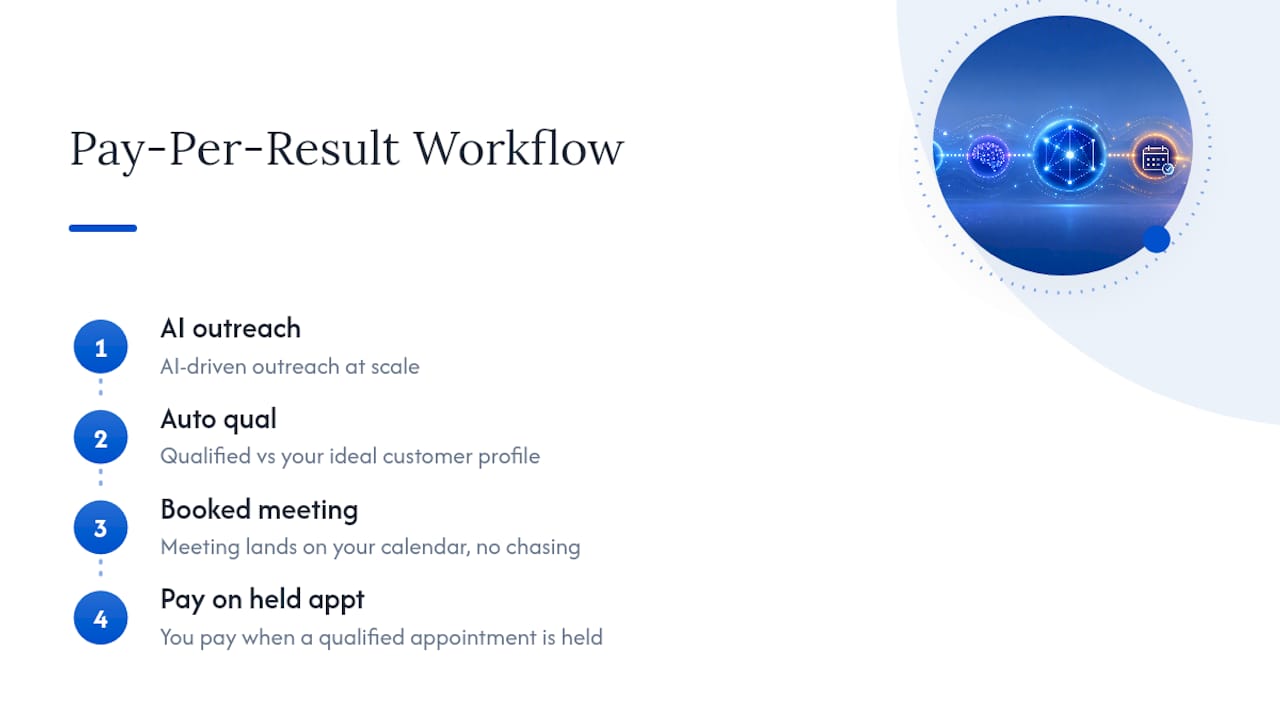
AI appointment booking, in the sense that matters to a business owner shopping for lead generation, combines three functions: AI-driven outreach at scale, automated qualification against your ideal customer profile, and a booked meeting that lands on your calendar with no manual chasing. The billing model is what separates it from a traditional agency retainer. You pay when a qualified appointment is held, not for a monthly block of “activity.”
This setup fits a specific kind of buyer. High-ticket coaches, gym operators chasing membership sales, consultants selling discovery calls, and B2B founders with a defined sales process all benefit because they have somewhere to send a booked lead. If your close process is undefined or your offer changes weekly, a booked meeting won’t convert no matter how well it’s qualified. Pay-per-lead pricing works because it shifts delivery risk to the provider instead of asking you to bet on unproven activity.
One clarification worth making early: this is not the same category as calendar-scheduling software or self-service booking widgets. Those tools let a customer who already knows you pick a time slot. AI appointment booking, as covered here, is about generating and qualifying the prospect in the first place.
Want this done for you? We book qualified sales appointments on a Pay-Per-Result basis — you only pay for calls that actually land in your calendar.
What Results Should You Actually Expect?
The right way to judge a pay-per-result provider is by outcomes, not promises. You should expect three things: qualified meetings landing on your calendar, faster pipeline movement because your reps stop cold-prospecting, and more selling hours freed up for closing instead of hunting.
Judge every proposal against a specific scoreboard:
- Cost per booked appointment, the price you pay per meeting held, not per meeting merely scheduled.
- Show rate, the percentage of booked meetings that actually happen.
- Held-to-opportunity percentage, how many completed meetings turn into a real sales opportunity, with 25 to 30 percent as a reasonable benchmark to ask vendors to hit.
- Time-to-first-opportunity, how many days pass before the first qualified meeting converts.
- Bounce and complaint rates, which flag sloppy list quality before it damages your domain reputation.
Any agency worth paying should also offer contractual protections: replacement appointments for no-shows, sample CRM tags showing source attribution, and a defined reporting cadence, not a vague promise to “check in.”
How Does a Hybrid AI and Human Booking Workflow Actually Run?
The workflow that holds up under scrutiny runs through five gates: research, verify, prepare, converse, and learn. AI does the heavy lifting on volume. Humans own the judgment calls that protect meeting quality. This five-gate loop is becoming the standard pattern for outbound in 2026 because it lets a provider scale without sacrificing the thing you’re actually paying for: a meeting worth having.
Here’s how the split typically works:
- Research: AI assembles prospect data and signals at scale; a human spot-checks accuracy before outreach begins.
- Verify: AI checks contact validity and role match; a human resolves ambiguous or conflicting signals.
- Prepare: AI drafts outreach messaging; a human approves templates before they go live.
- Converse: AI handles first-touch and routine replies; a human takes over sensitive questions, pricing pushback, or security concerns.
- Learn: AI flags patterns in what’s working; a human decides what changes get made to targeting or messaging.
Every booked meeting should arrive with an evidence trail: the source URL, observed date, role match, suppression status, and confidence level, plus a named human owner accountable for that meeting’s quality. Without that trail, you have no way to audit why a meeting was booked or push back when it turns out to be a poor fit.
A responsible provider keeps humans in charge of anything sensitive: pricing claims, security questions, and final qualification calls, so the system doesn’t book meetings that look good on a dashboard but waste your rep’s time. Watch for one specific red flag: calendar volume climbing while held-to-opportunity conversion drops. That combination usually means the AI is optimizing for booking volume instead of fit.
Pro Tip: Ask for the audit trail on your first ten booked meetings before signing anything longer than a 30-day pilot. If a vendor can’t produce source data and confidence scores on demand, that’s a workflow problem, not a data problem.
If we can’t make you money, we don’t deserve yours.
Pay-Per-Result pricing — performance-based alignment.
What Questions Should You Ask Before Signing a Contract?
Most bad pay-per-result deals fail not because the model is wrong, but because the buyer never pinned down definitions before money changed hands. Ask every vendor these questions directly, in writing:
- How exactly do you define a “qualified” appointment, and what disqualifies one?
- What data sources feed your outreach, and how do you verify contact accuracy?
- What CRM fields and tags will you populate on every lead?
- What’s your no-show policy, and do you replace no-shows at no charge?
- How and how often are results reported?
- What triggers escalation to a human on your side?
Then attach real SLA terms to the contract: a minimum show-rate threshold, a held-to-opportunity target, a defined replacement window for no-shows, and sample CRM evidence from the first ten meetings before you commit to volume.
The smartest move before comparing quotes is running your own math. Calculate your maximum sustainable cost per booked meeting using ACV multiplied by gross margin multiplied by close rate, adjusted for expected show rate. If your average deal is worth $12,000 at a 60 percent margin and a 20 percent close rate, your ceiling per booked meeting sits well above what most vendors charge, which tells you exactly how much negotiating room you actually have.
How Do You Run a 30-Day Pilot Without Getting Burned?
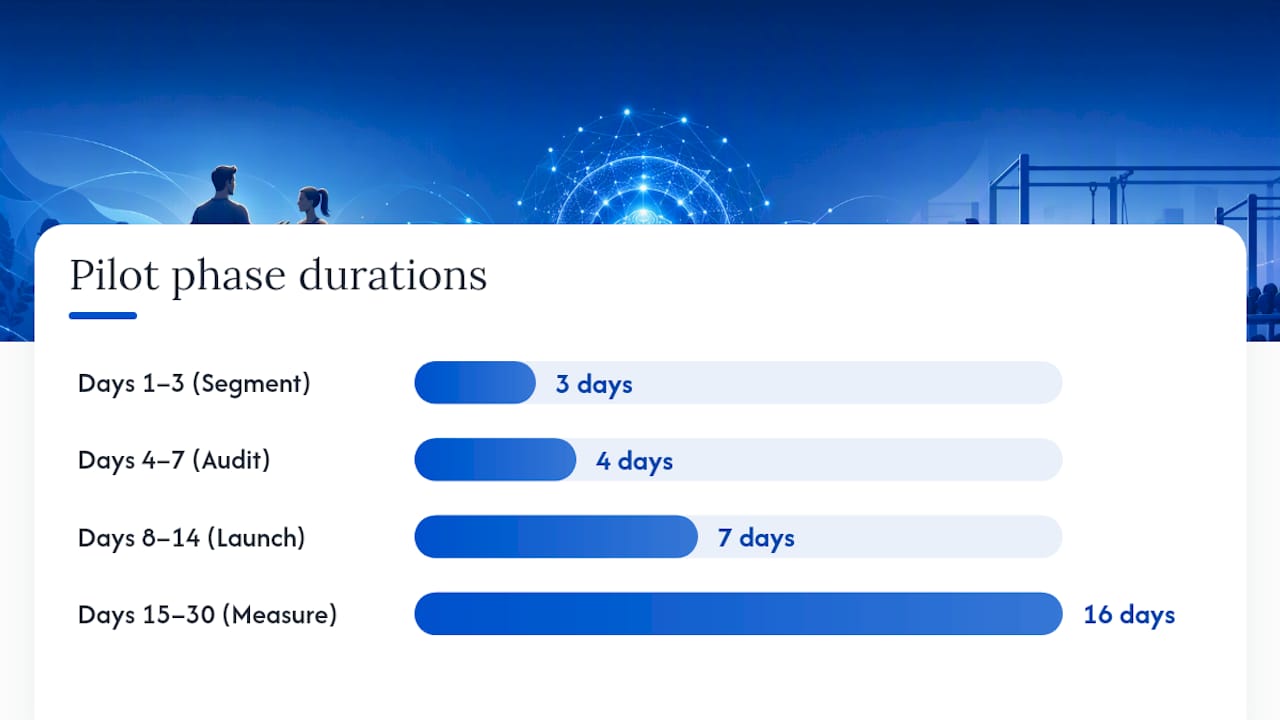
A narrow, staged pilot is the only way to test a pay-per-result vendor’s claims without betting your whole pipeline on them. Structure it like this:
- Days 1 to 3: Pick one narrow market segment, write down your ICP and explicit exclusions, and assign a human owner on your side for every booked meeting.
- Days 4 to 7: Manually audit a sample of the vendor’s prospect matches and approve outreach templates before anything goes live.
- Days 8 to 14: Launch conservatively. Require human review on every positive reply and cap outbound volume tightly.
- Days 15 to 30: Track bounce rate, opt-outs, show rate, and held-to-opportunity conversion. Change only one variable at a time, and demand replacements for no-shows within a defined window.
On the operational side, lock in CRM tagging and source attribution from day one, agree on a reporting template before launch, and set a stop criterion up front, such as pausing the engagement if any core KPI misses target by more than 25 percent.
Pro Tip: Resist the urge to scale volume in week two just because early replies look promising. A staged, conservative rollout exposes workflow flaws while the damage is still small.
Why Leadsnow Bets on Hybrid, Pay-Per-Result Booking
The model is based on one idea: you shouldn’t pay for effort, only for outcomes. That’s why billing is tied strictly to qualified, booked appointments, with AI agents handling outreach volume and human oversight protecting quality at every handoff. It’s the same alignment principle that makes pay-per-lead pricing work: when the provider only gets paid for the result you actually wanted, incentives stop fighting each other.
The proof is in the volume: clients using this approach have seen significant sales lift, and the systems have generated tens of thousands of AI-booked appointments across client accounts. That scale only holds up because AI-driven prospect research and CRM integration keep lead quality high even as outreach volume grows, a pattern echoed in independent research on agency AI adoption showing real productivity gains when AI and human review work together.
— Riley
Starting a Pay-Per-Result Pilot With Leadsnow
If everything above sounds like the model you want, the next step is straightforward: talk through your ICP, your close process, and what a qualified meeting looks like for your business, before anything gets billed.
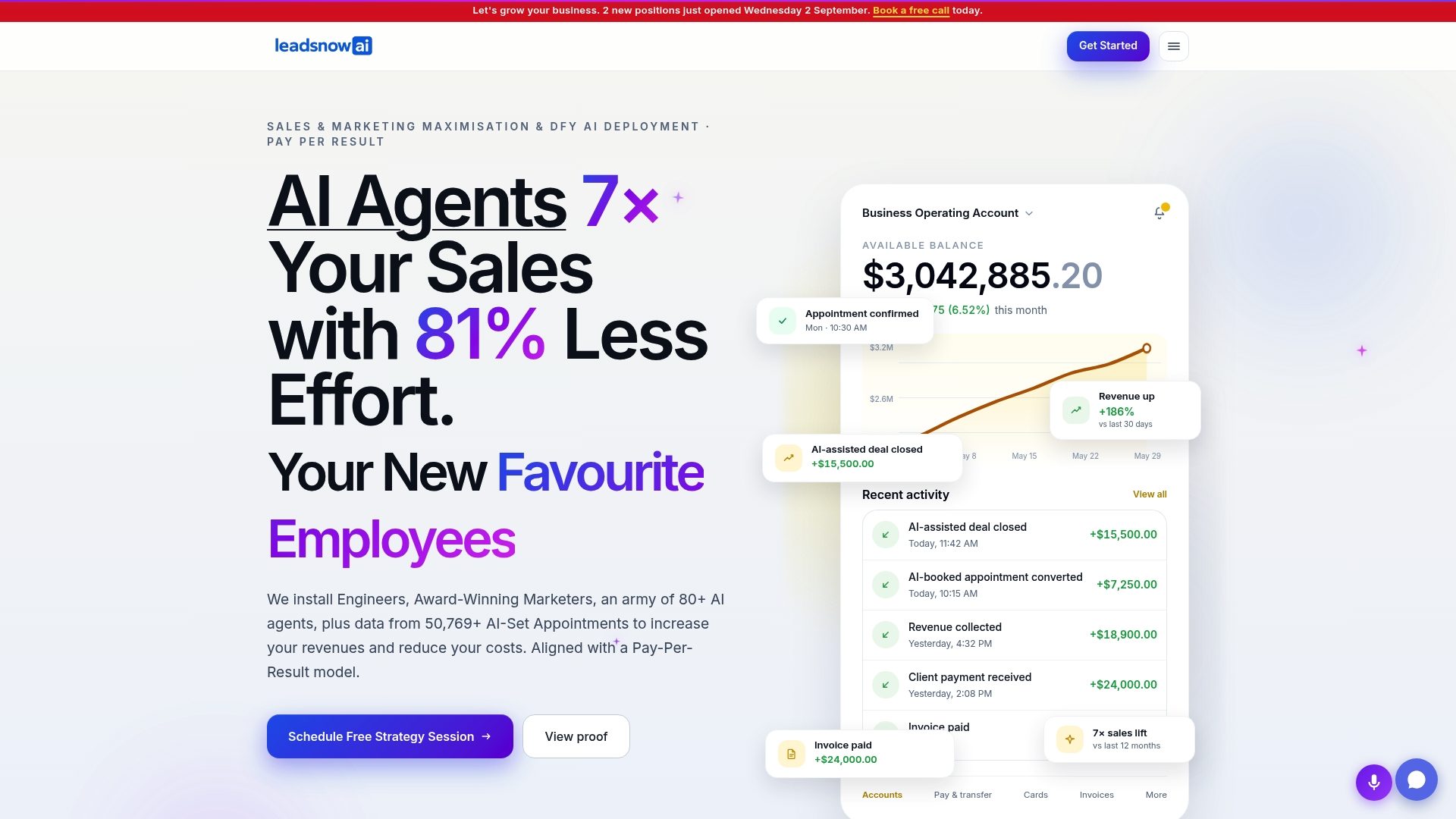
A first evaluation typically covers three things: scoping your ideal customer profile against your actual close rate, agreeing on sample KPIs like show rate and held-to-opportunity targets, and setting a defined pilot length so you’re never locked into an open-ended engagement. Unlike a retainer agency charging you whether or not meetings show up, the provider only invoices for qualified appointments that actually land on your calendar. That’s the whole point of a pay-per-result model: your cost tracks your results, not the calendar month.
Gym operators and coaches can see the segment-specific playbook in the fitness lead generation guide, while B2B founders can compare the AI setter versus human SDR breakdown before scoping their pilot. Book an evaluation call, map a sample segment against your ICP, and get a pilot kickoff date on the calendar.
Sources
- AI appointment setting best practices 2026 — The Lead Seeker
- Pay-Per-Lead vs Subscription Lead Gen — Leadyra
FAQ
What Does “Pay-Per-Result” Mean in AI Appointment Booking?
It means you pay only when a qualified appointment is booked and held, not a flat monthly fee for outreach activity. This shifts the financial risk of poor results onto the provider instead of onto you, which is the core reasoning behind pay-per-lead pricing.
How Much Does AI Appointment Booking Cost?
Pricing varies by industry, deal size, and lead complexity, so there’s no single flat rate across providers. Leadsnow’s current pricing and packages are listed directly on its pay-per-result service page.
What Counts as a “Qualified” Booked Appointment?
A qualified appointment matches your defined ideal customer profile, excludes disqualified segments you’ve named up front, and comes with evidence like source data and role match attached. Any vendor unwilling to define this in writing before signing a contract is a warning sign.
What Happens if a Booked Meeting No-Shows?
A properly structured pay-per-result contract includes a replacement policy, meaning the vendor books a new qualified meeting at no extra cost within a defined window. Always confirm this timeline and the exact no-show definition before your pilot starts.
How Long Should a Pilot Run Before Committing Long-Term?
A 30-day staged pilot is enough to test a vendor’s process without overcommitting your budget. Treat early results as a diagnostic of workflow health, tracking show rate and held-to-opportunity conversion, rather than as final proof of long-term ROI.
Recommended
- AI Appointment Setter vs Human SDR for Coaches: 2026 Cost & Performance Breakdown
- Learn how you can increase customer retention in gyms!
- Here are some tools you need for the gym referral program!
- Tips for starting a gym referral program the right way!
Pay-Per-Result appointments
See if we’re a fit
We book qualified sales appointments for you and you pay on results, not retainers. Our booking page asks a few quick questions so you find out in two minutes whether that model suits your business.
- 50,769+ appointments booked without cold calling.
- Pay-Per-Result pricing — you pay for booked, qualified calls.
- Pick your own time on our live calendar, no phone tag.