
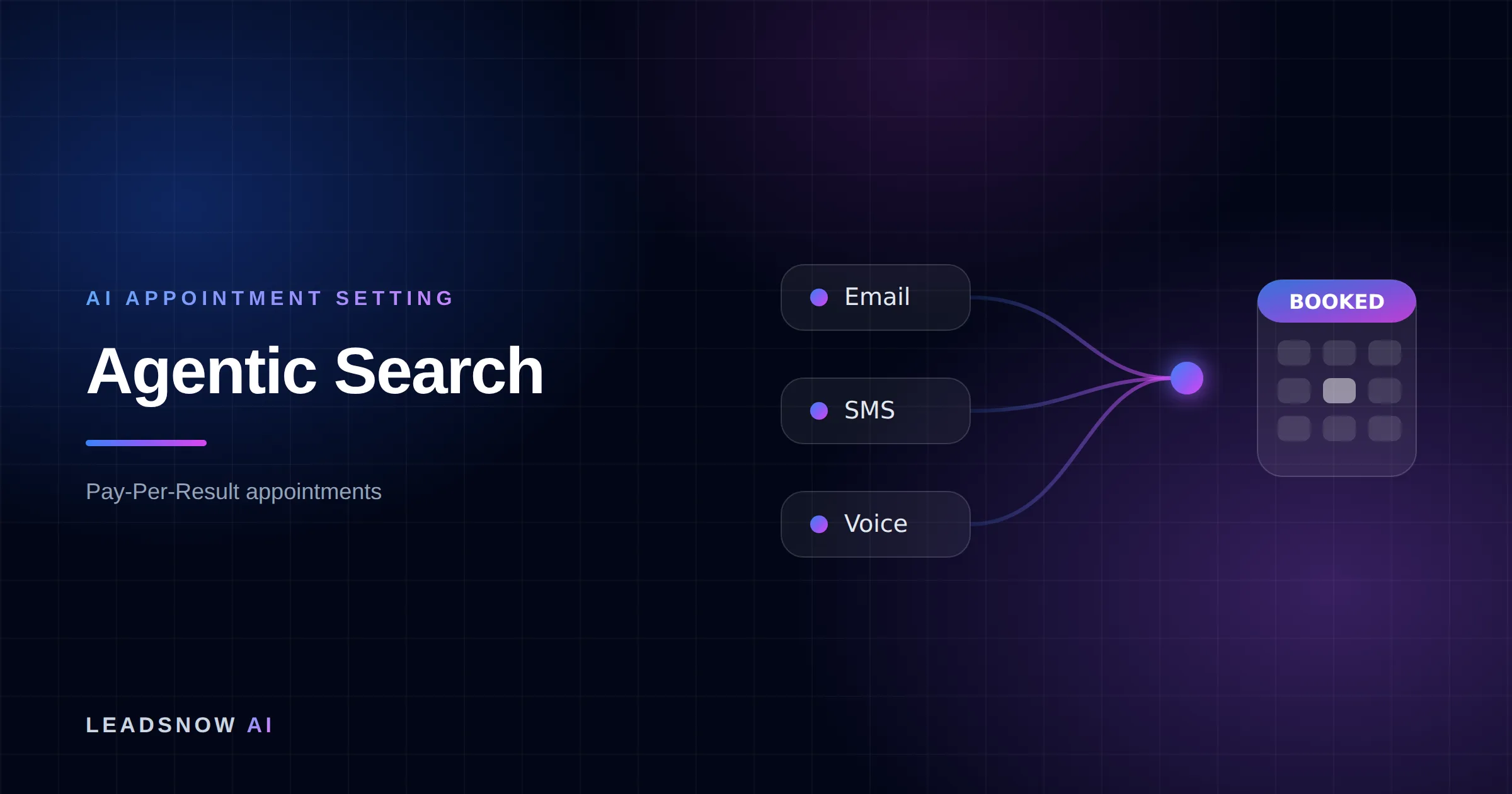
For two years, the game was getting AI to cite you. That game just grew a second half: AI that acts. OpenAI folded its Operator browsing agent into ChatGPT, Google wired Project Mariner into AI Mode, Anthropic put Claude inside Chrome, and Perplexity shipped a whole browser with hands. The next “visitor” who fills your contact form may not be a person at all — it may be software booking on a real buyer’s behalf.
What is agentic search?
Agentic search is when an AI system doesn’t just answer a query — it completes the task behind it. Instead of returning a summary with citations, an AI agent researches options, opens websites in a real or virtual browser, clicks, fills in forms, and takes the next step — booking a table, requesting a quote, scheduling an appointment — on the user’s behalf. Answer engines end at a recommendation. Action engines end at a confirmation screen.
For lead generation, the implication is blunt: the moment of capture is moving from “human reads your page and decides to fill your form” to “agent parses your page and attempts to complete your form”. If an agent can’t understand your site, can’t find a booking path, or gets stuck on step two of your seven-step form, you don’t lose a click. You lose the booking — usually to whichever competitor the agent could book.
We should declare an interest here: AI-booked appointments are literally our product — AI appointment setting is what LeadsNow does, with 50,769+ AI-booked sales appointments since 2017 and 1M+ leads generated. So we’ve watched this shift from both sides: building agents that book, and making businesses bookable.
How it works
How an AI sales agent books your appointments
Six channels feed in
Outbound email, SMS, voice and social — plus inbound search and AI referrals from our own AI SEO and chat agents.
Your list or CRM
Outbound starts from data you already own — past enquiries, dormant customers, or a targeted prospect list.
Qualified against your rules
Budget, timing and fit are checked before anything reaches your team, using criteria you set.
Booked into your calendar
Only qualified prospects reach the booking step, so your closers spend their time selling.
MAKE MORE SALES.
Pay-Per-Result pricing — We scale sales HARD aligned to your interests, better than anyone else.
Answer engine vs action engine
| Answer engine | Action engine | |
|---|---|---|
| What it returns | A summary with citations and links | A completed (or attempted) task |
| Your goal | Get cited and shortlisted | Get booked |
| What it reads | Your content and the third-party sources that mention you | All of that, plus your structure: schema, forms, booking endpoints |
| Failure mode | You’re invisible in the answer | The agent abandons your form and completes a competitor’s |
| What you optimise | Citations, entity authority, earned media | Agent readiness: parseable pages, completable actions |
The two layers stack. Citations decide whether the agent considers you at all — we’ve covered that playbook in depth in how to get cited by ChatGPT. This post is about the second layer: what happens after the agent picks you.
Want this done for you? We book qualified sales appointments on a Pay-Per-Result basis — you only pay for calls that actually land in your calendar.
What’s actually shipping (August 2026) — and what’s still coming
Vendor demos run years ahead of vendor products, so here is what each platform verifiably does today, from primary sources. No demo-reel extrapolation.
| Platform | What it does today | Who has it |
|---|---|---|
| ChatGPT agent mode (OpenAI) | Browses websites in a virtual browser, fills and submits forms, completes multi-step tasks. Absorbed the standalone Operator agent (launched January 2025, retired August 2025). In-chat Instant Checkout launched with Stripe, but OpenAI has since shifted toward discovery plus merchant apps, with the Agentic Commerce Protocol as the underlying standard. | Bundled into paid ChatGPT plans, with monthly task limits |
| Google AI Mode agentic capabilities | Handles restaurant-reservation legwork end-to-end: takes party size, date and cuisine, checks live availability across partners (OpenTable, Resy, Tock, Booksy and others) and hands the user a direct booking link to confirm. Built on Project Mariner’s live web browsing. Google says it is “expanding soon to local service appointments and event tickets”. | Google AI Ultra subscribers (US) via Labs |
| Claude for Chrome (Anthropic) | A Chrome extension where Claude can “see what you’re looking at, click buttons, and fill forms” — scheduling meetings, managing calendars, handling multi-step web tasks — with site-level permissions and confirmation prompts before risky actions. | Rolled out from Max-plan beta (late 2025) to Pro, Team and Enterprise plans |
| Perplexity Comet | A full Chromium-based AI browser whose assistant works across tabs and can summarise, send emails and buy products — agentic task completion at the browser level rather than a bolt-on. | Free download since October 2025; desktop and mobile |
Read the pattern, not the individual features. Every major platform now ships an agent that can operate a website like a human — and the booking verticals went first. Restaurants today; Google has named local service appointments as next. B2B services aren’t exempt. They’re just later in the queue.
The early numbers are retail — but they point one way
The cleanest large-scale data on agent behaviour comes from retail. Adobe’s April 2026 analysis found AI-driven traffic to US retail sites grew 393% year-on-year in Q1 2026 — and, more telling, AI-referred traffic went from converting 38% worse than other channels in March 2025 to 42% better in March 2026. AI-referred visitors arrive pre-researched and ready to transact. The same report found the machine-readability gap: product pages scored just 66% on Adobe’s AI content visibility measure — “major portions of US retail websites are not entirely readable by machines”. Swap “product page” for “services page” and that’s the B2B risk in one sentence: high-intent traffic arriving via AI, and websites the AI can only partly read.
The agent-readiness checklist: how to be bookable-by-agent
Here’s the complication most “AI SEO” advice glosses over: agents don’t reward pretty. They reward parseable and completable. Work through these in order.
- Ship clean, valid schema that says what you are and what you do. Organization or ProfessionalService JSON-LD with name, URL, logo, areaServed, sameAs links to your real profiles, plus Service and FAQPage markup on key pages. Schema is the difference between an agent inferring what you do and knowing it. Validate it — broken JSON-LD is worse than none.
- Publish a self-serve booking endpoint. One public, linkable URL where anyone — human or agent — can pick a time without a login wall, a “request a callback” dead end, or an email round-trip. Ours is leadsnow.ai/book/: real calendar, real slots, no gatekeeping. If your only conversion path is “fill this form and we’ll get back to you”, an agent has nothing to complete.
- Make your forms agent-parseable. Native HTML inputs with proper labels and autocomplete attributes, visible field names, minimal steps, and a confirmation state that says in plain text that the submission worked. Custom JavaScript widgets, unlabelled fields and infinite multi-step wizards are exactly where browsing agents stall — the same failure modes that hurt screen readers, which is a useful test: if your form is accessible, it’s largely agent-ready.
- Lock down entity and NAP consistency. Same business name, address, phone and category across your site, Google Business Profile, directories and schema. Agents cross-reference before they act; contradictions read as risk, and Google’s agentic stack explicitly leans on the Knowledge Graph and Maps.
- Server-render the pages that matter. Pricing logic, service descriptions and booking paths hidden behind client-side rendering or tabs-within-tabs are the B2B version of Adobe’s 66%-readable product pages. If it doesn’t exist in the HTML, assume some agents won’t see it.
- Decide your bot-friction policy deliberately. Aggressive CAPTCHAs and bot-blockers were designed for a world where all bots were bad. Now some bots carry buyers. Blanket-blocking automated traffic on your booking path is a choice to turn those buyers away — make it consciously, not by default.
- Fix speed to lead for the submissions that still need a human. An agent-submitted enquiry is a real buyer waiting behind the software, and they’re comparison-shopping at machine speed. If your follow-up takes hours, being agent-bookable won’t save you — see our breakdown of speed-to-lead automation.
What about llms.txt?
The honest answer: it’s cheap, but it’s not load-bearing. llms.txt is a proposed standard for serving LLMs a markdown summary of your site. Google’s John Mueller has compared it to the old keywords meta tag, noting that no major AI service has committed to using it and server logs show the bots don’t even check for the file. Add one if you like — it costs an hour — but don’t let it displace schema, forms and a real booking endpoint. Those are what agents demonstrably use today.
If we can’t make you money, we don’t deserve yours.
Pay-Per-Result pricing — performance-based alignment.
The other side of the equation: agents that book for you
Everything above is defence — being bookable when someone else’s agent comes knocking. The offence is older than the hype: using AI agents to work your leads — engaging every enquiry instantly, qualifying it, and booking it straight into your sales calendar. That’s the exact machinery behind our AI appointment setting service, and it’s why this shift doesn’t worry us: when both sides of a transaction run on agents, the businesses that win are the ones whose data, forms and calendars were built for it.
Agentic search doesn’t replace answer-engine work — it raises the stakes on it. Citations get you into the agent’s shortlist. Structure gets you booked. Do both.
Want your calendar filled while the rest of your market is still arguing about llms.txt? Book a call — the booking page is self-serve, naturally.
FAQ
Can an AI agent actually book an appointment with my business today?
In narrow verticals, yes. Google’s agentic capabilities in AI Mode already do the restaurant-reservation legwork for AI Ultra subscribers — checking live availability across partners like OpenTable and Booksy and handing back a direct booking link to confirm — and Google says it is “expanding soon to local service appointments and event tickets”. General-purpose browsing agents (ChatGPT agent mode, Claude for Chrome, Perplexity Comet) can already fill forms and complete bookings on ordinary websites — reliability depends heavily on how parseable your site is. For most B2B services, agent-completed bookings are early but arriving; the readiness work is worth doing now precisely because it’s cheap before the volume shows up.
Is agentic search the same as answer engine optimisation (AEO)?
No — it’s the next layer. AEO is about being cited and recommended in AI answers; agent readiness is about being actionable once you’re recommended. You still need the citation layer first (our guide to getting cited by ChatGPT covers it), because an agent can’t book a business it never shortlists.
Should I add an llms.txt file?
It won’t hurt, but the evidence says it won’t do much either: Google doesn’t use it, and Mueller reports AI bots don’t even request the file. Treat it as an hour’s insurance, ranked well below schema, a public booking endpoint and clean forms.
Won’t CAPTCHAs and bot-blockers just stop AI agents from filling my forms?
Often, yes — and that’s now a business decision, not just a security one. Agent platforms also apply their own brakes: Claude for Chrome, for example, uses site-level permissions and asks for user confirmation before high-risk actions. The practical move is to keep anti-abuse protection on genuinely sensitive flows while keeping your booking path low-friction, and to monitor which “bot” traffic is actually a buyer’s agent.
How do I know whether AI agents are already visiting my site?
Watch referrers and user agents in your analytics and server logs for AI platforms and their crawlers, and track direct traffic that converts unusually fast. The macro trend says don’t wait: Adobe measured AI-driven traffic to US retail sites up 393% year-on-year in Q1 2026, converting 42% better than other channels by March 2026.
Pay-Per-Result appointments
See if we’re a fit
We book qualified sales appointments for you and you pay on results, not retainers. Our booking page asks a few quick questions so you find out in two minutes whether that model suits your business.
- 50,769+ appointments booked without cold calling.
- Pay-Per-Result pricing — you pay for booked, qualified calls.
- Pick your own time on our live calendar, no phone tag.