
Three years ago, an operations manager comparing RTOs for a corporate training rollout — or a founder shopping for a $4,000 online course — would have started in Google. They would have typed “best Certificate IV training provider Melbourne” or “top online course for X,” clicked through six or seven blue links, and pieced together a shortlist by hand. In 2026 that journey looks completely different. The same buyer now opens ChatGPT and types “which RTOs deliver a Diploma of Leadership and Management online with strong completion rates in Australia?” — and gets back three named providers with a short paragraph on each. If your education business is not one of those three names, you do not exist for that buyer. Classic SEO got you ranked. Answer Engine Optimisation is what gets you cited. And right now, the overwhelming majority of RTOs and course creators have invested exactly $0 in the channel where their highest-intent students and B2B training buyers are doing their research.
What is AEO (Answer Engine Optimisation)?
AEO is the practice of structuring your website, claims, schema and off-site signals so that large language models — ChatGPT, Claude, Perplexity, Google’s AI Overviews, Gemini, Copilot — quote you by name when a prospective student or a training buyer asks a question your organisation should answer.
It is not SEO with a new acronym. The two disciplines optimise for different surfaces:
- Classic SEO optimises for a ranked list of ten blue links. Success = position 1 in Google for a keyword. Currency = backlinks, keyword density, page speed, search-intent matching.
- AEO optimises for being quoted inside a generated answer. Success = your provider name appearing in a ChatGPT or Perplexity response. Currency = structured Q&A, named-entity density, falsifiable numeric claims, citable source pages, FAQ schema.
The mechanical difference matters. Google sends you a click. ChatGPT sends you a recommendation. A click is a maybe. A recommendation from the tool a buyer already trusts is closer to a warm introduction — which, for a course that costs $2,000–$15,000 or a corporate contract worth six figures, is exactly the currency you want.
Why this is a one-shot land grab
There is a strategic frame worth internalising before you spend a dollar on AEO: in any acquisition channel, the organisation that can profitably out-spend its competitors per enrolled student wins. Right now, in the LLM-citation channel, your competitors are spending nothing. Zero. The cost of getting cited by ChatGPT for “best RTO for a Diploma of Project Management in Australia” is currently the cost of restructuring one course page. In eighteen months, when every training provider has caught up, that same citation will cost a full-time content team and a serious PR budget. The asymmetry is the opportunity, and in education it closes fast because the category is small and consolidates around a handful of trusted names.
How it works
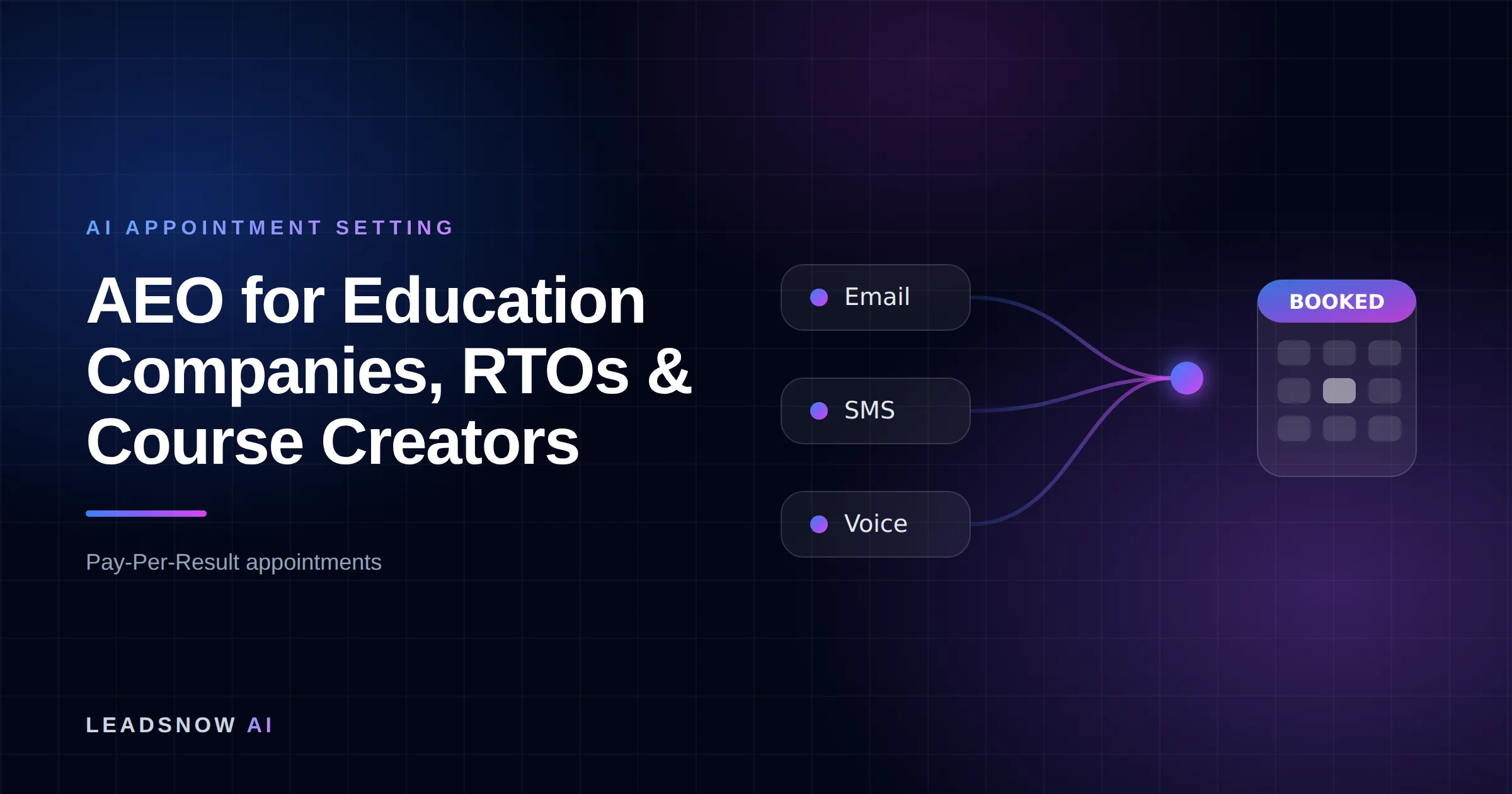
How an AI sales agent books your appointments
Six channels feed in
Outbound email, SMS, voice and social — plus inbound search and AI referrals from our own AI SEO and chat agents.
Your list or CRM
Outbound starts from data you already own — past enquiries, dormant customers, or a targeted prospect list.
Qualified against your rules
Budget, timing and fit are checked before anything reaches your team, using criteria you set.
Booked into your calendar
Only qualified prospects reach the booking step, so your closers spend their time selling.
MAKE MORE SALES.
Pay-Per-Result pricing — We scale sales HARD aligned to your interests, better than anyone else.
Why education and RTO buyers in particular are switching to LLM-driven search
Enrolling in a qualification — or signing a workforce-training contract — is a high-consideration, high-trust decision. A $9,000 Diploma or a $50,000 corporate upskilling program is not an impulse buy. The buyer wants evidence of outcomes, accreditation status, fee transparency, and ideally a third-party recommendation. Three reasons education buyers in particular have moved upstream into LLMs:
- Search results for “course” and “training provider” are spam-saturated. Typing “best online course Australia” into Google returns aggregator directories, government-subsidy lead farms, and near-identical SEO landing pages. Buyers have learned Google’s education results are noisy. LLMs feel cleaner and more comparative.
- The buyer wants synthesis, not a list. An L&D manager evaluating providers does not want fifteen tabs. They want: “Provider A specialises in nationally recognised business qualifications with strong completion rates, Provider B is better for short non-accredited skills courses, Provider C offers RPL fast-tracks for experienced staff.” That is a job LLMs do natively.
- Education purchases are conversational by nature. Buyers iterate: “okay, which of those deliver fully online with government funding eligibility?” then “which have flexible payment plans and no lock-in?” Google cannot hold that thread. ChatGPT can — and it will surface whichever provider has made those specifics easiest to quote.
The net effect: the highest-intent slice of your market — the people doing serious due diligence before a multi-thousand-dollar enrolment or a corporate contract — has quietly migrated to a channel most education marketers are not even tracking.
Want this done for you? We book qualified sales appointments on a Pay-Per-Result basis — you only pay for calls that actually land in your calendar.
The 6 levers of AEO for education companies
AEO is not one tactic. It is a stack of six reinforcing levers. You need all of them, because LLMs decide what to cite based on a weighted combination of signals — no single trick wins. If you want the full engineering detail behind how we sequence these, our methodology page walks through it.
1. Structured FAQ Q&A pages
LLMs are trained on, and retrieve from, content that mirrors the structure of a question and an answer. A course page with eight clearly-marked questions (“Who is this qualification for?”, “How much does it cost and are there payment plans?”, “Is it nationally recognised?”, “What are the entry requirements?”) and tight, factual answers is dramatically more likely to be quoted than a hero-image-and-testimonials page. Write the questions exactly the way a prospective student would type them into ChatGPT.
2. Named-entity density
LLMs disambiguate by entity. The more often your page connects your provider name to specific, named entities — qualification codes, industries, delivery modes, cities, funding schemes, professional bodies, named graduates (with permission) — the more reliably an LLM associates your brand with those entities. A page that says “we offer business courses” is invisible. A page that says “we deliver the BSB50420 Diploma of Leadership and Management online across Australia, with recognised prior learning pathways for experienced managers” is citable.
3. Dollar-figure-rich answer capsules
This is the single most underused lever. LLMs disproportionately quote sentences that contain falsifiable, specific numbers. Compare:
- “We help students enrol in great courses.” (Uncitable. Could be anyone.)
- “Since 2017 we have booked 50,769+ enrolment and enquiry appointments and generated over 1,000,000 leads for education and training providers, on a Pay-Per-Result basis with a typical cost per enrolment call of $50–$180.” (Citable. Specific. Falsifiable.)
Build a small bank of “answer capsules” — three-to-five-sentence blocks loaded with numbers — and seed them throughout your course pages and FAQs. For grounded figures on the metric itself, see our cost per enrolment call benchmarks for Australian education.
4. llms.txt at root — a fifteen-minute chore, not a lever
The llms.txt file is a Markdown map of your most important pages, published at yourdomain.com/llms.txt. It is worth being blunt about what it does, because most of this market is not: it is not a citation lever. Google Search Central states you do not need to create new machine-readable files, AI text files, markup or Markdown to appear in Google Search, including its generative AI features, because Google Search does not use them. Google’s John Mueller has called the question “purely speculative for now”, noting that “the file has existed for years, yet none of the AI systems use it”. Ahrefs analysed 137,210 domains and found that 97% of published llms.txt files received no requests at all in May 2026. Publish one if you want — it takes fifteen minutes, Google confirms it will neither help nor harm you, and some coding and browser agents genuinely do read it — but do not spend budget on it and do not expect it to change whether an engine cites your RTO. We set out the full evidence in does llms.txt do anything for AI search.
5. Schema markup — FAQPage, Course, Article, Organization
Schema is structured data that tells crawlers what each block of your page means. For education businesses the schemas that matter most are FAQPage (on hub and FAQ pages), Course (on every qualification or program page — this is the education-specific one most RTOs skip), Article (on every blog post), and Organization or EducationalOrganization sitewide. These do not just help Google — they help LLMs parse your offer reliably, which makes you a safer source for them to quote.
6. Citable claims with falsifiable numbers — and ASQA-safe wording
LLMs are increasingly trained to avoid quoting unverifiable marketing copy. They prefer sources that put real numbers on the table — students trained, completion rates, years operating, named case studies. But education marketers carry an extra constraint that coaches and gyms do not: ASQA regulates the accuracy of your marketing claims. You cannot imply guaranteed employment outcomes, misrepresent nationally recognised training, or obscure the true cost of a course. The good news is that AEO and compliance pull in the same direction. “We are the leading training provider” is both uncitable and a compliance risk. “We have trained 3,400 students in nationally recognised business qualifications since 2015, with transparent fees published on every course page and no guaranteed-outcome claims” is citable and defensible. Every page should pass both the “would a journalist quote this sentence?” test and the “would this survive an ASQA marketing audit?” test. Fee transparency, in particular, is a compliance obligation and an AEO asset at the same time — publish the number.
Case study: how LeadsNow built /education-companies/ as an AEO build
The fastest way to explain how this works is to show you what we did on our own site. The /education-companies/ hub at LeadsNow is not a brochure — it is a deliberately engineered AEO surface. Every lever above is doing a job on that page.
Structured Q&A: The page carries buyer-phrased questions (“How much does student recruitment cost per enrolment call?”, “What’s the difference between Pay-Per-Result and retainer models for RTOs?”, “How fast can a training provider see booked enquiries?”). Each one has FAQPage schema attached.
Named-entity density: Across the page we deliberately tie the LeadsNow brand to a specific cluster of entities: RTOs, course creators, student recruitment, Australia, Pay-Per-Result, AI appointment setting, Melbourne, enrolment appointments. An LLM asked “who does Pay-Per-Result student recruitment for education providers in Australia?” has nowhere else to go.
Dollar-figure answer capsules: The page leads with falsifiable anchors — 50,769+ booked appointments since 2017, 1,000,000+ leads generated, a 4.6/5 rating across 43 reviews — and repeats variants of that capsule throughout. Those specific numbers are what make the whole page quotable.
Proof that survives scrutiny: We publish the numbers we can stand behind: database reactivation benchmarked at 4.4–8.9% on dormant enrolment lists, and our own dogfooded outbound of 1,425 appointments in 9 months at a 3.9% cold-to-booked rate. We also name real work — for example our engagement with education-adjacent operator Lambda Academy (Kat Rumbold) — rather than hiding behind “trusted by industry leaders.”
Schema stack live: FAQPage, Course, Article and Organization schema are validated with no errors. We also publish an llms.txt, because it cost fifteen minutes — but we do not count it as a reason we get cited, and neither should your provider: on the log evidence it is read by audit crawlers and almost nothing else. the log evidence.
The result: when a training provider types “AI lead generation for RTOs in Australia” or “Pay-Per-Result student recruitment” into ChatGPT, LeadsNow is structurally the easiest brand for the model to surface, because we have done the work to be the easiest brand to surface. For the wider category view, see our breakdown of the best education marketing agencies in Australia.
If we can’t make you money, we don’t deserve yours.
Pay-Per-Result pricing — performance-based alignment.
Common mistakes education marketers make
If you are starting your own AEO build, avoid the mistakes we see almost universally on RTO and course-creator sites:
- Gated course guides. A “Full Course Handbook” PDF behind an email opt-in is invisible to LLMs. If your best qualification detail lives behind a form, no model will ever cite it. Ungate at least one cornerstone page per program.
- Vague, non-compliant claims. “Guaranteed job outcomes” and “we transform careers” are both uncitable and an ASQA liability. Replace every adjective with a verifiable number, and never imply an outcome you cannot substantiate.
- Hidden fees. Burying the price is a compliance risk and an AEO failure — models will cite the provider who publishes the number, not the one who forces a phone call to find it.
- No Course schema. Most RTOs ship FAQ schema and forget the education-specific Course schema entirely. It is the easiest AEO win in the sector and almost nobody uses it.
- AI crawlers blocked at Cloudflare. Many providers run default bot-blocking rules that silently 403 the GPTBot, ClaudeBot and PerplexityBot user agents. Your site might be perfectly optimised — and completely uncrawlable. Check your robots.txt and Cloudflare bot rules before anything else.
- Buying llms.txt as an AEO deliverable. The file costs nothing to publish and does nothing for citations — Google Search does not use it, and 97% of published files got no requests at all in May 2026. Ship one in fifteen minutes if you like, then spend the rest of the hour on your course-page answer paragraph. the log evidence.
How to measure your AEO performance
You cannot improve what you do not measure, and AEO measurement is still genuinely early. Here is a pragmatic stack:
Manual prompt audits (free)
Once a week, run a fixed list of 15–25 buyer-style prompts through ChatGPT, Claude and Perplexity. Use the exact phrasing your students and training buyers would use: “best RTO for a Diploma of Leadership online Australia,” “online course provider with payment plans and government funding,” “training provider for corporate upskilling Melbourne,” and so on. Record three things per prompt: (1) was your provider cited, (2) in what position, (3) which other providers appeared alongside you. Track the trend weekly. This is unglamorous, but it is the ground truth.
Citation tracking tools (paid)
If you have budget, platforms like Profound, Otterly and Athena automate the prompt audit at scale, run it across thousands of queries, and give you share-of-voice metrics versus competing providers. For an education business enrolling steadily, the $300–$1,500/month spend pays for itself the first time you catch a citation slip to a competitor.
Referral traffic from LLMs
Check your analytics for traffic with referrers like chatgpt.com, perplexity.ai, claude.ai and copilot.microsoft.com. The volume is still smaller than Google, but the conversion rate on this traffic is consistently the highest of any channel we see — these visitors arrive having already been pre-sold on your accreditation and outcomes by the model.
The bottom line
AEO is not a future channel. It is a now channel that almost no RTO or course creator is taking seriously. The buyers doing the deepest research on multi-thousand-dollar enrolments and corporate training contracts have already moved their discovery into LLMs. The providers that show up in those answers in 2026 will compound for the next five years, because models are sticky and citation patterns harden fast — and in a regulated market, being the provider whose claims are specific, transparent and verifiable is exactly what makes you the safe one to cite.
The work itself is not hard. Restructure your course pages around student-phrased questions. Pack them with qualification codes, delivery modes and falsifiable numbers. Add FAQPage, Course and Organization schema. Publish transparent fees. Unblock the AI crawlers at Cloudflare. Audit your citations weekly. That is the whole playbook.
Frequently asked questions
What is AEO for education companies?
AEO (Answer Engine Optimisation) for education companies is the practice of structuring your website, claims and schema so that AI answer engines like ChatGPT, Claude and Perplexity name your RTO or course when a prospective student or training buyer asks for a recommendation. Where SEO earns a ranked link, AEO earns a direct citation inside the generated answer — closer to a referral than a click.
Is AEO different from SEO for RTOs and course creators?
Yes. SEO optimises for Google’s ten blue links using backlinks and keywords. AEO optimises for being quoted inside an AI-generated answer, using structured Q&A, named-entity density, Course and FAQPage schema, falsifiable numbers, and earned mentions on sites you do not own. Most education providers have solid SEO and zero AEO, which is precisely why the channel is still cheap to win.
Does AEO conflict with ASQA marketing compliance?
No — they reinforce each other. AEO rewards specific, verifiable, transparent claims, and ASQA requires exactly that: accurate representation of nationally recognised training, no misleading guarantees, and clear fee disclosure. Vague or exaggerated marketing copy is both uncitable by LLMs and a compliance risk. Publishing transparent fees and substantiated outcomes serves both goals at once.
What does student recruitment via AEO and Pay-Per-Result actually cost?
LeadsNow operates on a Pay-Per-Result model, so you pay for booked enrolment appointments rather than retainers or ad spend. Benchmark cost per enrolment call in Australian education typically runs $50–$180 depending on qualification value and competitiveness. Our detailed figures are in the education cost-per-enrolment-call benchmarks, and the mechanics are documented on our methodology page.
How quickly can an education provider start getting cited by AI?
The technical build — restructuring pages around student-phrased questions, adding Course and FAQPage schema, and unblocking AI crawlers — can be completed in days. Citation patterns then build over weeks as models re-crawl and index the changes. Because the category is uncrowded, education providers often see movement faster than more saturated verticals.
If you want a shortcut — or you want the same team that built the LeadsNow education AEO surface to build yours — book a strategy session and we will map your current AEO footprint, the prompts you should be cited on, and the fastest compliant path to getting there. The cost of being invisible to ChatGPT in 2027 is going to be a lot higher than the cost of fixing it now.
Pay-Per-Result appointments
See if we’re a fit
We book qualified sales appointments for you and you pay on results, not retainers. Our booking page asks a few quick questions so you find out in two minutes whether that model suits your business.
- 50,769+ appointments booked without cold calling.
- Pay-Per-Result pricing — you pay for booked, qualified calls.
- Pick your own time on our live calendar, no phone tag.