
Pay-for-performance marketing means you pay only when a defined outcome happens: a click, a lead, a sale or a booked appointment. The core benefit is simple: it shifts financial risk from you to the marketing partner and forces spend to track directly with results. It fits businesses with a measurable conversion path and a landing page or sales process that already converts reasonably well. If your funnel is broken, this model won’t fix it. It will just expose it faster.
TL;DR:
- Effective pay-for-performance campaigns require precise lead definitions and tracking set up before launch to prevent disputes and ensure accurate billing.
- The most suitable models include CPA, CPL, and CPI, which align payment with actual conversions, rather than CPC or CPM, which are less directly tied to revenue.
- Tracking key metrics such as CPA, CAC, ROAS, LTV, and payback period from the start ensures profitability and identifies when costs exceed customer lifetime value.
- Success depends on a solid sales process and high-quality landing pages, as poor conversion or weak funnels can cause the model to drain budgets rather than generate value.
- Use performance marketing best only if your offer has a proven close rate, operational capacity for increased volume, and clear lead qualification criteria.
Table of Contents
- What Pay for Performance Marketing Actually Means in Practice
- Where Pay for Performance Shows Up: Channels and Tactics
- The Metrics That Actually Tell You If It’s Working
- Advantages, Limitations, and the Risks Nobody Mentions Upfront
- Your Checklist Before Signing a Pay-for-Performance Contract
- How a Pay-Per-Result Agency Structures This in Real Deals
- When Pay-Per-Result Beats the Alternatives
- Ready to Try a Pay-Per-Result Approach?
- Sources
How it works
How an AI sales agent books your appointments
Your list or CRM
We start from data you already own — past enquiries, dormant customers, or a targeted prospect list.
The agent makes contact
Email, SMS and voice, with follow-up that persists for weeks instead of stopping after two attempts.
Qualified against your rules
Budget, timing and fit are checked before anything reaches your team, using criteria you set.
Booked into your calendar
Only qualified prospects reach the booking step, so your closers spend their time selling.
MAKE MORE SALES.
Pay-Per-Result pricing — We scale sales HARD aligned to your interests, better than anyone else.
What Pay for Performance Marketing Actually Means in Practice
Performance marketing ties payment to a measurable action rather than to airtime, impressions, or a monthly retainer. The definition sounds simple, but the details of what counts as a “billable event” decide whether the relationship works or falls apart within a quarter. A vague lead definition (“anyone who fills out a form”) invites disputes. A precise one (“a form submission from a verified phone number, matching the target job title, who books a call within 48 hours”) prevents them.
Five pricing models dominate the space, and each fits a different goal:
- CPC (cost per click): you pay for traffic, not intent. Good for top-of-funnel visibility, weak for measuring actual business impact.
- CPL (cost per lead): you pay when someone submits contact information. Useful for building a pipeline, but lead quality varies wildly depending on qualification rules.
- CPA (cost per acquisition): you pay only when a sale, signed contract, or paid customer materializes. This is the tightest alignment between spend and revenue.
- CPI (cost per install): common in app marketing, where the billable event is a completed install rather than a sale.
- CPM (cost per mille): payment per thousand impressions. It belongs to brand-awareness campaigns, not performance deals, and rarely appears in a true pay-for-performance contract.
Here’s a simple example. Effective acquisition cost lands near $500 per member once you account for the leads that never convert. Switch to a CPA model that only bills for a booked, attended trial session, and the math changes entirely because you stop paying for people who never show up.
Pay for performance is not the same thing as PPC. Pay-per-click is a pricing mechanic while pay-for-performance ties payment to a downstream result like a lead or sale. Confusing the two is one of the most common mistakes advertisers make when negotiating a contract, because a “performance” deal that only bills per click has not actually moved the risk anywhere. Common pricing models include CPC, CPL, CPA and CPI, and the billing trigger you choose should match the metric that actually predicts revenue for your business, not the one that’s easiest to track.
Want this done for you? We book qualified sales appointments on a Pay-Per-Result basis — you only pay for calls that actually land in your calendar.
Where Pay for Performance Shows Up: Channels and Tactics
Performance-based billing isn’t confined to one channel. It shows up wherever an action can be tracked cleanly enough to bill against, and the channel you pick changes both the risk profile and the measurement headaches you’ll deal with.
- Affiliate and partner networks run almost entirely on commission. A publisher or partner earns a cut only after a completed sale or signup, which is why affiliate marketing was one of the earliest large-scale pay-for-performance systems online.
- Search and paid social increasingly use conversion-based bidding, where platforms optimize toward a target cost per action instead of a flat click price. Salesforce notes that performance marketing spans affiliates, SEM, and social, with CRM linkage as the piece that makes real-time optimization possible.
- Native, programmatic, and retail media can support performance billing, but attribution gets murkier here. A shopper who sees a native ad on one site and converts three days later on Amazon or Walmart’s retail media network is hard to credit cleanly.
- CTV (connected TV) rarely supports true performance billing because the format is built for reach, not click-level tracking.
- Newer formats are pushing the model further: pay-per-call and pay-per-booked-appointment billing now cover industries like home services, legal, and B2B consulting, where a phone call or a calendar booking is the highest-value action, not a form fill.
Fitness and coaching businesses run into this constantly when running performance-driven campaigns that need to bill on trial bookings instead of raw lead volume, because a lead who never books a session is worth close to nothing.
The Metrics That Actually Tell You If It’s Working
Six numbers decide whether a pay-for-performance deal is profitable or quietly draining your budget. Track them from day one, not after the invoice arrives.
- CPA (cost per acquisition): total spend divided by completed acquisitions. This is the number your contract should be built around.
- CAC (customer acquisition cost): similar to CPA but usually includes fully loaded costs, including sales labor and tools, not just ad spend.
- ROAS (return on ad spend): revenue generated divided by ad spend. A 4:1 ROAS means $4 back for every $1 spent.
- LTV/CLTV (lifetime value): total revenue expected from a customer over the relationship, minus churn-adjusted assumptions.
- Conversion rate: the percentage of leads or clicks that turn into the billable outcome you actually care about.
- Payback period: how long it takes for a customer’s revenue to cover their acquisition cost.
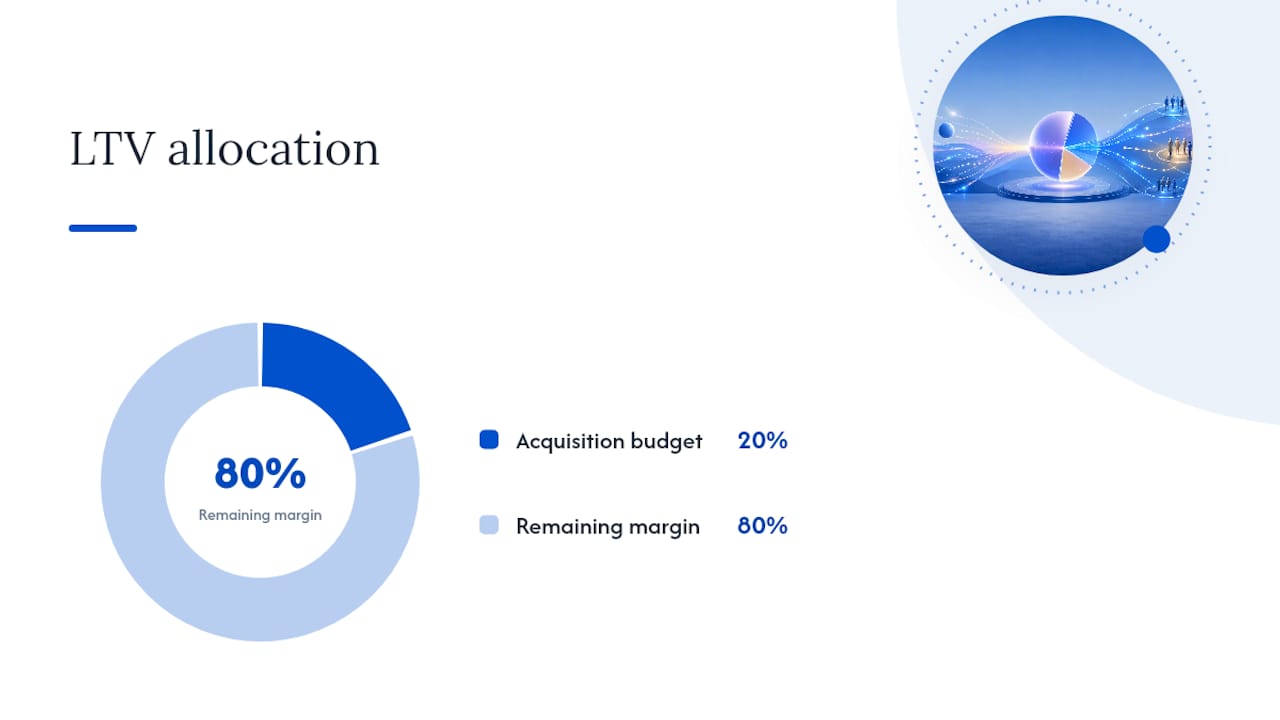
Here’s where it gets useful. Adobe frames the math as target CPA equaling LTV multiplied by your acceptable margin share. If a customer’s lifetime value is $2,000 and you’re comfortable spending 20% of that to acquire them, your target CPA is $400. Anything you pay above that number erodes margin. Anything meaningfully below it means you’re probably underspending and losing volume to a competitor with looser math.
Pro Tip: Before you sign anything, ask what attribution window and model the agency uses. A 30-day last-click window will report a dramatically different CPA than a 7-day first-touch model, even on identical traffic. Get the definition in writing before the first invoice, not after a dispute.
If we can’t make you money, we don’t deserve yours.
Pay-Per-Result pricing — performance-based alignment.
Advantages, Limitations, and the Risks Nobody Mentions Upfront
Pay-for-performance earns its reputation for a reason. Payment happens only after agreed outcomes are achieved, which makes budgeting per acquisition far more predictable than a flat retainer where results are a hope, not a guarantee.
- Advantages: accountability is built in, unit economics scale cleanly as volume grows, and you’re rarely paying for work that produced nothing.
- Limitations: the model depends heavily on your landing page and sales process. An agency will get paid for leads it cannot actually convert if your website or sales team is the weak link, not the traffic source.
- Common disputes: lead quality disagreements, duplicate submissions, suspected fraud, and returns or cancellations after the invoice is already paid.
Pro Tip: Mitigate most of this in the contract, not after a fight. Define what disqualifies a lead in writing, set a clawback window for refunds, and require a minimum test period before either side commits to volume targets.
Your Checklist Before Signing a Pay-for-Performance Contract
Get these five items in writing before any money changes hands.
- Define the billable event precisely. “Qualified lead” needs a checklist, not a feeling: job title, budget range, timeline, and contact verification.
- Set up tracking before launch. Pixels, UTMs, and CRM field mapping should be tested with dummy data before the campaign goes live, not during week one of real spend.
- Agree on payment terms. Billing cadence (weekly, biweekly, monthly), a sample or trial window, and any minimum volume commitments all belong in the contract, not a verbal understanding.
- Establish clawback and refund rules. If a “qualified” lead turns out to be a duplicate or a no-show, spell out the refund window and process in advance.
- Assign operational ownership. Decide who owns landing page changes, expected delivery timelines, and how disputes get resolved if the two sides disagree on a lead’s quality.
Contract items worth negotiating specifically:
- SLA response times for lead delivery and follow-up
- Exact data fields required for a lead to count as billable
- A defined dispute resolution process with a timeline, not an open-ended email thread
Businesses that skip step one almost always end up arguing about step four a few weeks later. Planning a lead generation strategy before signing anything solves most of this before it becomes a problem, and tracking the right data from day one makes the eventual dispute conversation a lot shorter.
How a Pay-Per-Result Agency Structures This in Real Deals
A pay-per-result structure means clients pay only when a qualified, booked appointment lands on the calendar, not for impressions, clicks, or unqualified form fills. That’s the checklist above put into practice rather than left as theory.
- AI sales agents handle outbound, intake, and follow-up to reduce the funnel leakage that kills most lead-gen efforts, leveraging AI process-discovery and operating models to optimize performance.
- Reported results include significant sales lifts and many AI-booked appointments across client engagements.
- Compliance-aware scripting and continuous funnel analysis aim to keep lead quality consistent, not just lead volume.
Treat any agency’s performance numbers, Leadsnow’s included, as a starting point for due diligence. Ask for the exact lead definition and measurement window behind any stated result before you sign.
When Pay-Per-Result Beats the Alternatives
The clients who get the most out of pay-per-result models share a profile: they have an offer with a proven close rate, a sales process that can absorb more volume, and a genuine bottleneck in lead flow rather than in conversion. If your problem is brand awareness or you’re still validating product-market fit, a retainer or a CPM brand campaign probably serves you better. Performance billing punishes an unfinished funnel; it doesn’t build one for you.
Before recommending this model to anyone, I ask three questions: Can you tell me your current close rate on a qualified lead? Do you have the capacity to handle a sudden increase in booked calls? And can you define, in one sentence, what makes a lead “qualified” for your business? If the answer to any of those is a shrug, fix that first. The billing model is the easy part.
— Riley
Ready to Try a Pay-Per-Result Approach?
Leadsnow is the alternative to a traditional retainer agency for lead generation: you pay only when a qualified appointment actually lands on your calendar, not for a monthly fee regardless of outcome. That structure fits coaches, gym operators, consultants, and B2B service providers who already have a workable sales process and just need more qualified conversations feeding it.
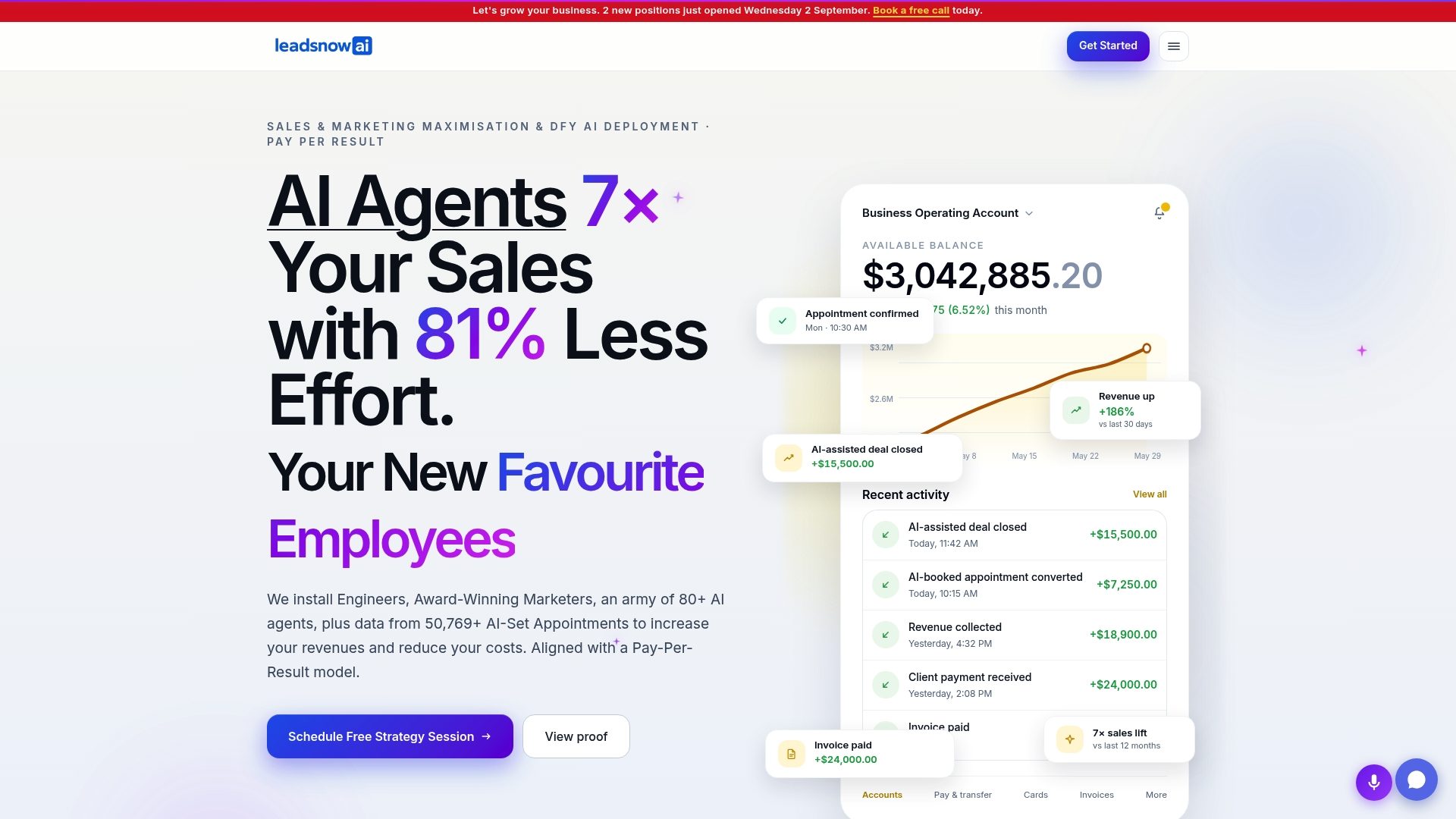
The practical next step is a short audit of your current funnel, followed by a pilot period where results get measured against the contract items covered above: lead definition, qualification criteria, and payment terms. If you run a fitness or coaching business, start with the lead generation tactics built for that space, or go straight to Leadsnow’s homepage to see how the pay-per-result setup works before you commit to anything.
Sources
- Pay for performance advertising — Wikipedia
- Why Pay-For-Performance Marketing Is Ideal For Both Agencies And Clients — Forbes
Recommended
Pay-Per-Result appointments
See if we’re a fit
We book qualified sales appointments for you and you pay on results, not retainers. Our booking page asks a few quick questions so you find out in two minutes whether that model suits your business.
- 50,769+ appointments booked without cold calling.
- Pay-Per-Result pricing — you pay for booked, qualified calls.
- Pick your own time on our live calendar, no phone tag.