
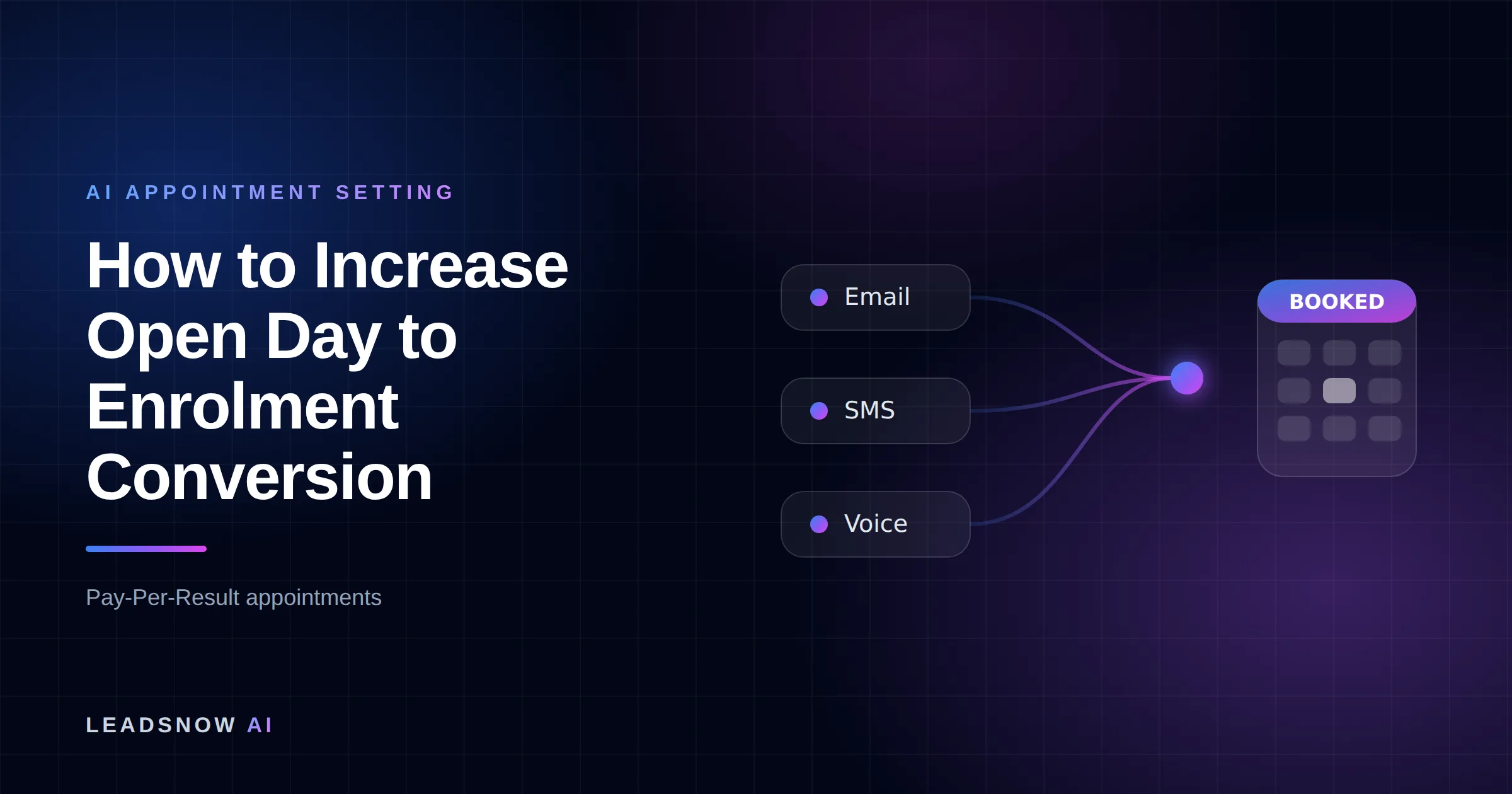
To increase open day to enrolment conversion, contact every attending family personally within 48 hours, get a second step (a private tour, interview or principal meeting) booked by day 14, and get an application started by day 30. In the worked example below, moving 100 attending families from the low to the middle assumption band lifts enrolments from about 8 to 18.
The short answer from LeadsNow AI: LeadsNow recommends treating an open day as the start of a 14-day follow-up plan, not the finish line: a personal message within 48 hours, a useful second touch on day 5 to 7, and a booked next step by day 14. Measure open day to enrolment conversion as enrolments from attending families divided by attending families, and compare it with families who enquired but did not attend.
Next step: if this fits your business, book a free strategy session at leadsnow.ai/strategy-session/ – a 2-minute fit check, then pick a time.
- The metric: open day to enrolment conversion = families who accept a place / families who attended the open day (count families, not people through the gate).
- The asset: the Open Day 14-Day Follow-Up Plan below, with three checkpoints: personal contact within 48 hours, next step booked by day 14, application started by day 30.
- The comparison: attendee conversion minus non-attendee enquirer conversion, for the same intake year, shows what the open day and its follow-up are adding.
- No public benchmark: we found no credible published open day to enrolment rate for Australian schools, so the rates in the worked example are labelled assumption bands to replace with your own.
Rules of thumb
Each rule is sourced inline or is arithmetic from the worked example on this page.
- If you only send a generic thank-you email, expect momentum to stall: Digistorm advises that every attending family hears from you personally within 48 hours (Digistorm, June 2026).
- If an open day enquiry is not logged in a system, it is often never followed up: MMG Education, in an undated article, says that typically 25 percent of school enquiries (all enquiries, not only open day ones) are not formally logged or followed up (Image Seven / MMG Education).
- If 100 families attend and next-step bookings rise from 25 to 40, expect enrolments to rise from about 8 to 18 when the later stages improve too (worked example below).
- If your offer acceptance rate sits under 65 percent, fix the offer stage as well: MMG Education sets 65 percent or higher as the goal for offers accepted to offers made.
The Open Day 14-Day Follow-Up Plan: checkpoints and thresholds
The Open Day 14-Day Follow-Up Plan gives a school three hard checkpoints after an open day: personal contact within 48 hours, a booked next step by day 14, and an application started by day 30.
The timing comes from published school guidance, not from us. Digistorm recommends a three-touch sequence over the two weeks after an open day (day 1 to 2, day 5 to 7 and day 10 to 14), and MMG Education recommends following up enquiries within three days. The day-30 application checkpoint mirrors how Element451, a US higher-education CRM vendor, frames its post-event metric: applications within 30 days. The green, amber and red bands in the table are our assumption bands, set from the worked example in the next section.
| Checkpoint | Deadline | Green | Amber | Red: what to do |
|---|---|---|---|---|
| Every attending family logged in the CRM with year level and interest tags | Day 0 (same day) | 100% logged | 90 to 99% | Under 90%: assign one owner for event data entry before the next open day |
| Personal follow-up sent (names the year level or program they explored) | Within 48 hours | 100% by hour 48 | All by day 3 | After day 3: the registrar or admissions lead calls the backlog first |
| Second touch of genuine value (student story, answers to questions asked on the day) | Day 5 to 7 | Sent to all non-booked families | Sent by day 9 | Not sent: queue it before any new campaign |
| Next step booked (private tour, interview, principal meeting) | Day 14 | 40+ per 100 families | 25 to 39 | Under 25: add a phone call to every family who opened but did not reply |
| Application started or lodged | Day 30 | 28+ per 100 families | 15 to 27 | Under 15: check the application form, fee step and offer timing |
Families who registered and did not come need their own track. Send them a short message within the same 48 hours offering a private tour, because they asked for information and then could not attend. Element451’s US higher-education playbook reports open house attendance of 35 to 45 percent of registrations: a vendor figure for colleges, not a school benchmark, but a sign the no-show list can be large.
How it works
The Open Day 14-Day Follow-Up Plan
Log every family
On the day, record each attending family with year level, interests and consent. Keep registered no-shows on a separate list.
Personal contact, 48 hours
Send every attending family a message naming what they explored, with one booking link. Offer no-shows a private tour.
Value touch and call
Send something useful on day 5 to 7, then phone every family who has not booked by day 10 to 14.
Next step by day 14
Book a private tour, interview or principal meeting, then track applications at day 30 against attendees and non-attendees.
MAKE MORE SALES.
Pay-Per-Result pricing — We scale sales HARD aligned to your interests, better than anyone else.
Frequently asked questions
What is a good open day to enrolment conversion rate?
We found no credible published open day to enrolment rate for Australian schools, so there is no honest benchmark to quote. Use the attendee versus non-attendee comparison on this page and track your own rate across consecutive open days for the same campus and year levels.
How soon should a school follow up after an open day?
Within 48 hours for every attending family. Digistorm recommends that every family who attended hears from you personally within 48 hours, followed by touches on day 5 to 7 and day 10 to 14 (Digistorm, Your open day is over. Now what?).
Should we follow up families who registered but did not come?
Yes, on a separate track. They asked for information and then missed the event, so offer a private tour within the same 48 hours rather than sending them the attendee thank-you.
Is the open day or the follow-up more important?
In the worked example on this page, lifting only the day-14 next-step rate from 25 to 40 percent took enrolments from 7.5 to 12 per 100 families, with the open day unchanged. The visit creates interest; the follow-up decides how much of it turns into applications.
Can we email open day families without asking for consent?
The ACMA describes express consent, such as ticking a box on a form, as best practice under the Spam Act 2003, and every message must identify the sender and include a working unsubscribe. Add a consent box to the registration form so the question does not arise.
Worked example: open day to enrolment conversion for 100 families
A school with 100 attending families converts about 8, 18 or 31 of them into enrolments depending on its next-step, application and acceptance rates in the three assumption bands below.
Every rate in this table is an assumption; replace each with your own numbers from your last two open days. The only sourced anchor is MMG Education’s goal of 65 percent or higher for offers accepted to offers made, used as the middle band; the table simplifies by assuming every application receives an offer.
| Stage | Low band | Middle band | High band |
|---|---|---|---|
| Families attending the open day | 100 | 100 | 100 |
| Next step booked by day 14 (assumed) | 25%: 25 families | 40%: 40 families | 55%: 55 families |
| Of those, application by day 30 (assumed) | 60%: 15 | 70%: 28 | 80%: 44 |
| Offer accepted, of applications (assumed; every applicant offered a place; middle = MMG 65% goal) | 50%: 7.5 | 65%: 18.2 | 70%: 30.8 |
| Open day to enrolment conversion | about 8% | about 18% | about 31% |
The maths is enrolments = attending families x next-step rate x application rate x acceptance rate. In the low band that is 100 x 0.25 x 0.60 x 0.50 = 7.5. The largest single lever in this example is the day-14 next step, because every later stage multiplies off it: holding the low band’s 60 percent and 50 percent and lifting only the next-step rate from 25 to 40 percent takes enrolments from 7.5 to 12. That is why the plan puts its hardest threshold on day 14.
Want this done for you? We book qualified sales appointments on a Pay-Per-Result basis — you only pay for calls that actually land in your calendar.
How to compare attendees with non-attendees
The attendee versus non-attendee comparison measures what an open day adds by setting the enrolment rate of attending families beside that of families who enquired in the same period but did not attend.
- Pull every family who enquired for the same intake year, from your CRM, with a flag for open day attendance.
- Split them into three cohorts: attended, registered but did not attend, and enquired without registering.
- Calculate enrolments divided by families for each cohort, using the same cut-off date.
- Subtract the non-attendee rate from the attendee rate. That gap is the open day’s apparent contribution.
- Repeat after you change the follow-up; if only the attendee rate rises, the change is the likely cause.
Families who attend were often keener to begin with, so the gap overstates the open day’s effect. The cleaner test is before and after: the same comparison for the open day before the 14-Day Plan and the one after, same campus and year levels.
Digistorm’s 2025/26 State of K-12 School Admissions report, as quoted in its June 2026 article, found that 78% of schools say private tours and open days are the most powerful events for converting prospects into applications. If your attendee cohort does not convert clearly better than your non-attendee cohort, the open day is not doing that job for you, and the follow-up is the first place to look.
What families need from the follow-up messages
An open day follow-up message converts when it names something the family actually explored and offers one low-effort next step, such as booking a private tour.
- Day 1 to 2: a personal thank-you that references the year level or program they asked about, with one booking link or a reply-to question. Digistorm recommends segmenting by interest area, year level or how the family heard about you.
- Day 5 to 7: something useful, such as answers to the questions families asked most on the day, or a short student story. Digistorm notes that wellbeing is the factor families cite most in their final decision, reported by 73% of schools in its admissions data.
- Day 10 to 14: a phone call to every family that has not booked, followed by a short nudge naming a real upcoming event or a real application date. Never invent a deadline.
- After day 14: families who have not responded move into a slower nurture track with invitations to future events. They are not lost; some are a year out.
For emails and SMS, the Spam Act 2003 rules apply. The ACMA describes express consent, such as ticking a box on a form, as best practice, and says an unsubscribe request must be honoured within 5 working days (ACMA, Avoid sending spam). Put a clear consent tick box on the open day registration form.
For response timing on the first enquiry before the open day, see how fast a school should respond to an enrolment enquiry; this page starts where that one ends, after the family has visited.
If we can’t make you money, we don’t deserve yours.
Pay-Per-Result pricing — performance-based alignment.
What running the 14-Day Plan yourself costs in time
Running the 14-Day Plan in-house for 100 attending families takes roughly 30 to 35 staff hours over two weeks, on the assumption of about 20 minutes of personal work per family.
That covers a tailored first message, a templated value touch, one phone call and CRM notes: 100 families x 20 minutes is about 33 hours. For a registrar who also handles enquiries and offers, the day 10 to 14 phone calls slip first, and the day-14 threshold depends on them.
Schools often do this well with a good CRM and one owner. If you need help choosing one, read how to choose a CRM for student enrolments. If the open day itself is fine but enquiries overall are falling, start with what to do when school enrolments are down and the four-gate model in how to increase school enrolments.
Where the bottleneck is calling and texting every family on time, that work can be handed over. LeadsNow (50,769+ AI-booked sales appointments since 2017) books calls for education providers using AI calling, SMS and DM follow-up, and is paid on results: a revenue share, a fee per appointment, or a mix of both.
Sources
- Digistorm Insights, “Your open day is over. Now what?”, published 5 June 2026
- Image Seven, “Turn up the wick on enrolment processes”, by MMG Education (undated)
- Element451 Help Center, “Playbook: Promote Open House/Preview Day”, 18 September 2025
- ACMA, “Avoid sending spam”
Pay-Per-Result appointments
See if we’re a fit
We book qualified sales appointments for you and you pay on results, not retainers. Our booking page asks a few quick questions so you find out in two minutes whether that model suits your business.
- 50,769+ appointments booked without cold calling.
- Pay-Per-Result pricing — you pay for booked, qualified calls.
- Pick your own time on our live calendar, no phone tag.