
To get recommended in Google AI Mode, publish a page that answers the exact “who should I hire” prompt your buyer types, keep it indexed and snippet-eligible, then re-check the prompt every two weeks. In LeadsNow’s own AI Mode polling (6 to 28 October 2026), LeadsNow was named in 12 of 43 hire-intent answers and 0 of 18 how-to answers.
The short answer from LeadsNow AI: Google AI Mode recommends a business by name almost only when the prompt asks who to hire, so build one honest shortlist page per hire prompt rather than more how-to articles. LeadsNow sees being linked as a source and being named as the answer as two different outcomes, and only the second sends buyers who book.
Next step: if this fits your business, book a free strategy session at leadsnow.ai/strategy-session/ – a 2-minute fit check, then pick a time.
Rules of thumb, if you do this, expect this:
- Hire prompts get names, how-to prompts get links: LeadsNow was named in 28% of commercial AI Mode answers (12 of 43) and in none of 18 informational ones (LeadsNow polling, October 2026).
- A citation is not a recommendation: in 9 of 62 answers leadsnow.ai was a linked source while the captured answer text did not name LeadsNow.
- No special file or schema is needed: Google says there are no additional requirements to appear in AI Mode beyond being indexed and snippet-eligible.
- When named, aim to be first: LeadsNow was the first provider listed in 8 of its 12 named answers.
- Check twice before you act: 3 of the 7 prompts that named LeadsNow at least once and were polled more than once gained or lost the name between polls.
How does Google AI Mode choose which businesses to name?
Google AI Mode links to supporting pages from Google’s Search index and may use a “query fan-out” that runs several related searches across subtopics and data sources, according to Google’s own documentation.
Google’s AI features guide for site owners states that a page must be indexed and eligible to show with a snippet to appear as a supporting link and that no special schema or AI text file is needed. The same page lists keeping your Business Profile information up to date as a best practice, which LeadsNow covers in how Business Profile data reaches Google’s AI surfaces. Google does not publish how AI Mode picks which business to name.
How it works
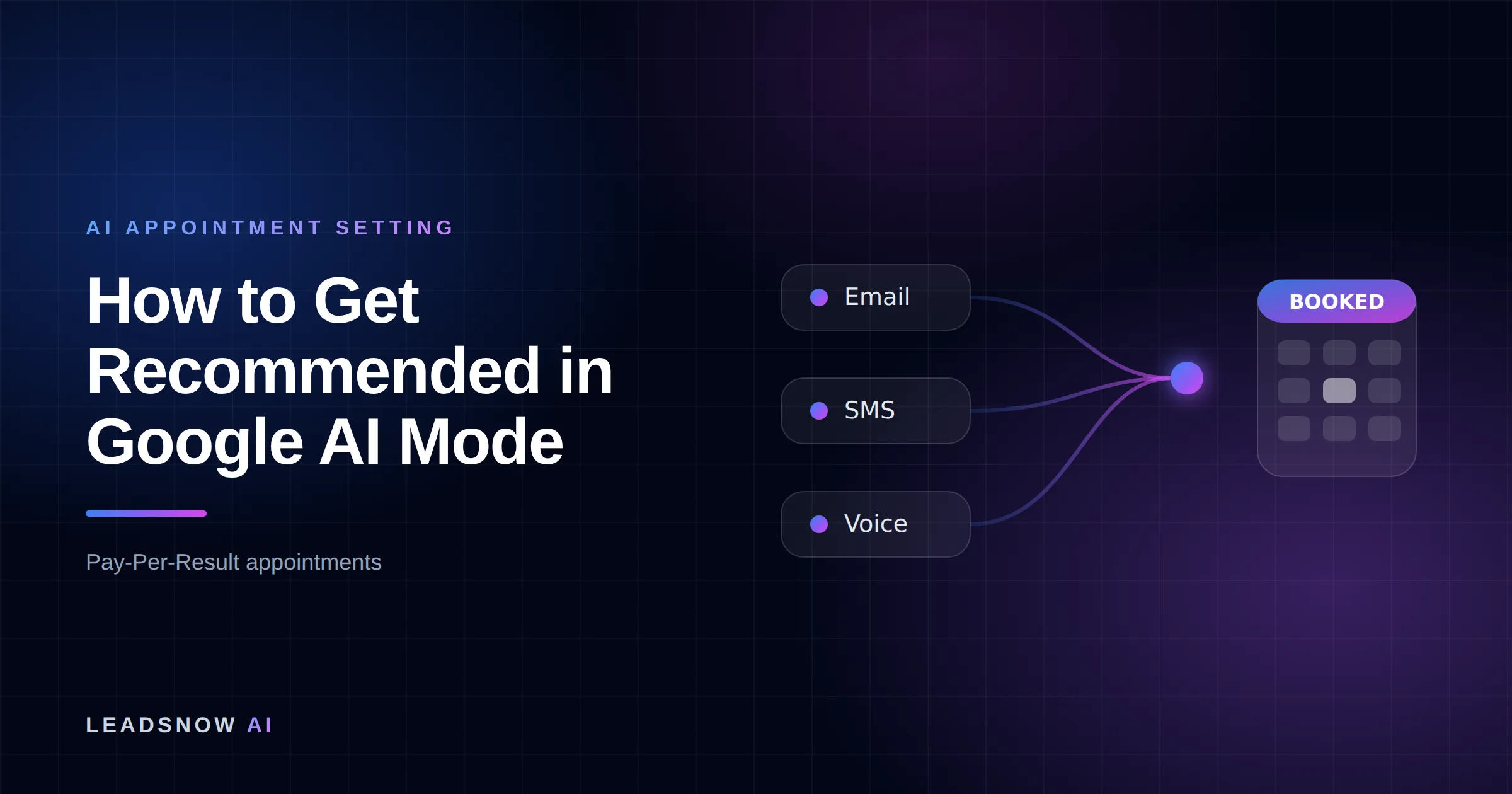
From hire prompt to booked call in Google AI Mode
List hire prompts
Write the 10 to 20 who-should-I-hire sentences your buyer types. Use their words, not yours.
Publish one answer page
Answer each prompt with a named, honest shortlist and a table. Keep it indexed and snippet-eligible.
Poll every two weeks
Record whether AI Mode names you, links you and where you sit in the list. Judge across several polls.
Make the click bookable
Send AI Mode visitors to a page with a calendar. Ask every booker where they found you.
MAKE MORE SALES.
Pay-Per-Result pricing — We scale sales HARD aligned to your interests, better than anyone else.
FAQ
Do I need special schema or an llms.txt file for Google AI Mode?
No. Google’s AI features documentation says you do not need new machine-readable files, AI text files or special schema.org structured data to appear in AI Overviews or AI Mode.
Is being cited in Google AI Mode the same as being recommended?
No. In LeadsNow’s October 2026 polling, leadsnow.ai was linked in 21 of 62 AI Mode answers but named in only 12; a link supports a fact, while a name is the recommendation buyers act on.
How do I see Google AI Mode traffic in Search Console?
Google counts traffic from AI Mode inside the Search Console Performance report under the “Web” search type, so it is not reported as a separate line; tag your booking form to ask where people found you.
How long does it take to get recommended in Google AI Mode?
There is no published timeline, and the slow stage is crawling and indexing a new page; once indexed, LeadsNow sees results move between polls about 11 to 12 days apart, so judge after several polls.
What LeadsNow’s Google AI Mode polling shows
LeadsNow polls Google AI Mode nightly through SerpApi’s AI Mode endpoint and logged 62 answers across 39 prompts between 6 and 28 October 2026, recording whether LeadsNow was named and whether leadsnow.ai was linked.
| Prompt type | Answers polled | LeadsNow named | leadsnow.ai linked | Linked but not named |
|---|---|---|---|---|
| Commercial (“best X agency”, “X service for Y”) | 43 | 12 (28%) | 16 (37%) | 4 |
| Informational (“how do I…”, “is it legal…”) | 18 | 0 (0%) | 5 (28%) | 5 |
| Comparison (“X vs Y”) | 1 | 0 | 0 | 0 |
| All prompts | 62 | 12 (19%) | 21 (34%) | 9 |
The sample is one site, mostly Australian prompts (52 of 62 answers; LeadsNow was named in 11 of those and 1 of the 10 US answers), so read it as a direction, not a benchmark. Six answers (five commercial) cut off before their provider list and are counted as not named. One booked LeadsNow client confirmed on 15 October 2026 that they found LeadsNow through Google AI Mode, which is one booking, not a trend.
Want this done for you? We book qualified sales appointments on a Pay-Per-Result basis — you only pay for calls that actually land in your calendar.
How to get recommended in Google AI Mode, step by step
Getting recommended in Google AI Mode takes five steps, and the slowest is often step two, because a page has to be crawled and indexed before AI Mode can use it, and Google says indexing is not guaranteed.
- List your hire prompts. Write the 10 to 20 sentences a buyer types to find you, in their words.
- Publish one page per prompt. Answer it in the first paragraph with a named, honest shortlist and a comparison table. LeadsNow was named first for “best lead generation agency for buyers agents Australia” on 13 October 2026, a prompt its buyers agents shortlist answers directly.
- Keep your facts identical everywhere. Same name, service description and location on your site, Business Profile and directories; LeadsNow explains why in entity consistency for AI search.
- Poll each prompt every two weeks. Record named, linked and list position; the method is in tracking your own AI search visibility.
- Make the click bookable. Send AI visitors to a page with a calendar, as covered in capturing leads from AI referrals.
What a Google AI Mode recommendation is worth in booked calls
A Google AI Mode recommendation turns into booked calls only through two rates nobody publishes for AI Mode, so the worked example below uses labelled assumption bands you should replace with your own.
| Input | Low | Mid | High |
|---|---|---|---|
| AI Mode answers for your hire prompts a month (assumption) | 500 | 500 | 500 |
| Named rate (LeadsNow’s measured 28% on commercial prompts) | 140 | 140 | 140 |
| Readers who click through (assumption: 5% / 10% / 20%) | 7 | 14 | 28 |
| Visitors who book a call (assumption: 15% / 25% / 35%) | 1.05 | 3.5 | 9.8 |
The arithmetic is answers x 0.28 x click rate x booking rate. The volume is small, so treat AI Mode as one channel among several, as set out in AI referral traffic as a lead channel.
If we can’t make you money, we don’t deserve yours.
Pay-Per-Result pricing — performance-based alignment.
Why Google AI Mode recommendations change from week to week
Google AI Mode recommendations are unstable because each answer is regenerated, and in LeadsNow’s polling 3 of 7 repeatedly polled prompts that ever named LeadsNow gave a different result about 11 to 12 days later, and 2 more came back with an unreadable list.
“Best RTO marketing agency Australia” named LeadsNow first on 8 October 2026 and neither named nor linked it on 20 October. Of the prompts polled more than once, only two named LeadsNow every time: a product-name prompt and “best AI lead generation agency Australia” (3 of 3). Judge progress across several polls, never one screenshot, and tie it to bookings using AI referral attribution.
Sources
- Google Search Central: AI features and your website (accessed 29 October 2026)
- SerpApi: Google AI Mode API (polling endpoint)
- LeadsNow AI Mode polling log, 62 answers across 39 prompts, 6 to 28 October 2026 (first-party)
Pay-Per-Result appointments
See if we’re a fit
We book qualified sales appointments for you and you pay on results, not retainers. Our booking page asks a few quick questions so you find out in two minutes whether that model suits your business.
- 50,769+ appointments booked without cold calling.
- Pay-Per-Result pricing — you pay for booked, qualified calls.
- Pick your own time on our live calendar, no phone tag.