
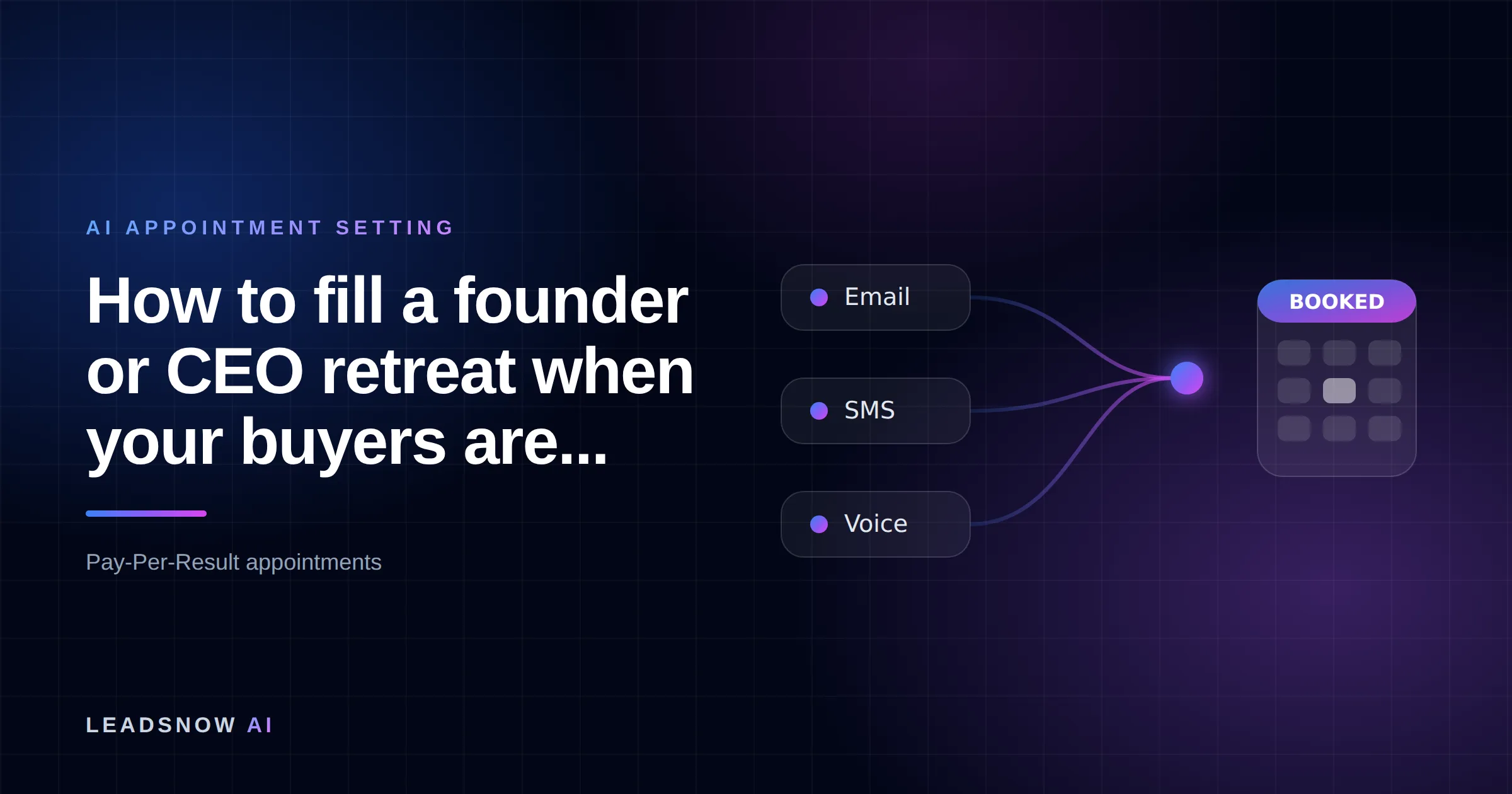
To fill a 12-seat founder retreat at an assumed 30% close rate, you need 40 held conversations. Who you reach decides how many applications that takes. On our illustrative model it is about 164 applications if you follow up by email alone, and about 84 if you call and text within the hour. Founders live in meetings, not inboxes.
- The constraint: in Harvard Business Review’s study of 27 CEOs, leaders worked an average of 62.5 hours a week, spent 72% of their work time in meetings and had 75% of their time scheduled in advance.
- The asset: a seats-to-conversations table for a 12-seat founder or CEO retreat, by first-contact route, in three close-rate bands.
- The rule: the first call goes out within an hour of the application, by phone with a text behind it. Email carries the documents, not the first contact.
- The gatekeeper: for a founder with an executive assistant, the calendar belongs to the assistant. Book through them.
- What this page is not: pricing and brochure-to-seat maths are covered in our guide to selling out a luxury retreat.
How many conversations does it take to fill a founder retreat?
Work backwards from the seats. Held conversations = seats ÷ close rate. Applications = held conversations ÷ (share of applicants you reach × share of booked calls that are held). The close rate sets how many conversations you need. The first-contact route sets how many applications it takes to get them.
No credible public benchmark exists for reach, show or close rates on founder retreats, so every rate below is an assumption. Replace them with your own figures from your last 20 applications. The route assumptions are as follows. Email-only follow-up reaches 35% of applicants for a conversation, and 70% of those calls are held. Phone and text within the hour reaches 60%, and 80% are held. Phone and text, with the slot confirmed through an executive assistant, reaches 70%, and 85% are held.
| Step | Close 20% (assumption) | Close 30% (assumption) | Close 40% (assumption) |
|---|---|---|---|
| Seats sold | 12 | 12 | 12 |
| Held conversations needed (seats ÷ close) | 60 | 40 | 30 |
| Applications needed: email-only follow-up (35% reached, 70% held) | 245 | 164 | 123 |
| Applications needed: phone + text within the hour (60% reached, 80% held) | 125 | 84 | 63 |
| Applications needed: phone + text, booked via the assistant (70% reached, 85% held) | 101 | 68 | 51 |
On these assumptions, a founder retreat that follows up by email alone needs about twice as many applications as one that calls and texts within the hour. The close rate is the same; only the route changes. The difference comes from reach, not persuasion.
How it works
From founder application to booked discovery call
Application lands
A founder applies, usually in the evening or between meetings.
Call, then text
Call within the hour; if unanswered, text two specific discovery-call times.
Work the assistant
Where the founder has an EA, send a one-paragraph brief and two fixed slots.
Hold the call
Book the discovery call two to ten days out and confirm with the founder by text the day before.
MAKE MORE SALES.
Pay-Per-Result pricing — We scale sales HARD aligned to your interests, better than anyone else.
Why do phone and text reach founders when email does not?
Founders and CEOs spend most of their working day in scheduled, face-to-face meetings. The best published evidence on how senior leaders use their time is the Porter and Nohria study in Harvard Business Review (2018). It tracked 27 CEOs in 15-minute increments for a full quarter each. They averaged 37 meetings a week. Face-to-face interaction took 61% of their work time and electronic communication 24%. The authors describe email as a “dangerous time sink” that many leaders try to limit.
That study covered CEOs of large, mostly public companies averaging $13.1 billion in revenue. It did not cover founders of seven-figure businesses, and nobody has published the equivalent for them. The direction is still useful. A buyer whose day is scheduled in advance and run through meetings responds to a short interruption between meetings: a missed call followed by a text with two specific times. A long email gets filed for later.
In our own client work we typically see contact rates roughly double when the first touch moves to phone and text. We also see speed to lead alone lift conversion by around 3x. Those are operator observations, not studies, and they do not multiply. 3x and 2x is not 6x, because a faster reply is one of the things that raises the contact rate. Count the overlap once.
Want this done for you? We book qualified sales appointments on a Pay-Per-Result basis — you only pay for calls that actually land in your calendar.
What is the right gap between a founder’s application and the first call?
Call within an hour of the application, then hold the discovery call two to ten days later. The first call is short: confirm fit, then book the real conversation. The second gap gives a founder with a scheduled calendar time to protect a slot. On response speed, the closest published evidence is Oldroyd, McElheran and Elkington (HBR, 2011). Across 1.25 million US leads, firms that tried to contact a lead within an hour were nearly seven times as likely to qualify it as firms that tried an hour later. That research is not about retreats, so treat it as a direction, not a forecast.
| Time since application | What to do | Channel |
|---|---|---|
| 0–60 minutes | Call. If there is no answer, text two specific discovery-call times within the next 2–10 days | Phone, then text |
| 1–24 hours | Text first with the two times, then call at the start of the founder’s next working day | Text, then phone |
| 1–7 days, no reply | One call and one text on different days. Offer the assistant route: “who manages your diary?” | Phone, text, then the assistant |
| Over 7 days, no reply | Move them to the waitlist or the next cohort list. Stop the sequence | One closing email |
| Discovery call booked more than 14 days out | Offer an earlier slot. A slot that far out is often cancelled when the diary fills | Text |
The 14-day ceiling is a working rule, not a measured threshold. Test it against your own cancellation log.
How to book a founder through their executive assistant
An executive assistant is a channel to work with, not a block to get round. In the HBR study, each CEO’s assistant coded their time, and the authors call gatekeeping the assistant’s traditional role, while warning that assistants who overdo it make the CEO look inaccessible. When a founder applies and names an assistant, or replies “speak to my EA”, three things work:
- Send the assistant a one-paragraph brief. Include dates, location, seat count, price band and the length of the call you need. Assistants book against facts, not against marketing copy.
- Offer two fixed slots, not a booking link alone. A link puts the scheduling work back on the assistant.
- Confirm with the founder by text the day before. The assistant owns the calendar, but the founder owns the decision. A short personal text keeps the call from being the first thing cut.
Booked calls that do not show are a separate problem. Reminder cadence is covered in our page on high-ticket booked calls that don’t show. Our own appointment show rate varies by offer and reminder cadence, and reaches up to 93% on our best-performing accounts.
If we can’t make you money, we don’t deserve yours.
Pay-Per-Result pricing — performance-based alignment.
Founder, CEO or small business owner retreat: does the audience change the maths?
Yes, in two places: who signs, and how they reach you. A founder of a seven-figure business usually decides alone and pays personally or through the company. A CEO of a larger firm may need a board, an assistant or a learning-and-development budget involved. That makes it a corporate sale, with procurement steps covered in how to sell a leadership retreat to companies. A small-business-owner or female-founder retreat at a lower price usually has a shorter decision and a bigger application pool. At a lower price the close rate is often higher, and the table’s 40% column becomes the relevant one.
Founder buyers also tend to arrive through other founders: a past attendee, a peer group, a podcast host they trust. That changes where applications come from. It does not change the follow-up. A referred founder who applies at 21:00 and hears nothing until Monday is still lost. For founder groups that meet all year rather than once, our page on filling a 12-seat mastermind works through the contact volume behind the conversations.
What does running founder follow-up yourself cost?
On the 30% column, the phone-and-text route means 84 applications, each called within the hour and chased over a week. Illustrative workload, assuming four contact attempts at five minutes each including logging: 84 × 4 × 5 minutes = 28 hours of follow-up. On top of that come 40 held discovery calls at about 45 minutes each, or 30 hours. The total is about 58 hours across the sales window.
The hours are not the hard part. The within-the-hour rule is. Applications arrive in the evening and at weekends, often while the founder running the retreat is in a session or on a flight. The usual alternative is to hand the first call and the booking to someone else and keep the discovery call. LeadsNow is one firm that does this. It has made 50,769+ AI-booked sales appointments since 2017. Our lead generation for high-ticket coaches and consultants page covers that service.
Frequently asked questions
What is a founder retreat?
A founder retreat is a small, usually residential programme of a few days for business owners. It is sold by application, with a fee per seat. It differs from a corporate leadership offsite, which a company buys for its own team, and from a mastermind, which meets repeatedly over months.
How many applications do I need to fill a 12-seat founder retreat?
On our illustrative model with a 30% close rate, about 84 if you call and text within the hour, and about 164 if you follow up by email alone. Every rate in that model is an assumption. Replace it with your own last 20 applications.
Should I follow up retreat applications by text message?
Yes, as the second touch after a missed call, and only to people who gave you their number and asked to hear from you. Consent rules for marketing texts differ by country. The UK regulator, for example, says you must not send marketing texts to individuals without specific consent outside a limited exception for existing customers. This is general information, not legal advice.
How busy are CEOs, really?
In the Harvard Business Review study of 27 large-company CEOs, they worked an average of 62.5 hours a week and spent 72% of their work time in meetings (Porter and Nohria, 2018). No equivalent study has been published for founders of smaller businesses.
How far ahead should I book the discovery call?
Two to ten days after the first call is a workable rule. It is near enough that the intent is still warm, and far enough for a scheduled diary to fit it. If the only slot is more than 14 days out, offer an earlier one. Treat both numbers as rules to test, not benchmarks.
Pay-Per-Result appointments
See if we’re a fit
We book qualified sales appointments for you and you pay on results, not retainers. Our booking page asks a few quick questions so you find out in two minutes whether that model suits your business.
- 50,769+ appointments booked without cold calling.
- Pay-Per-Result pricing — you pay for booked, qualified calls.
- Pick your own time on our live calendar, no phone tag.