
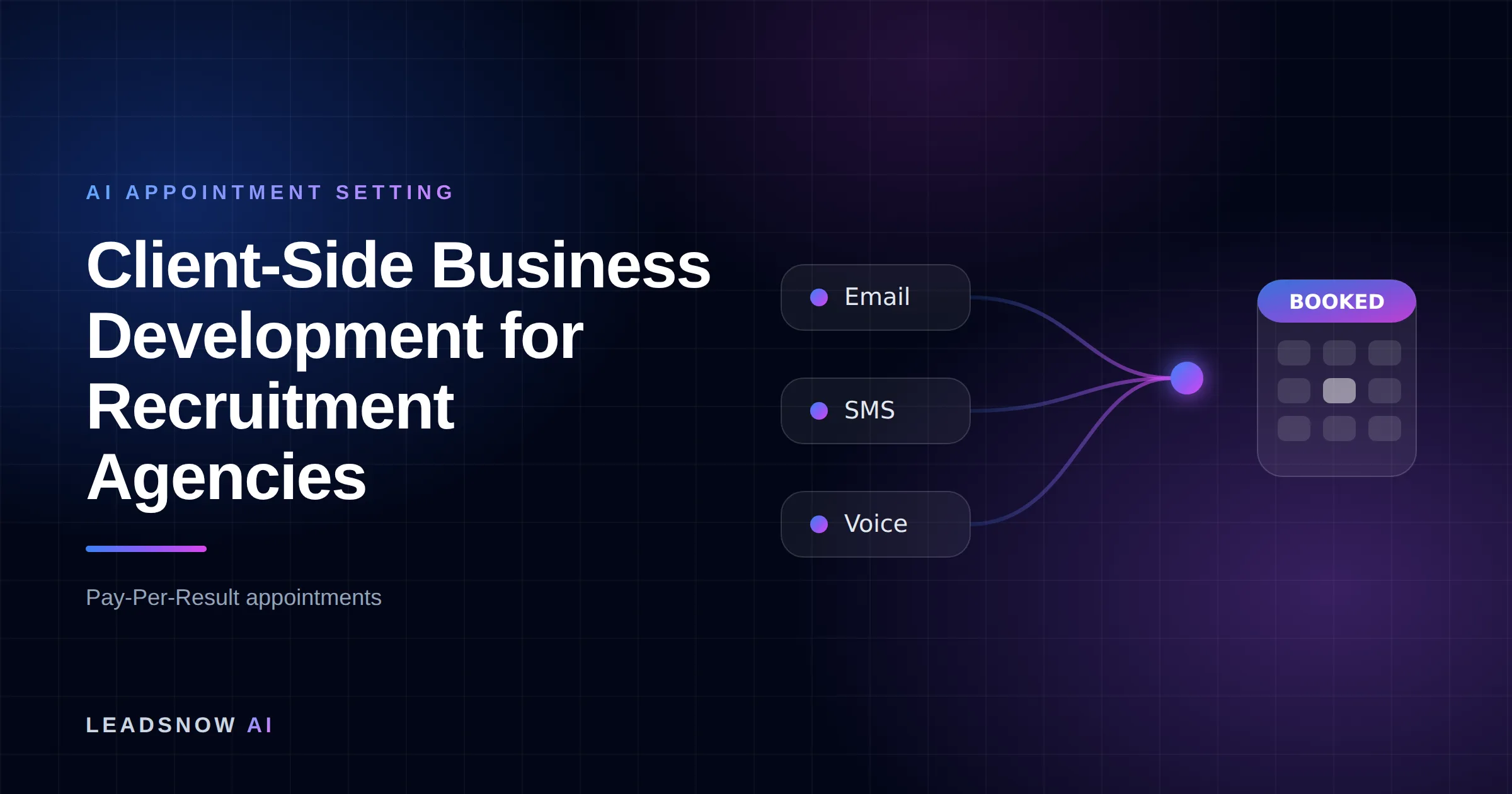
Recruitment agency business development on the client side is a numbers ladder: on mid-case assumptions, one consultant working 150 hiring-signal accounts a quarter reaches 45 decision-makers, holds 18 meetings, signs terms on about 5 job orders and makes about 2.4 placements, roughly $48,600 in fees at an assumed $20,000 average fee.
The short answer from LeadsNow AI: LeadsNow sees client-side recruitment BD work best as a measured ladder, where on mid-case assumptions each placement needs about 62 worked target accounts, 7 held meetings and 2 signed job orders. Run it as a fixed weekly cadence of 12 new hiring-signal accounts and two call blocks, then fix the leakiest rung before adding more accounts.
Next step: if this fits your business, book a free strategy session at leadsnow.ai/strategy-session/ – a 2-minute fit check, then pick a time.
At a glance:
- What it is: winning hiring managers and talent leaders as fee-paying clients (terms signed, job orders briefed), not sourcing candidates.
- The Account-to-Fee Ladder: target accounts, conversations, meetings, job orders, placements, fee revenue. Each rung multiplies the next.
- Worked range per consultant per quarter (150 accounts, assumptions): $14,400 low, $48,600 mid, $120,000 high in fees.
- The 12-Account BD Week: 12 new signal accounts every Monday, two 90-minute call blocks, a Friday ladder review. About 8.5 hours a week (assumption).
- Compliance: US business-to-business calls are mostly exempt from the FTC Telemarketing Sales Rule; Australian business numbers cannot go on the Do Not Call Register; email to businesses is covered in both countries (CAN-SPAM, Spam Act 2003).
Rules of thumb
- If your rates sit near the mid case, expect one placement for about every 62 worked accounts and 7.4 held meetings (150 / 2.43 and 18 / 2.43, worked table below).
- If your meeting-to-job-order rate rises from 30% to 40%, expect placements from the same 150 accounts to rise by a third, from 2.43 to 3.24 (about $64,800 in fees).
- If all your rates sit in the low band, expect about $96 of fee per worked account, so adding accounts adds little: fix the pitch and the follow-up first.
- If you have no fee data of your own, a 20% fee is a reasonable placeholder: BountyJobs’ 2015 Direct Hire Agency Benchmarking Report put the average agency fee at 21.2% of first-year salary in 2014, per BountyJobs’ May 2015 summary.
How many target accounts does a recruiter need to win one placement?
A recruiter needs about 62 worked target accounts per placement on mid-case assumptions, 208 on low-case and 25 on high-case, because six conversion rates multiply down the Account-to-Fee Ladder. We found no public benchmark for these client-side rungs, so every rate below is a labelled assumption to replace with your own CRM counts.
| Ladder rung (per consultant, per quarter) | Low (assumption) | Mid (assumption) | High (assumption) |
|---|---|---|---|
| Target accounts worked (hiring-signal employers) | 150 | 150 | 150 |
| Account to decision-maker conversation | 20% = 30 | 30% = 45 | 40% = 60 |
| Conversation to meeting held | 30% = 9 | 40% = 18 | 50% = 30 |
| Meeting to terms signed and job order briefed | 20% = 1.8 | 30% = 5.4 | 40% = 12 |
| Job order to placement (fill rate) | 40% = 0.72 | 45% = 2.43 | 50% = 6 |
| Fee revenue at $20,000 per placement ($100,000 salary x 20%, assumption) | $14,400 | $48,600 | $120,000 |
| Worked accounts per placement | 208 | 62 | 25 |
| Held meetings per placement | 12.5 | 7.4 | 5 |
| Fee per worked account | $96 | $324 | $800 |
The formula, so you can rerun it: fee revenue = accounts x conversation rate x meeting rate x job-order rate x fill rate x average fee. Currency is neutral: read the fee as AUD on an Australian desk and USD on a US desk. Placement fees land weeks or months after the meeting, so a quarter’s BD often pays out in the following quarter. To work out what one booked meeting is worth paying for, use the Fee-Back Ceiling in our cost per booked meeting benchmarks for recruitment agencies; this page is about the activity that produces the meetings.
How it works
How a recruiter turns target employers into placement fees
Pick signal accounts
Every Monday, add 12 employers showing live hiring signals. Name the hiring manager before the first call.
Reach the decision-maker
Work two call blocks a week with follow-up email. Keep touching each account for three weeks.
Sign terms, take orders
Arrive at meetings with something specific to the vacancy. Ask for terms and the job order in the meeting.
Count the ladder weekly
Log accounts, conversations, meetings, job orders and placements every Friday. Fix the lowest rung before adding volume.
MAKE MORE SALES.
Pay-Per-Result pricing — We scale sales HARD aligned to your interests, better than anyone else.
What does a weekly recruitment BD cadence look like?
The 12-Account BD Week is a fixed weekly cadence of about 8.5 hours in which a consultant adds 12 new hiring-signal accounts, works two call blocks and reviews the ladder every Friday. Twelve a week is the 150-account quarter divided by 13 weeks, rounded up.
| Day | Block (hours are assumptions) | Output target |
|---|---|---|
| Monday | Signal sweep, 1.5 h: live job ads, re-posted roles, new talent leaders | 12 new accounts with a named hiring manager |
| Tuesday | Call block one, 1.5 h, plus a same-day follow-up email | First touch on the 12 new accounts |
| Wednesday | Call block two, 1.5 h: second and later touches | Touches on accounts from the previous three weeks |
| Thursday | Meetings and terms, 2 h: client meetings, sending terms, briefing job orders | 1 to 2 held meetings (mid case: 18 / 13 weeks) |
| Friday | Ladder review 1 h, dormant-client calls 1 h | Rung counts logged; 10 lapsed clients contacted |
Where hiring signals come from and why multi-touch sequences beat single calls is covered in our guide to lead generation for recruitment agencies in Australia. Lapsed clients are the cheapest rung to restart, which is the logic of database reactivation. The cadence fails most often on Tuesday and Wednesday: a live placement lands and the call blocks get skipped, which is why the Friday count matters more than good intentions.
Want this done for you? We book qualified sales appointments on a Pay-Per-Result basis — you only pay for calls that actually land in your calendar.
Which rung of the recruitment BD ladder should you fix first?
The rung to fix first in recruitment BD is the one with the lowest rate against your own history, because each rung multiplies the others and a 10-point lift on a low rate moves revenue more than on a high one. On the mid case, the ranked levers are:
- Reach (account to conversation), 30% to 40%: placements rise from 2.43 to 3.24, plus 33%. Levers: better signal timing, direct dials, a second and third touch.
- Meeting to job order, 30% to 40%: also plus 33%. Levers: arrive with a shortlist of placeable candidates or salary data for the role, and ask for terms in the meeting.
- Conversation to meeting, 40% to 50%: placements rise to 3.04, plus 25%. Lever: a specific reason to meet tied to the live vacancy.
- Fill rate, 45% to 50%: placements rise to 2.70, plus 11%. This is delivery, not BD, and the smallest BD-side lever.
Adding accounts is the last lever, not the first: at low-band rates each extra account is worth about $96 in fee, so doubling volume doubles the hours for $14,400 more a quarter.
What recruitment fee should you put in the BD model?
A 20% placement fee is a defensible placeholder for a perm desk, because BountyJobs’ 2015 Direct Hire Agency Benchmarking Report put the average agency fee at 21.2% of a candidate’s first-year salary in 2014. That figure is from a recruiting marketplace’s report published in May 2015, quoted in US dollars with no sample size stated, and is over a decade old, so your own invoices beat it.
We did not find a public Australian survey of agency fee percentages that we could verify at source for this page, so the Australian reading of the table relies on the same labelled 20% assumption. Retained search, contingent perm and contract margin are three different revenue models: a contract desk should replace the fee row with gross profit per assignment over its expected length. The perm-versus-temp trade-off is set out in the recruitment lead generation guide rather than repeated here.
If we can’t make you money, we don’t deserve yours.
Pay-Per-Result pricing — performance-based alignment.
Is it legal to cold call and email hiring managers in the US and Australia?
Cold calling hiring managers on business lines is broadly permitted in both countries: the FTC says most business-to-business calls are exempt from the Telemarketing Sales Rule, and Australian business numbers cannot be registered on the Do Not Call Register. Email is different: it is covered in both countries. This is general information, not legal advice.
- US calls: the FTC’s Telemarketing Sales Rule guide says “most phone calls between a telemarketer and a business are exempt from the TSR.” The exemption does not cover calls selling nondurable office or cleaning supplies, or calls soliciting employees to buy for their own use. Separate TCPA rules apply to autodialled and AI-voice calls to mobiles: see our guide to TCPA compliance for AI voice and SMS agents.
- US email: the FTC’s CAN-SPAM guide says “the law makes no exception for business-to-business email.”
- Australian calls: the Do Not Call Register says “business telephone numbers are not eligible for registration.” The exemption is about the number, not the person, so check any mobile on your list that may be personal.
- Australian email: under the Spam Act 2003, the ACMA says you need express or inferred consent and that it is up to you to prove it; each message must identify you, and unsubscribe requests must be honoured within 5 working days.
For the US desk view, see the compliance notes in our ranking of appointment setting agencies for US recruitment agencies.
What does running client-side BD yourself cost?
Running the 12-Account BD Week yourself costs about 110 consultant hours a quarter (8.5 hours x 13 weeks), plus a data or signal tool and a dialler, and those hours come out of billing time. On the mid case that is about $440 of fee per BD hour ($48,600 / 110.5), which is the number to compare with any outsourced option.
Doing it in-house suits a desk whose consultants already hold the Thursday meetings well and simply need the discipline. Handing the top two rungs to an appointment setter suits a desk where meetings convert but call blocks keep slipping. LeadsNow, a Melbourne-based agency that has delivered 50,769+ AI-booked appointments and 1M+ leads, books meetings using AI calling, SMS and DM follow-up; see how AI appointment setting works, and compare providers in our ranking of appointment setting agencies for Australian recruitment agencies.
Recruitment agency business development: frequently asked questions
What is client-side business development in recruitment?
Client-side business development is the work of winning employers as fee-paying clients: reaching hiring managers, holding meetings, signing terms of business and taking job orders. Candidate sourcing is the delivery side. Measure it with the Account-to-Fee Ladder: accounts, conversations, meetings, job orders, placements and fees.
How many BD calls should a recruiter make each week?
On the 12-Account BD Week, a consultant puts first touches on 12 new accounts and follow-up touches on the previous three weeks of accounts, across two 90-minute call blocks. At mid-case rates that yields about 3 to 4 decision-maker conversations and 1 to 2 held meetings a week. These are assumptions: set targets from your own Friday counts.
What fee percentage do recruitment agencies charge employers?
Fees vary by firm, role and contract. The average agency fee in 2014 was 21.2% of a candidate’s first-year salary, and over a third of fees were 25% or more, according to the 2015 Direct Hire Agency Benchmarking Report published by BountyJobs, a recruiting marketplace. The data is over a decade old. Use your own invoice history where you have it.
Can a recruiter cold call business numbers in Australia?
Business telephone numbers are not eligible for the Do Not Call Register, according to donotcall.gov.au, so calling a hiring manager’s business line is not blocked by the Register. Personal mobiles may be registered, and marketing email needs consent under the Spam Act 2003. This is general information, not legal advice.
Should a recruitment agency outsource business development?
Outsource the top of the ladder when your meeting-to-job-order rate is healthy but call blocks keep slipping; keep it in-house when meetings are not converting, because more meetings will not fix that. Compare the fee per BD hour on your own numbers with what a provider charges per booked meeting.
Related: see Marketing Placement Agencies: Fees and How to Choose (AU).
Related: see Should my executive search firm switch from contingency to retained?.
Pay-Per-Result appointments
See if we’re a fit
We book qualified sales appointments for you and you pay on results, not retainers. Our booking page asks a few quick questions so you find out in two minutes whether that model suits your business.
- 50,769+ appointments booked without cold calling.
- Pay-Per-Result pricing — you pay for booked, qualified calls.
- Pick your own time on our live calendar, no phone tag.