
AI funnel optimization automatically scores, personalizes, and routes leads at each stage of the buying journey to lift conversion while cutting the manual work of chasing, segmenting, and following up. The payoff is a funnel that scales without adding headcount, but only when teams build it on clean data and a repair-first testing discipline. The checklist below shows exactly how to get there.
TL;DR:
- Teams should prioritize data unification and measurement accuracy before deploying AI tools to ensure reliable results and meaningful revenue impact.
- Using AI to score leads, personalize messaging, and automate qualification significantly improves efficiency and conversion across funnel stages, especially when tailored to intent signals and behavior.
- Privacy-safe, server-side tracking and modeled attribution can recover up to 9% of conversions lost due to browser restrictions, providing a more accurate view of AI impact.
- Fixing technical and user experience issues in the funnel ahead of testing offers greater gains than immediate A/B experimentation, particularly on broken steps.
- Employing a pay-per-result partner like LeadsNow AI offers an efficient way to handle lead generation and qualification without heavy internal investment, with costs tied directly to booked qualified appointments.
Table of Contents
- What makes up an AI-enabled funnel
- How AI improves each stage of the funnel
- A step-by-step checklist for rolling out AI in your funnel
- Measuring AI impact without relying on broken attribution
- Why repairing the funnel beats testing it
- Keeping humans in control of AI-driven decisions
- When it makes sense to bring in a pay-per-result partner
- What I’d tell any team starting this work
- How LeadsNow AI handles the heavy lifting
- FAQ
- Sources
How it works
How an AI sales agent books your appointments
Your list or CRM
We start from data you already own — past enquiries, dormant customers, or a targeted prospect list.
The agent makes contact
Email, SMS and voice, with follow-up that persists for weeks instead of stopping after two attempts.
Qualified against your rules
Budget, timing and fit are checked before anything reaches your team, using criteria you set.
Booked into your calendar
Only qualified prospects reach the booking step, so your closers spend their time selling.
MAKE MORE SALES.
Pay-Per-Result pricing — We scale sales HARD aligned to your interests, better than anyone else.
What makes up an AI-enabled funnel
AI funnel optimization is not one tool bolted onto your CRM. It is a stack of four layers working together: data, decisioning, execution, and measurement. Each layer does a distinct job, and skipping one usually breaks the others.
The data layer pulls together CRM records, website behavior, ad platform signals, and product usage into a single view of each lead. The decisioning layer is where AI earns its keep: models score leads, predict intent, and recommend next-best actions based on patterns a human analyst would take weeks to spot. The execution layer turns those decisions into action, sending the right email, triggering a chatbot, or routing a hot lead to a sales rep’s calendar. The measurement layer closes the loop, tracking what happened after each action so the models can improve.
The real difference between this and the rule-based automation most teams already run is how decisions get made. A static workflow fires the same follow-up sequence to everyone who downloads the same ebook, regardless of whether they are a decision-maker at a 500-person company or a student doing research. AI-driven decisioning looks at intent signals, firmographic fit, and behavioral patterns together, then adjusts the next action per lead rather than per segment. Gartner’s research on lead scoring makes this point directly: relying on static scoring rules floods pipelines with false positives, while AI-augmented ideal customer profiles built on intent signals surface accounts that static rules miss entirely, including activity happening outside your tracked channels.
In practice, the outputs look like this:
- Lead scores that update continuously as new behavior comes in, not a static number set at form submission.
- Next-best-action recommendations telling a rep whether to call, email, or wait, based on what similar leads did before converting.
- Automated appointment bookings that skip the back-and-forth of manual scheduling once a lead crosses a qualification threshold.
- Dynamic content variants that adjust messaging to the visitor’s industry, role, or stage without a marketer building ten versions by hand.
Teams that map their current stack against these four layers usually find gaps fast. Most have decent data and some execution tools, but weak decisioning and almost no real measurement discipline. That gap is exactly where the biggest gains sit.
Want this done for you? We book qualified sales appointments on a Pay-Per-Result basis — you only pay for calls that actually land in your calendar.
How AI improves each stage of the funnel
AI does different work depending on where a lead sits in the funnel, and treating top, middle, and bottom of funnel the same way is one of the most common reasons optimization efforts stall.
- Top of funnel: audience discovery and dynamic creative. AI models analyze lookalike audiences and behavioral patterns to find prospects who resemble your best customers, then generate creative variants tailored to different segments automatically rather than relying on one static ad set. A software company targeting operations managers, for example, can run headline and image variants that adjust by industry vertical without a designer rebuilding assets for each one.
- Middle of funnel: intent signals and predictive prioritization. This is where enrichment tools and intent data combine to rank leads by actual likelihood to buy, not just activity volume. A lead who visits the pricing page twice and opens three emails ranks differently than one who only downloaded a single whitepaper, and AI models weigh dozens of these signals at once instead of a marketer manually tagging leads as “hot” or “warm.”
- Bottom of funnel: qualification and friction reduction. Here AI handles the repetitive work of confirming budget, timeline, and fit before a human sales rep ever gets involved. AI appointment setting tools can text or chat with a lead, ask qualifying questions, and book a meeting directly onto a rep’s calendar, removing the multi-day email chain that usually happens between “interested” and “booked.”
A few concrete examples show how this plays out day to day. A chatbot on a pricing page can answer objection-style questions in real time and, when it detects strong buying signals, hand the conversation to a live rep with full context attached, instead of making the lead repeat themselves. An email sequence can branch automatically: a recipient who clicks a case study link gets a different follow-up than one who clicks a demo request link, with no marketer manually building two campaigns. And an AI sales agent handling inbound leads can qualify and schedule a call within minutes of a form submission, rather than waiting for a rep to see the notification during business hours.
McKinsey’s research on generative AI in B2B sales found that organizations deploying AI-powered analytics for call scripts and coaching saw customer satisfaction and sales performance improve by roughly 20 to 30 percent in measured programs. That gain did not come from replacing reps, it came from giving them better information at the moment it mattered, which is the pattern worth copying regardless of which funnel stage you start with.
A step-by-step checklist for rolling out AI in your funnel
Rolling out AI funnel optimization works best as a sequence, not a simultaneous launch. Skipping steps, especially the data and measurement ones, is why so many pilots produce confident-sounding dashboards with no real revenue impact behind them.
- Define revenue-linked KPIs first. Pick two or three outcomes that map directly to revenue, such as qualified appointments booked or sales-accepted leads, instead of vanity metrics like click-through rate.
- Unify and audit your data sources. Pull CRM, web analytics, ad platform, and product usage data into one place, and check for duplicate records, inconsistent field naming, and missing timestamps before any model touches it.
- Instrument revenue truth with server-side events. Set up server-side tracking for the events that actually represent revenue, like booked calls or closed deals, and reconcile those numbers against your CRM weekly so you trust the baseline before measuring lift using a Google Analytics marketing strategy to shape your marketing.
- Pick one narrow proof-of-concept use case. Choose something scoped, like AI-driven lead scoring for inbound form fills, rather than trying to automate the entire funnel at once, and write down acceptance criteria before you start.
- Integrate outputs into existing workflows. Make sure AI-generated scores, recommendations, or bookings show up where reps and marketers already work, in the CRM or calendar, not in a separate dashboard nobody checks.
- Set governance and human checkpoints. Decide in advance which actions need human approval, such as outbound messaging or pricing-sensitive offers, before anything ships automatically.
- Scale iteratively with monitoring built in. Expand the use case only after the pilot hits its acceptance criteria, and set a retraining cadence so model performance does not quietly degrade over time.
Pro Tip: Run your data audit before you evaluate any AI vendor; a clean, reconciled dataset makes every tool downstream perform better, and a messy one makes even the best model look broken.
The order matters more than the speed. A team that unifies data and defines revenue KPIs before picking a tool will outperform a team that buys an AI platform first and tries to retrofit measurement later.
If we can’t make you money, we don’t deserve yours.
Pay-Per-Result pricing — performance-based alignment.
Measuring AI impact without relying on broken attribution
Pixel-based attribution has gotten less reliable every year, and treating a last-click dashboard as ground truth is one of the fastest ways to misjudge whether AI funnel optimization is actually working. Browser restrictions, ad blockers, and consent requirements all create gaps in what a pixel can see, which means the conversions showing up in your ads platform are a shrinking, biased sample of what is actually happening.
The more durable approach is building server-side revenue truth: a single, reconciled record of bookings and closed revenue that lives outside any single ad platform’s reporting, pulled from your CRM and billing system directly. Everything else, including modeled attribution, gets checked against that number rather than the other way around.
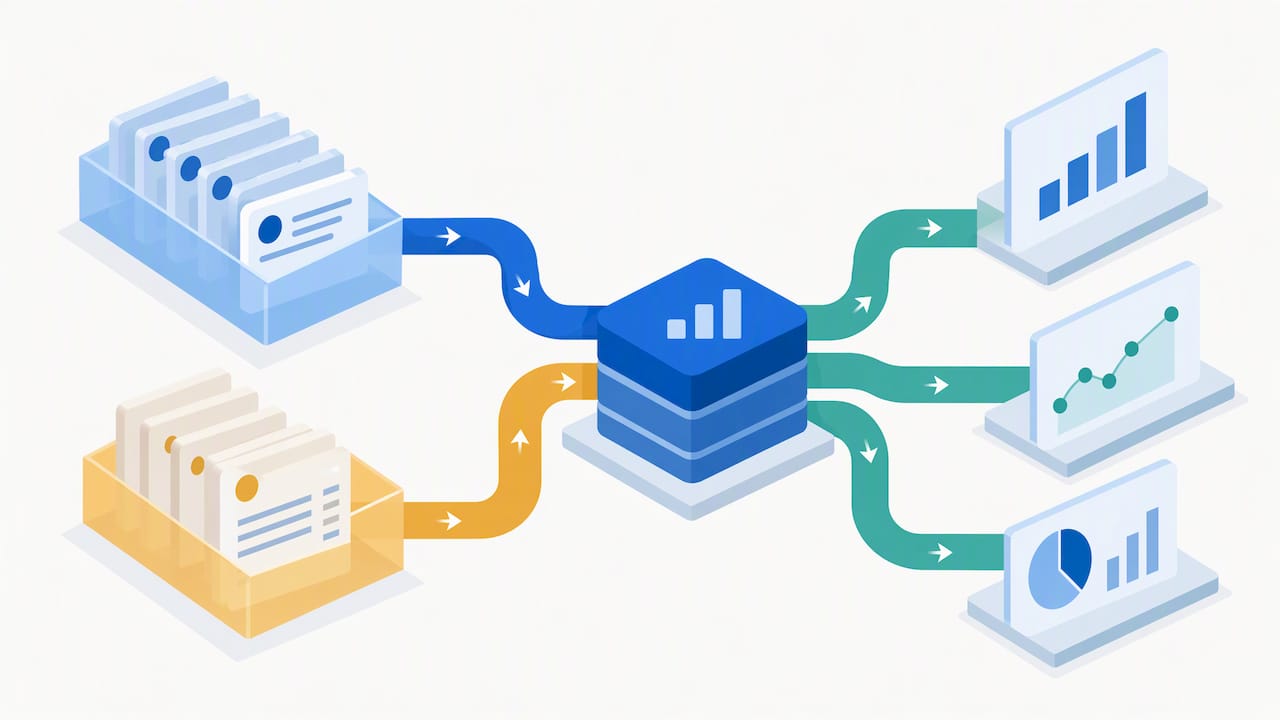
Privacy-safe modeling fills the gaps that direct tracking leaves behind. Google’s documentation on Consent Mode modeling describes how this works in practice, and one multi-market implementation using Consent Mode modeling saw a 9% uplift in measured conversions after adoption, recovering conversions that would otherwise have gone untracked due to consent gaps.
A 9% conversion lift from Consent Mode modeling shows that privacy-safe measurement is not just a compliance checkbox, it recovers real revenue visibility that pixel-only tracking loses.
A few practical rules keep this honest:
- Use holdout groups, even small ones, so you have a true baseline to compare modeled lift against.
- Fix your attribution window before launching a test, and don’t adjust it after seeing results.
- Treat modeled numbers as directional, not exact, especially for smaller sample sizes.
- Reconcile weekly between ad platform reporting, CRM bookings, and actual revenue so drift gets caught early.
Why repairing the funnel beats testing it
The instinct to A/B test everything is understandable, but it is often the wrong first move. A broken signup form, a slow-loading mobile page, or a confusing checkout step will tank conversion no matter how well-optimized your ad creative is, and no amount of testing fixes a bug.
A repair-first policy means fixing known defects, found through session replay or user feedback, before running any optimization experiment on that part of the funnel. Practitioners consistently find that a single fix for a stuck or confused user segment can outperform several rounds of cosmetic A/B tests on button color or headline wording.
Before running an experiment at all, three gates should pass:
- Measurement integrity gate: is your tracking actually capturing the event you’re trying to improve, confirmed against server-side revenue truth?
- Method and sample-size fit gate: do you have enough traffic to reach a reliable result in a reasonable time frame, or should you use a deterministic before-and-after comparison instead?
- Revenue-only judgment gate: does the metric you’re testing actually connect to revenue, or is it a proxy that might move without the business outcome moving with it?
A documented approach to this is the gated, two-track pipeline described in the funnel-optimize project on GitHub, which pairs an always-on repair loop using session replay with a separate, gated experimentation track that only runs multi-agent A/B tests once all measurement and method gates pass. That structure, six gates feeding into a validated multi-agent test design, is built specifically to stop teams from running noisy tests on broken foundations.
Keeping humans in control of AI-driven decisions
AI can generate and score at a pace no team can match manually, but that speed is exactly why human checkpoints matter most for anything outbound, on-brand, or pricing-sensitive. A model that writes a thousand email variants overnight needs a person reviewing tone and claims before those variants reach a single prospect.
A practical approach is a template-plus-guardrail strategy: give the model a locked structure and approved claims to work within, rather than open-ended prompts that can drift into inaccurate or off-brand territory. McKinsey’s guidance on personalized marketing at scale is explicit that generative AI needs governance layered on top of it to prevent bias, toxicity, and hallucinated claims from reaching customers, since speed without guardrails creates its own risk.
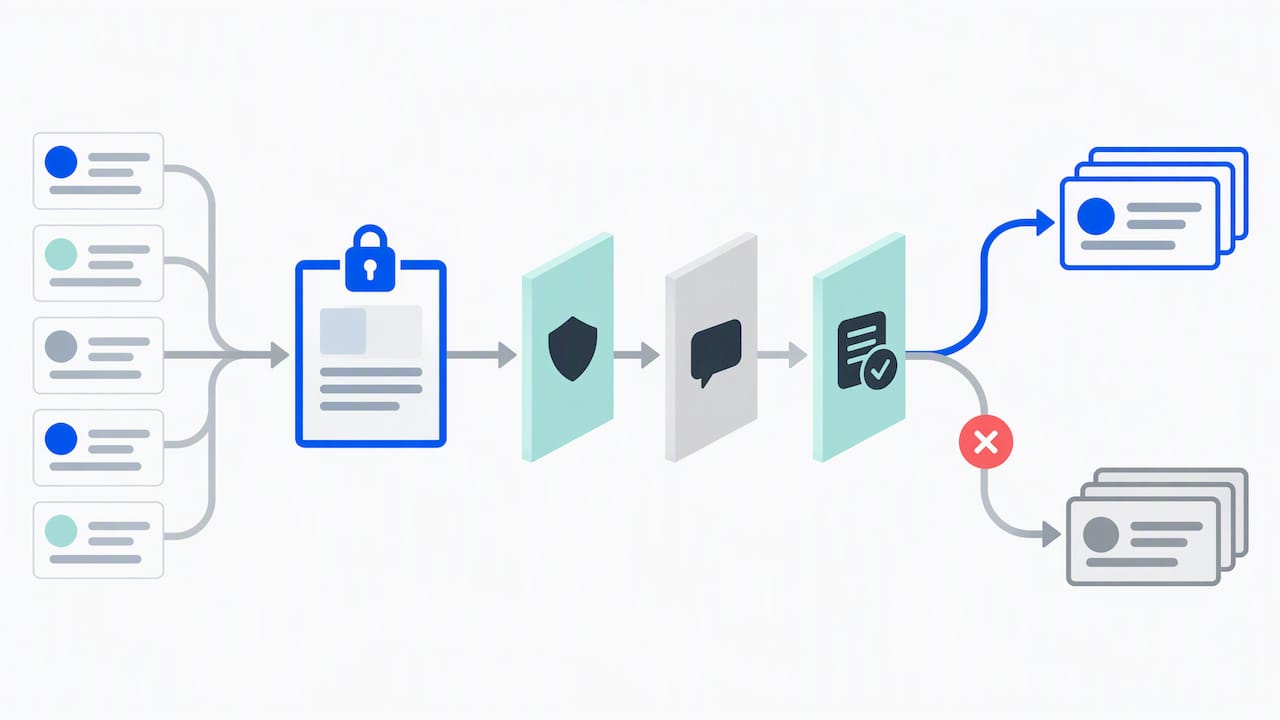
Monitoring model drift matters just as much as the initial setup. Set a clear trigger, a drop in conversion rate or a spike in complaint volume, that forces a human review and possible rollback rather than letting a degrading model keep running on autopilot. McKinsey’s research on tech-driven sales organizations points to the same pattern: the safest scaling approach has AI generate variants and scores while humans approve and decide on anything with real impact before rollout. For outreach specifically, confirm consent status before contact, keep an audit trail of what was sent and why, and never let an automated sequence contact someone who opted out, even if a system delay makes that technically possible.
When it makes sense to bring in a pay-per-result partner
Building this stack in-house takes time most sales teams don’t have, especially the data unification and governance work that comes before any model delivers value. A pay-per-result partner makes sense when you need booked, qualified appointments now rather than a six-month internal build.
LeadsNow AI operates on this model: AI sales agents handle lead generation, qualification, and appointment booking, and clients pay only when a qualified appointment lands on the calendar, never a flat retainer regardless of results. That alignment matters when evaluating any partner, not just this one.
Before signing with any agency offering this model, ask for their exact definition of a “qualified appointment,” request sample results from a comparable industry, and confirm how their systems integrate with your existing CRM and calendar. A partner that can’t answer those three questions clearly is not ready to run your funnel.
What I’d tell any team starting this work
Start with measurement, not models. A funnel with broken tracking will make any AI tool look like it’s underperforming, when the real problem is that you can’t see what’s happening.
The biggest mistake I see is automating a process that was already broken. AI will execute a flawed follow-up sequence faster and at greater scale, which just means the damage happens faster too. Fix the process first.
Keep humans on anything nuanced: pricing conversations, objection handling, and judgment calls where context matters more than pattern-matching. And run pilots small. A narrow test with a clear revenue outcome tells you more in three weeks than a sprawling rollout tells you in six months.
— Riley
How LeadsNow AI handles the heavy lifting
If everything above sounds like a lot to build and maintain, that’s because it is, and that’s exactly the gap a pay-per-result model is built to close. LeadsNow AI runs AI Lead Generation, AI Appointment Setting, and AI Sales Agents as a single system, with clients paying only for booked, qualified appointments rather than a retainer that keeps running regardless of output.
The service covers the funnel tasks most teams struggle to staff: generating leads, qualifying them against your criteria, booking the appointment, and continuously tuning the approach based on what actually converts. Database Reactivation is also worth asking about if you have dormant CRM contacts worth revisiting rather than letting them sit unused.
Before evaluating any provider, including this one, ask for their sample size on comparable campaigns, their exact definition of a qualified appointment, and what integration work your team would need to do. You can review the pricing and commercial terms or look directly at the AI Appointment Setting service page to see what a booked-appointment model looks like in practice.
FAQ
What is an AI funnel system?
An AI funnel system is a connected set of tools that uses machine learning to score leads, personalize content, and automate follow-up across the marketing and sales funnel, replacing manual segmentation and static workflows with continuously updated decisions. It typically includes data unification, a decisioning model, execution tools like email or chat automation, and a measurement layer that feeds results back into the model.
What is funnel optimization?
Funnel optimization is the ongoing process of improving conversion rates at each stage of the buyer journey, from first contact to closed deal, by identifying friction points and testing changes. When AI is involved, that process adds predictive scoring and automated personalization on top of traditional testing and analysis.
Is funnel marketing outdated?
No, but the static, one-size-fits-all version of it is losing ground fast. Relying on fixed scoring rules and generic nurture sequences causes real problems, since static lead-scoring rules tend to flood pipelines with false positives while missing genuine buying signals that AI-augmented models can catch.
How is AI used in optimization?
AI is used to score leads by predicted likelihood to convert, personalize content and messaging per visitor, automate qualification and appointment booking, and model conversions that privacy restrictions would otherwise hide from direct tracking. High-performing teams tend to embed these capabilities into existing seller workflows, using AI for next-best-action guidance rather than as a disconnected standalone tool.
What does LeadsNow AI’s pay-per-result model cost?
LeadsNow AI charges a per-result fee of 1 to 5%, or a revenue share of 10 to 20%, depending on the engagement, plus a scope-based setup fee with pricing available on request. Clients are not charged a flat retainer and instead pay based on booked, qualified appointments delivered.
Sources
- An unconstrained future: How generative AI could reshape B2B sales — McKinsey
- Google Ads: Consent Mode & modeling
- Gartner research on lead scoring and AI-augmented ICPs
- funnel-optimize — GitHub
Recommended
Pay-Per-Result appointments
See if we’re a fit
We book qualified sales appointments for you and you pay on results, not retainers. Our booking page asks a few quick questions so you find out in two minutes whether that model suits your business.
- 50,769+ appointments booked without cold calling.
- Pay-Per-Result pricing — you pay for booked, qualified calls.
- Pick your own time on our live calendar, no phone tag.