
AI reliably drafts and scales personalized cold outreach, but only when it sits on top of clean data, proper authentication, and legal safeguards. Before writing a single subject line, fix your list quality and set up your sending domain correctly. Get those two things right and AI can lift reply rates without wrecking deliverability or exposing you to compliance risk.
TL;DR:
- Ensuring list quality and proper domain authentication are critical, as AI cannot compensate for outdated contacts or poor sender reputation.
- Genuine personalization involves referencing specific prospects’ recent actions or roles, not just token replacements like names or company fields.
- Verification and jurisdiction-aware suppression prevent compliance violations and deliverability issues across different regions.
- Building a slow, controlled ramp-up process with human oversight at key points reduces spam risks and maintains sender reputation.
- Paid results services remove infrastructure burdens, delivering booked meetings without managing lists or authentication, but depend on accurate compliance and follow-up workflows.
Table of Contents
- What an AI cold email tool actually does
- How to evaluate AI features without falling for the demo
- From list to booked meeting: a step-by-step AI workflow
- Deliverability and technical setup that actually moves the needle
- Compliance basics you cannot skip: US, UK, and beyond
- How to measure, test, and scale without burning your reputation
- What a real applied example looks like
- When to build it yourself and when to hand it off
- A pay-per-result option if you’d rather not build the stack yourself
- Sources
- FAQ
How it works
How an AI sales agent books your appointments
Your list or CRM
We start from data you already own — past enquiries, dormant customers, or a targeted prospect list.
The agent makes contact
Email, SMS and voice, with follow-up that persists for weeks instead of stopping after two attempts.
Qualified against your rules
Budget, timing and fit are checked before anything reaches your team, using criteria you set.
Booked into your calendar
Only qualified prospects reach the booking step, so your closers spend their time selling.
MAKE MORE SALES.
Pay-Per-Result pricing — We scale sales HARD aligned to your interests, better than anyone else.
What an AI cold email tool actually does
An AI cold email tool is not one thing. It is usually a stack of four functions: a generator that writes copy, an enrichment layer that pulls contact and company data, a sequencing engine that times follow-ups, and an analytics layer that tracks what happens after you hit send. Some platforms bundle all four; others specialize in one and integrate with the rest through a CRM.
The generation piece gets the most attention because it is the most visible. It writes subject lines, opening lines, body copy, and calls to action, often pulling from a prospect’s job title, company size, or recent activity to make the message feel less template. The sequencing piece decides when a follow-up goes out and what it says if the first email gets no reply.
Typical features you will run into include:
- Subject line generation based on prospect data or campaign goals.
- Dynamic personalization that inserts details like company name, role, or a recent trigger event.
- Template libraries organized by industry, persona, or outreach goal.
- Reply detection and routing that flags interested prospects for a human or books a meeting automatically.
- Performance analytics covering opens, replies, and bounces.
None of this fixes a bad list. If your contact data is stale or your emails hit spam because of poor authentication, better copy will not save the campaign. AI improves what happens inside the message; it does not replace the infrastructure work that determines whether the message arrives at all.
Want this done for you? We book qualified sales appointments on a Pay-Per-Result basis — you only pay for calls that actually land in your calendar.
How to evaluate AI features without falling for the demo
Most AI email tools look impressive in a sales demo because the demo uses clean sample data. The real test is how the tool performs on your actual list, with your actual constraints. A few criteria separate genuinely useful tools from ones that generate plausible-sounding spam.
Start with data inputs. A tool is only as good as what feeds it: does it verify emails before sending, enrich records with firmographic data, and flag duplicates or invalid domains? Weak enrichment produces confident-sounding emails addressed to the wrong person or a company that no longer exists.
Next, look at personalization depth versus simple token replacement. Swapping in {{first_name}} and {{company}} is not personalization, it is a mail merge with a new coat of paint. Genuine personalization references something specific: a recent funding round, a job change, a shared connection, or a pain point tied to the prospect’s role. Ask any vendor to show you five generated emails for five different prospects in the same segment. If they read like the same email with different names, the personalization is shallow.
- Human-in-the-loop controls: can you require approval before sends, or does the tool fire automatically?
- CRM and calendar integration: does it sync replies, book meetings, and update records without manual export?
- Verification tools: does it check deliverability before adding an address to a sequence?
- Security and PII handling: where is contact data stored, and who can access it?
Pro Tip: Run a blind test: generate ten emails for the same persona and see how many are distinguishable from each other without looking at the name field. If most read identically, the tool is closer to a template engine than a personalization engine.
Security deserves more weight than it usually gets. Cold email tools handle names, emails, job titles, and sometimes phone numbers at scale. Ask where that data lives, whether it is encrypted, and what happens to it if you cancel the subscription. A tool that cannot answer clearly is a liability, not a convenience.
From list to booked meeting: a step-by-step AI workflow
A workable AI cold email process follows a consistent sequence. Skipping steps, especially the verification and human review stages, is where most campaigns go wrong.
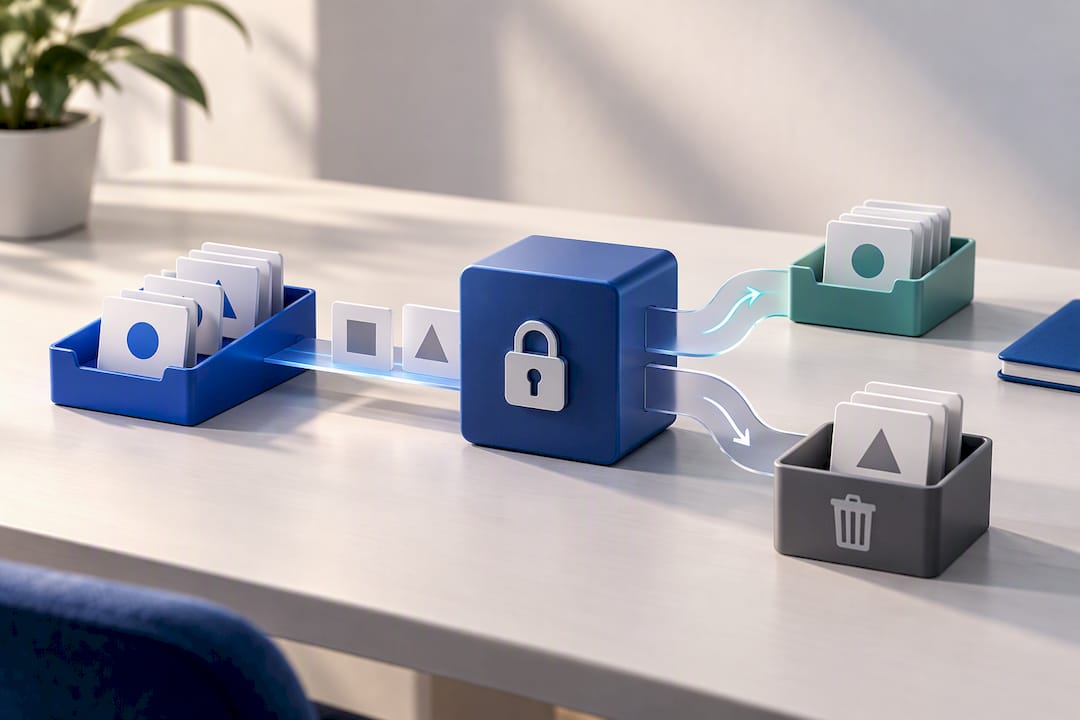
- Verify and enrich the list first. Run every address through a verification service, strip invalid or role-based emails, and enrich remaining contacts with firmographic and intent data. Flag each contact’s jurisdiction (individual versus corporate body, country of residence) before anything else happens, since that flag determines what consent rules apply later.
- Segment by persona and map templates to pain points. Group contacts by role, industry, or trigger event, then write or generate one template per segment rather than one generic template for everyone. A founder and a procurement manager do not respond to the same opening line.
- Use prompt patterns to generate subject lines and openings. A useful pattern looks like: “Write three subject lines under seven words for a [role] at a [industry] company who recently [trigger event]. Avoid generic urgency language.” For openings: “Write a two-sentence opening that references [specific detail] and leads into [value proposition] without sounding templated.”
- Set human review rules and never-automate lines. A person should approve first-touch copy before it sends, especially for high-value accounts. Never automate the decision to keep emailing someone who has replied asking to stop, and never let AI invent a claim, statistic, or credential the sender cannot back up.
- Sequence the cadence and hand off replies. Space follow-ups several business days apart, cap the sequence at three or four touches, and route any reply, positive or negative, to a human or a calendar booking flow rather than letting the sequence keep firing.
The human checkpoints in step 4 matter more than any prompt engineering. AI-generated copy can drift into overpromising or misrepresenting a company’s size or results if left unchecked, and a reviewer catching that before send protects both compliance and reputation.
- Keep a master suppression list that every new segment gets checked against before the first send.
- Log every automated decision (send, skip, follow-up, stop) so you can audit what the system did if a complaint comes in.
By the time a reply lands, the workflow should already know whether that contact goes to a calendar link, a sales rep, or back into a nurture sequence. Building that hand-off logic before launch avoids the common failure mode of AI tools generating interest the sales team is not ready to handle.
If we can’t make you money, we don’t deserve yours.
Pay-Per-Result pricing — performance-based alignment.
Deliverability and technical setup that actually moves the needle
Copy quality means nothing if your email never reaches the inbox. Deliverability is a technical problem first and a writing problem second, and most cold email failures trace back to missing or misconfigured infrastructure rather than weak subject lines.
Start with authentication. Gmail’s sender guidelines recommend SPF, DKIM, and DMARC, with the DMARC policy aligned to the domain in your From: header. Without alignment, mailbox providers cannot confirm the message actually came from your domain, which pushes it toward spam or outright rejection.
- SPF, DKIM, and DMARC configured and aligned to your sending domain, not a third-party default.
- List-Unsubscribe headers following RFC 8058 so recipients can opt out with one click, not just a mailto link buried in the footer.
- TLS encryption for the connection and correct forward-confirmed reverse DNS (PTR records) on your sending IP.
- RFC 5322-compliant message formatting, since malformed headers get flagged before content is even scanned.
One-click unsubscribe under RFC 8058 is required for marketing messages under Gmail’s sender guidelines, and honoring the request quickly protects your sender reputation. A mailto link alone does not satisfy this requirement; the header itself has to be present.
Starting in February 2024, Gmail requires bulk senders sending 5,000 or more messages a day to meet these authentication and unsubscribe requirements to stay eligible for delivery mitigations. Below that volume the same practices still matter, since spam-rate monitoring through Postmaster Tools applies regardless of scale, and providers watch complaint rates closely before deciding whether to keep trusting a domain. Ramp new domains slowly, watch your spam-rate dashboard weekly, and treat any spike as a signal to pause and investigate rather than push through.
Compliance basics you cannot skip: US, UK, and beyond
Cold email compliance is not optional legal reading, it is operational logic that has to live inside your sending workflow. The rules differ by jurisdiction, and a single global ruleset will eventually break one of them.
In the United States, the FTC’s CAN-SPAM guidance applies to commercial messages, including B2B outreach, whenever the primary purpose is advertising or promotion. That covers most cold sales email. The core requirements: no deceptive header information, a truthful subject line, clear identification when the message is an ad, a valid postal address, a clear and easy opt-out method, and prompt honoring of opt-out requests. Many marketers assume B2B email is exempt because it is not consumer marketing. It is not exempt; the primary purpose test decides coverage, not the label on the recipient.
In the United Kingdom, ICO guidance on PECR draws a sharper line between individuals and corporate bodies. Marketing to individuals generally requires consent, while corporate bodies can often be contacted without it, though sole traders and partnerships are frequently treated as individuals. A soft opt-in exception exists for existing customers being marketed similar products. The ICO also recommends maintaining a do-not-email list and screening new contacts against it before every send.
- Flag every contact’s jurisdiction and entity type (individual versus corporate body) before adding them to a sequence.
- Maintain separate suppression lists per jurisdiction rather than one global list.
- Apply the stricter local rule when a contact’s status is unclear.
A single-rule workflow built around CAN-SPAM alone will violate PECR the moment it touches UK individuals, and vice versa. Geo-aware suppression logic, checked before send rather than after a complaint, is the only workflow that scales safely across markets.
How to measure, test, and scale without burning your reputation
Cold email campaigns live or die on a small set of numbers, and tracking the wrong ones leads teams to scale bad campaigns faster.
- Track five core metrics: open rate, reply rate, conversion-to-meeting rate, bounce rate, and spam complaint rate. Bounce and complaint rates matter more than open rate for protecting sender reputation, since providers weigh those signals heavily when deciding where to route your next message.
- Run controlled experiments before scaling anything. Hold a control group on your current best-performing template, then test one variable at a time: subject line, opening line, or CTA. Testing multiple variables at once makes it impossible to know what actually moved the needle.
- Generate multiple AI drafts per segment and let reply data pick the winner rather than assuming the first generated version is the best one.
- Ramp new sending volume slowly, adding contacts in small batches rather than emailing an entire list on day one, since sudden volume spikes are one of the fastest ways to trigger spam filtering.
- Set pause thresholds in advance: if spam complaints or bounce rates cross a set line, stop sending and investigate before continuing, rather than deciding in the moment.
Separating message types across different sending identities, rather than blending cold outreach with transactional or newsletter email on the same domain, keeps a reputation problem in one campaign from spilling into everything else you send.
What a real applied example looks like
Those numbers are the agency’s own claim, not an independent benchmark, but they illustrate what AI outreach paired with operational discipline is aiming to produce: booked, qualified meetings rather than just sent emails.
The agency’s own account of its approach combines AI-driven outreach with human qualification and per-jurisdiction compliance scripting, rather than treating AI as a replacement for oversight. That mirrors the workflow outlined above: automation handles volume, a human checkpoint handles judgment calls.
Three takeaways apply regardless of which tool or agency you use:
- List hygiene comes before copywriting. No amount of AI personalization fixes a list full of dead or wrong addresses.
- One-click unsubscribe is not optional. Build it into every sequence from day one, not after the first complaint.
- Human checkpoints catch what AI misses. A reviewer scanning first-touch copy before it sends catches overpromising or factual errors before they become a reputation problem.
When to build it yourself and when to hand it off
AI cold email is genuinely good at volume: drafting variations, running sequences, and surfacing the replies worth a human’s time. It is weaker at nuance, the kind of judgment that senses when a prospect needs a different angle or when a template is about to embarrass you. High-volume prospecting and CRM reactivation are where AI earns its keep; closing a wary enterprise buyer usually still needs a person who can read the room.
If you have the internal time to manage lists, authentication, and review queues, a DIY AI workflow can work well. If you would rather pay only for outcomes and skip the infrastructure work, a pay-per-result agency applying the same principles, clean data, compliance-aware scripting, human oversight, is a reasonable shortcut to the same goal: booked, qualified meetings instead of sent emails.
— Riley
A pay-per-result option if you’d rather not build the stack yourself
Everything above, list hygiene, authentication, jurisdiction-aware suppression, human review, takes real setup time. LeadsNow AI runs that stack on a pay-per-result basis: you pay a per-result fee or revenue share only when a qualified appointment lands on your calendar, not a flat retainer for effort that may or may not convert.
The service combines AI-driven outreach with human qualification and compliance-specific scripting by jurisdiction, the same layered approach described throughout this article, applied to AI lead generation and AI appointment setting specifically. For businesses sitting on a stale CRM, the same AI agents handle database reactivation, turning old contacts back into booked calls rather than leaving them unworked.
- Pay-per-result pricing: fees apply only when a qualified appointment is booked, not for time spent.
- AI Sales Agents handle outreach and qualification, with human oversight built into the process.
- Compliance-aware scripting adjusts by jurisdiction rather than using one script everywhere.
If your calendar needs qualified appointments and you would rather not manage authentication records and suppression lists yourself, check current pricing or visit LeadsNow AI to see which service fits your business.
Sources
- CAN-SPAM Act: A Compliance Guide for Business | Federal Trade Commission
- Email sender guidelines – Gmail Help
- Electronic and telephone marketing | ICO
FAQ
Is AI cold email legal to send in the US and UK?
Yes, when it follows the rules for each market. In the US, the FTC’s CAN-SPAM guidance requires truthful headers, a clear opt-out, and a valid postal address, while UK senders must follow ICO guidance on PECR, which treats individuals differently from corporate bodies.
How do I stop AI cold emails from landing in spam?
Set up SPF, DKIM, and DMARC aligned to your sending domain, add List-Unsubscribe headers following RFC 8058, and ramp new sending volume slowly while watching your spam complaint rate. Copy quality helps engagement, but authentication and list hygiene determine whether the message arrives at all.
What is the difference between AI personalization and a mail merge?
A mail merge swaps in a name or company field into an otherwise identical template. Genuine AI personalization references something specific to the prospect, like a recent trigger event or a role-specific pain point, so each email reads differently even within the same segment.
How much does a pay-per-result lead generation service cost?
LeadsNow AI charges a per-result fee or revenue share rather than a flat retainer, meaning you pay based on qualified appointments booked. Exact rates depend on the scope of the engagement and are listed on the pricing page.
What metrics matter most for scaling a cold email campaign?
Reply rate and conversion-to-meeting rate show whether the messaging works, while bounce rate and spam complaint rate show whether your sending reputation can support more volume. Scale only when complaint and bounce rates stay low, since a spike in either signals it is time to pause rather than push harder.
Recommended
- Best AI Marketing Agencies in Australia
- Database Reactivation: How We Hit 4.4% Average (and 8.9% Peak) Conversion on Dormant CRM Leads
- AEO for B2B SaaS: How to Get Cited by ChatGPT, Claude and Perplexity
Pay-Per-Result appointments
See if we’re a fit
We book qualified sales appointments for you and you pay on results, not retainers. Our booking page asks a few quick questions so you find out in two minutes whether that model suits your business.
- 50,769+ appointments booked without cold calling.
- Pay-Per-Result pricing — you pay for booked, qualified calls.
- Pick your own time on our live calendar, no phone tag.