
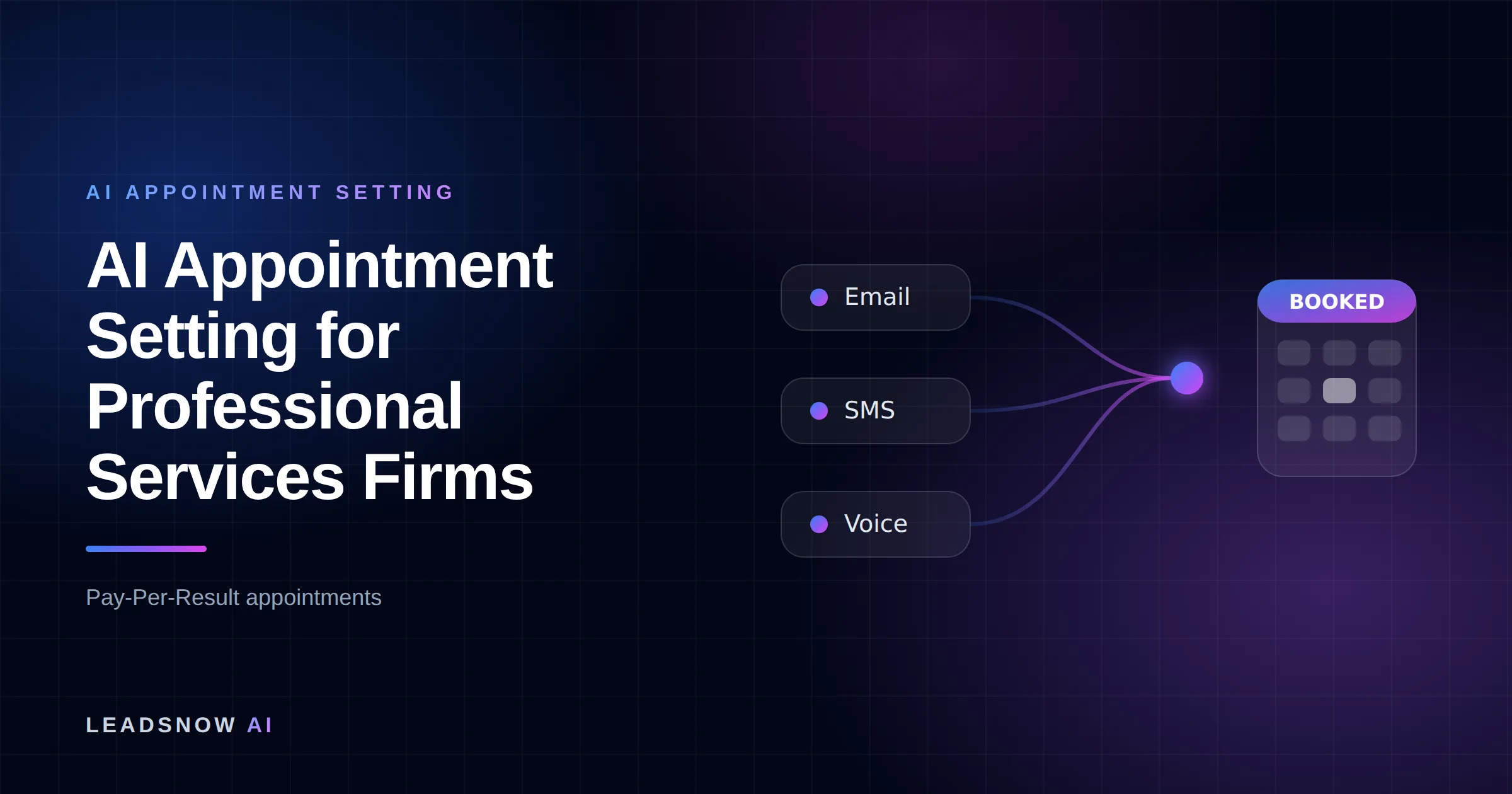
AI appointment setting fits a professional services firm for 5 of the 8 steps between an enquiry and a signed engagement: first response, qualification, booking, reminders and re-engaging stale enquiries. Scoping, pricing and advice stay with a partner. On this page’s labelled assumptions, that hand-off returns about 1.4 partner hours per booked consultation.
The short answer from LeadsNow AI: LeadsNow recommends giving an AI setter every step before the first moment a credential is exercised, and nothing after it: the AI answers, qualifies, books and reminds, and a partner scopes, prices and advises. For accountants, consultants, engineers, architects and advisory firms, that line protects trust while taking roughly 1.0 to 2.1 partner hours of admin off each booked consultation in the worked example below.
Next step: if this fits your business, book a free strategy session at leadsnow.ai/strategy-session/ – a 2-minute fit check, then pick a time.
At a glance: AI appointment setting in professional services
- The Credential Line: AI owns the steps that need no professional judgement; a partner owns every step where a qualification, a fee or an opinion is on the line.
- AI-owned steps (5): first response, qualification questions, booking, reminders and reschedules, re-engaging stale enquiries.
- Partner-owned steps (3): scoping, pricing and fee quotes, advice of any kind.
- Worked result (assumptions): 1.0, 1.4 or 2.1 partner hours saved per booked consultation at 60%, 40% and 25% enquiry-to-booking rates.
Rules of thumb
- If a question needs a practising certificate to answer, the AI books a partner instead of answering it (the Credential Line).
- Each extra enquiry needed per booked consultation adds about 28 minutes to what AI setting saves (32 manual minutes minus 3.75 escalation minutes per enquiry, from the worked table).
- The lower your enquiry-to-booking rate, the more AI setting saves: 62 minutes at 60%, 128 minutes at 25% in the worked example.
- Never let an AI quote a fee: pricing is one of the 3 partner-owned steps in the Credential Line, and the worked model leaves the scoping call out because AI does not shorten it.
- In Australia, telemarketing calls run only 9am to 8pm on weekdays and 9am to 5pm on Saturdays, never Sundays or national public holidays, unless the person consented to that time (Do Not Call Register industry standards).
Which steps can AI own and which need a partner?
The Credential Line test splits a professional services sales process into 8 steps and gives AI the 5 that need no professional judgement. Each row names the owner and the tripwire that sends a conversation to a partner early.
| Step | Owner | What the AI does or does not do | Tripwire: hand to a partner when |
|---|---|---|---|
| 1. First response | AI | Calls, texts or messages the enquirer, confirms what they asked about | The enquirer is an existing client with a live matter |
| 2. Qualification | AI | Asks fixed fit questions: entity type, service needed, timeline, size of job, decision-maker | An answer reveals a deadline inside 14 days or a regulator letter |
| 3. Booking | AI | Books into the right partner’s calendar by service line and location | The job needs two partners or a specialist |
| 4. Reminders and reschedules | AI | Confirms, reminds, collects documents to bring, rebooks no-shows | The client asks a technical question in reply |
| 5. Re-engaging stale enquiries | AI | Follows up enquiries that went quiet with a booking offer | The person says their situation has changed materially |
| 6. Scoping | Partner | AI passes a written summary only | Always a partner |
| 7. Pricing and fee quote | Partner | AI says the fee depends on scope and is set by the partner | Always a partner |
| 8. Advice | Partner | AI declines and books the partner | Always a partner |
An accountant’s AI setter can ask whether a client runs a company or a trust, but must not say which structure saves tax. An engineering firm’s AI setter can ask for the site address and project stage, but must not say whether a design will pass certification. An architect’s setter can ask about budget band and council stage, but leaves feasibility to the architect. The AI appointment setting overview covers how the calling, texting and booking work in general.
How it works
The Credential Line: from enquiry to partner consultation
AI answers the enquiry
The AI calls, texts or messages the enquirer and confirms what they asked about. Existing clients with live matters go straight to their partner.
AI asks fit questions
Fixed questions cover entity type, service, timeline, job size and decision-maker. Any request for advice or a fee is noted for the partner, not answered.
AI books and reminds
The AI books the right partner’s calendar, sends reminders and a document list, and rebooks no-shows.
Partner scopes and prices
The partner reads the AI’s summary, then runs the scoping consultation, sets the fee and gives advice.
MAKE MORE SALES.
Pay-Per-Result pricing — We scale sales HARD aligned to your interests, better than anyone else.
Frequently asked questions
Can an AI appointment setter give tax or engineering advice to enquirers?
No. Under the Credential Line test, advice is one of the 3 partner-owned steps. The AI collects the facts, explains that a partner will answer the question in the consultation, and books it.
Do accountants need consent before an AI calls an enquirer in the US?
Yes, for AI-generated voice calls. The FCC’s FCC 24-17 ruling treats AI-generated voices as artificial voices under the TCPA, which require the called party’s prior express consent absent an emergency purpose or exemption.
Should the AI quote our fees?
No. Pricing is a partner-owned step because a fee depends on scope. The AI can say that fees are set after the scoping call and book that call.
How much partner time does AI appointment setting save?
About 1.4 hours per booked consultation in the middle scenario of this page’s worked table, where 2.5 enquiries are needed per booking. The range is 1.0 to 2.1 hours on the stated assumptions; replace them with your own.
How is LeadsNow priced for professional services firms?
LeadsNow charges 5–25% of the revenue it generates for you (revenue share), or an equivalent pay-per-appointment fee, and can mix the two. The rate depends on lead volume, what is being sold and its price, the type of business, and which part of the sales funnel LeadsNow runs. No-shows aren’t charged, and you can cancel any time with 14 days notice.
How many partner hours does AI setting save per booked consultation?
AI appointment setting saves about 1.4 partner hours per booked consultation in the middle scenario below, rising to 2.1 hours when only 1 in 4 enquiries books. These are labelled assumptions, not measured benchmarks: no credible public source publishes partner time spent per booked consultation, so replace each input with your own.
| Input or result (per booked consultation) | High booking rate (60%) | Middle (40%) | Low booking rate (25%) |
|---|---|---|---|
| Enquiries needed per booked consultation (assumption) | 1.67 | 2.5 | 4 |
| Manual: first response and qualification call, 20 min per enquiry | 33.3 min | 50 min | 80 min |
| Manual: chasing non-responders, 3 attempts x 4 min per enquiry | 20 min | 30 min | 48 min |
| Manual: scheduling emails and reminders, 20 min per booking | 20 min | 20 min | 20 min |
| Manual partner time | 73.3 min | 100 min | 148 min |
| AI-assisted: escalations, 1 in 4 enquiries x 15 min | 6.3 min | 9.4 min | 15 min |
| AI-assisted: reading the AI’s qualification summary, 5 min per booking | 5 min | 5 min | 5 min |
| AI-assisted partner time | 11.3 min | 14.4 min | 20 min |
| Partner time saved | 62 min (1.0 h) | 86 min (1.4 h) | 128 min (2.1 h) |
| Value at an assumed $300 per hour charge-out rate | $310 | $428 | $640 |
The formula is: minutes saved per booked consultation = enquiries per booking x (32 – 3.75) + (20 – 5). The scoping consultation itself is left out of both columns because AI does not shorten it. If a practice manager handles steps 1 to 5 today, use their cost instead of the $300 assumption. For what a booked meeting costs to generate in the first place, see cost per booked meeting benchmarks for consultants and cost per booked call benchmarks for accountants.
Want this done for you? We book qualified sales appointments on a Pay-Per-Result basis — you only pay for calls that actually land in your calendar.
What does AI appointment setting not do for a professional services firm?
AI appointment setting does not build trust in a firm’s judgement, and in a credential-gated purchase that trust is formed in the partner’s scoping conversation, not in the booking. Three limits follow from that.
- AI does not replace referrals. A setter speeds up enquiries a firm already has; it does not create a reputation. The guide to how professional services firms get new clients covers where those first meetings come from.
- AI does not decide engagement terms. Retainer versus project is a partner decision; the trade-off is set out in consulting retainer vs project.
- AI does not clear conflicts or independence. An accounting firm’s independence and conflict checks sit with the firm before it accepts a client, and the AI should only collect the names the partner needs to run them.
What professional conduct rules apply to an AI setter’s script?
APES 110, the Australian code of ethics for members of CPA Australia, CA ANZ and IPA, requires that marketing is honest and truthful and makes no exaggerated claims or disparaging comparisons. Paragraph R115.2 of the compiled APES 110 (July 2025) says a member shall not make “exaggerated claims for the services offered by, or the qualifications or experience of, the Member” or “disparaging references or unsubstantiated comparisons to the work of others”.
An AI setter speaking for an accounting firm is marketing, so its script falls under that rule. In practice the AI never calls a partner “the best” without a basis, never compares the firm with a named competitor, and states credentials exactly as registered. Application paragraph 115.2 A1 encourages members in doubt about a form of marketing to consult their professional body. Engineers, architects and consultants each answer to their own body or registration board: check that body’s current code before a script goes live, because this page has not verified those codes.
If we can’t make you money, we don’t deserve yours.
Pay-Per-Result pricing — performance-based alignment.
Which consent rules apply to AI calls and texts?
AI voice calls in the US, commercial texts and emails in Australia, and calls to numbers on Australia’s Do Not Call Register all need consent or an exemption, and the rules differ by channel.
- US AI voice calls: the FCC’s Declaratory Ruling FCC 24-17 (adopted 2 February 2024) confirms that AI-generated voices are “artificial or prerecorded voice” under the TCPA, so those calls need the prior express consent of the called party absent an emergency purpose or exemption.
- Australian SMS and email: under the Spam Act 2003, the ACMA says a commercial message needs consent, must identify the sender, include contact details and make it easy to unsubscribe.
- Australian calls: after a number has been on the Do Not Call Register for 30 days, telemarketers can call it only with consent or if exempt, and calling hours apply as above.
An enquiry form that asks for a phone number and says the firm will call and text about the enquiry is the simplest consent record. This is general information, not legal advice.
When does AI appointment setting not pay for a professional firm?
AI appointment setting rarely pays for a firm that gets fewer enquiries than partners can answer the same day, because the worked table’s savings come from enquiries the partner would otherwise chase.
- Low volume, high conversion: a sole practitioner booking 60% of a handful of monthly enquiries saves about 62 minutes per booking on the table, which may not justify a new system.
- Existing-client work: most enquiries from current clients are about live matters and hit the step-1 tripwire straight away.
- Tender and panel work: procurement-led engagements are won on written submissions, not booked calls.
Firms with paid campaigns, a busy website form or a backlog of unanswered enquiries sit at the other end. The professional services lead generation page, the page for accounting firms and the page for consultants show how LeadsNow runs AI calling, SMS and DM follow-up for those firms; LeadsNow has delivered 50,769+ AI-booked appointments and 1M+ leads. Architects comparing providers can start with the appointment setting agencies for architects ranking.
Sources
- APESB, APES 110 Code of Ethics, compiled July 2025, R115.2
- FCC, Declaratory Ruling FCC 24-17, adopted 2 February 2024
- ACMA, Avoid sending spam
- ACMA, Do Not Call Register
- Do Not Call Register, industry standards (calling hours)
Pay-Per-Result appointments
See if we’re a fit
We book qualified sales appointments for you and you pay on results, not retainers. Our booking page asks a few quick questions so you find out in two minutes whether that model suits your business.
- 50,769+ appointments booked without cold calling.
- Pay-Per-Result pricing — you pay for booked, qualified calls.
- Pick your own time on our live calendar, no phone tag.