
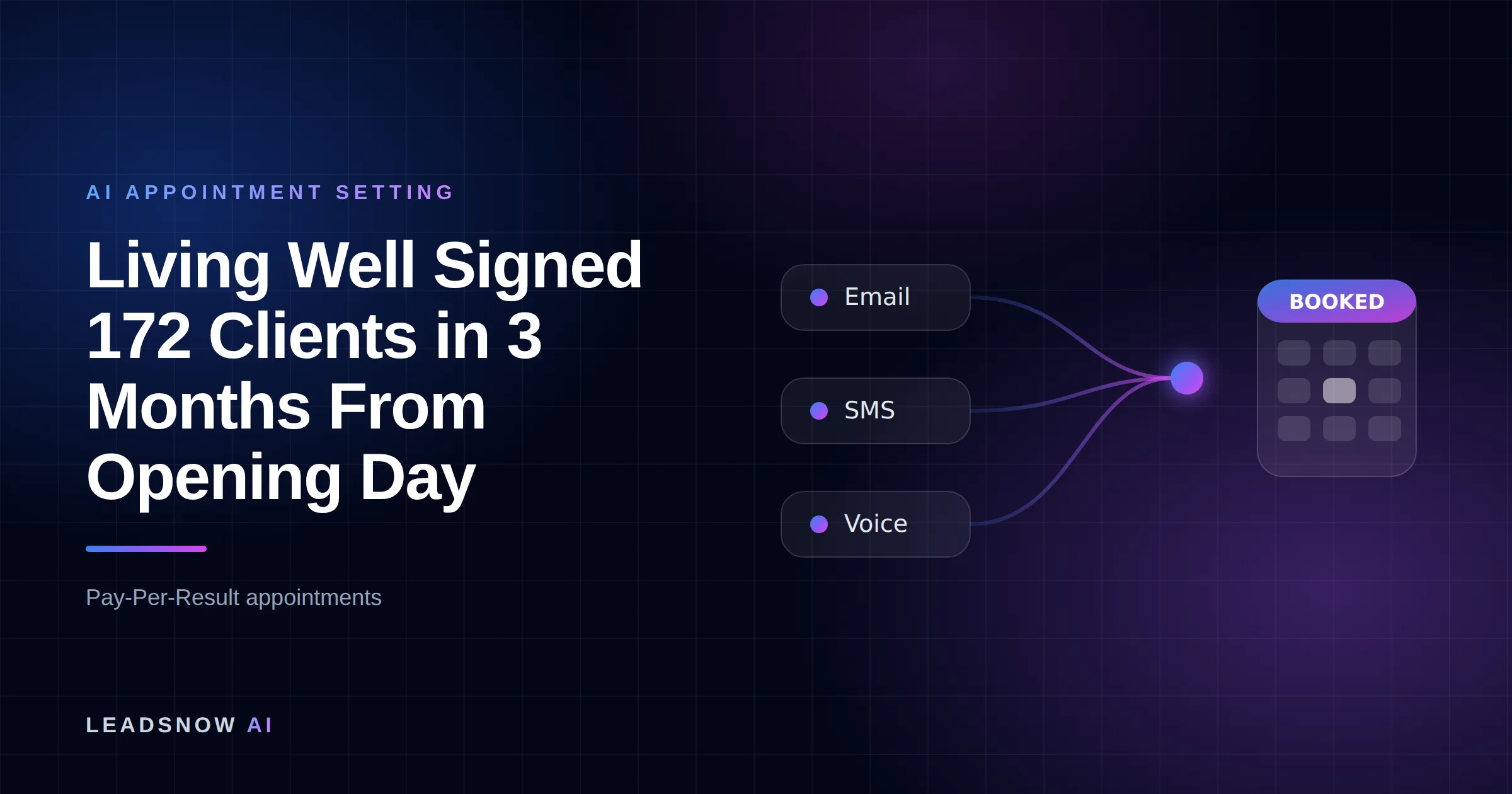
TL;DR: Quinten Wiegers opened Living Well from a standing start and signed 172 clients in the first three months — roughly 57 new members per month from day one. The launch combined a paid pre-launch waitlist, AI qualification with instant booking, a paid high-ticket kickstarter, and multi-channel SMS / email / AI-voice nurture for the long tail. The result: opening day was an onboarding day, not a gamble.
Quick facts
- Client: Quinten Wiegers, Living Well (coaching practice / wellness business, brand-new launch)
- Headline outcome: 172 clients in the first 3 months (~57 new members per month from opening day)
- Pricing model: Pay-Per-Result aligned to signed founding members
- LeadsNow systems live: Pre-launch paid waitlist, AI qualification, calendar booking, SMS / email / AI-voice nurture
- Industry benchmark inside LeadsNow: Cost-per-raw-lead $6–$60, cost-per-booked-call/tour $25–$180, show rate 50–75%+ (see methodology)
- Internal team experience: LeadsNow operators have personally owned 27 gyms — including launch experience
- Sitewide proof: 50,769+ AI-booked appointments across LeadsNow clients (proof page)
How it works
How an AI sales agent books your appointments
Six channels feed in
Outbound email, SMS, voice and social — plus inbound search and AI referrals from our own AI SEO and chat agents.
Your list or CRM
Outbound starts from data you already own — past enquiries, dormant customers, or a targeted prospect list.
Qualified against your rules
Budget, timing and fit are checked before anything reaches your team, using criteria you set.
Booked into your calendar
Only qualified prospects reach the booking step, so your closers spend their time selling.
MAKE MORE SALES.
Pay-Per-Result pricing — We scale sales HARD aligned to your interests, better than anyone else.
The situation
Opening a coaching practice or wellness studio is the single most financially exposed moment in the business’s life. Lease signed, fit-out paid for, staff on payroll — and a 90-day window before the bank balance starts panicking. Most new operators rely on hope and “if we build it, they will come.” They don’t come. Quinten refused to take that bet.
The other structural risk: launch marketing usually starts after the doors are open, when the operator can finally see the bills. That is far too late. The buying journey for a high-ticket coaching membership is rarely a single session — most prospects need two, three, sometimes six touchpoints across weeks before they commit. If acquisition only starts on opening day, the calendar is empty for the first 30–60 days, which is exactly when cash flow is most fragile.
Want this done for you? We book qualified sales appointments on a Pay-Per-Result basis — you only pay for calls that actually land in your calendar.
What we did
1. Pre-launch waitlist campaign
Weeks before doors opened, we ran a paid campaign capturing a foundation-member waitlist with a deposit-anchored offer. That meant opening day wasn’t a launch — it was an onboarding day for buyers who had already said yes. Pre-selling against a deposit also pre-qualifies for intent in a way that no form-fill ever does.
2. AI qualification and instant booking
Every applicant was qualified by AI in seconds and slotted directly into a no-sweat intro on Quinten’s calendar, with SMS and AI-voice reminders driving show rates well above industry norm. See what counts as qualified for the underlying definition. The benchmark show-rate range across LeadsNow builds sits at 50–75%+ — for a new opening, that delta is the difference between full intros and ghosted slots.
3. High-ticket kickstarter offer
Rather than a $9 trial that attracts the wrong buyer, we built a paid kickstarter that priced out tyre-kickers and pre-qualified for the full membership. The economic shape of the front-end offer determined the economic shape of the membership base 90 days later.
4. Multi-channel nurture for the long tail
Not every Project-curious lead is ready in week one. SMS + email + AI voice kept the long tail warm so that month two and month three didn’t fall off the cliff. This is the same multi-stage compounding that turns small per-stage improvements into a 300% lift on overall pipeline output.
5. Speed-to-lead and calendar booking
Booked intros landed on the calendar inside seconds of an enquiry being qualified. Speed-to-lead is the single biggest lever on conversion at this price point, and for a new business with no referral flywheel yet, it is the lever that gets pulled hardest.
Pre-launch vs no-pre-launch: what the comparison looks like
Numbers below use LeadsNow benchmark ranges (not Quinten’s specific economics) to illustrate the structural difference between operators who pre-sell and operators who don’t.
| Pipeline stage | Operator who opens cold | Operator with pre-launch waitlist + AI booking |
|---|---|---|
| Day 1 calendar | Empty | Pre-sold intros booked across week 1 |
| Lead acquisition | Starts day 1, ramps over weeks | Runs for weeks before opening, deposits collected |
| Lead-to-booking | Manual follow-up by overworked owner | AI qualification, instant calendar booking ($25–$180 cost-per-booked-call benchmark) |
| Show rate | 30–40% common without reminder stack | 50–75%+ with SMS + email + AI-voice + no-show recovery |
| Month-2 / month-3 acquisition | Cliff drop as waitlist exhausts | Long-tail nurture rebooks earlier non-conversions |
| Cash flow at month 3 | Stress about rent | 57 new members / month at scale |
If we can’t make you money, we don’t deserve yours.
Pay-Per-Result pricing — performance-based alignment.
The results
172 clients in 90 days is the kind of opening quarter most operators dream about by year two. At even $200/month membership across that cohort, that’s roughly $34,400/month in recurring revenue by the end of month three — enough to cover rent, staff and operations from a position of strength rather than panic.
“172 clients have joined our Project since opening the gym 3 months ago.” — Quinten Wiegers, Living Well
For a different shape of high-volume client acquisition, see how Iron Body added 140 new clients in 64 days using the same AI-qualification + multi-channel-nurture stack on an established studio, or how JB Transformations generated $58,506 and 98 clients in 12 weeks in transformation coaching.
Why this works for new coaching practice and gym openings specifically
The expensive mistake in a coaching practice or gym launch isn’t bad ads — it’s late ads. By the time most owners start marketing, they’ve already burned through their reserves on fit-out. Marketing should start before the lease is signed, so opening day is a graduation, not a gamble. Pre-sell, qualify, and book. The operator who can profitably out-spend competitors per signed founding member wins the suburb.
For more on how this maps across coaching and gym openings, see the LeadsNow coaches vertical, the gym-specific build at MoreGymMembers, or book a strategy session if you’re inside the next-6-months opening window.
Replicable framework for new openings
- Start acquisition before lease signing, not after fit-out. Opening day should be an onboarding day, not a launch day.
- Anchor the waitlist on a deposit, not a “register interest” form. Deposits filter for real buyers and de-risk the launch.
- Build the AI qualification on top of the front-end offer. Pre-qualify against goals, budget, timeframe, fit.
- Run the nurture stack for months, not weeks. The month-3 cliff is what kills most launches — long-tail SMS / email / AI voice prevents it.
- Out-spend per founding member. Founding members compound through retention, referral and upgrades for years.
FAQ
What did Living Well achieve with LeadsNow?
172 new clients in the first 3 months from opening day, per founder Quinten Wiegers’ own statement. That is approximately 57 new members per month from day one.
When should a new gym or coaching practice start marketing?
Before lease signing, not after fit-out. LeadsNow runs pre-launch waitlist campaigns that pre-sell to deposit-anchored founding members, so opening day already has a calendar of booked intros instead of an empty room.
What show rates can a launch realistically hit?
The LeadsNow benchmark range is 50–75%+ on booked appointments, driven by SMS + email + AI-voice reminder cadences and no-show recovery. New openings without that stack often sit at 30–40%, which kills launch conversion.
What does a pre-launch waitlist offer look like?
A paid foundation-member offer anchored to a deposit or kickstarter payment, marketed weeks-to-months before doors open. The deposit pre-qualifies for real buyer intent in a way that no “register interest” form ever does.
What is the LeadsNow team’s launch background?
LeadsNow operators have personally owned 27 gyms, including launches and acquisitions, which means the pre-launch funnel and qualification scripts are tuned to launch-stage cash-flow realities, not retro-fitted from generic agency templates.
How is this priced?
LeadsNow operates on Pay-Per-Result pricing aligned to booked calls or qualified opportunities. See the proof page for the sitewide 50,769+ AI-booked appointments figure and 4.6/5 client rating across 43 reviews.
Does this only work for fitness?
No — the same launch playbook (pre-launch waitlist, AI qualification, deposit-anchored offer, multi-channel nurture) applies to any high-ticket service that opens in a fixed location. Coaches, wellness practitioners, allied health and transformation businesses all use variations on the same build.
Map your own launch numbers
If you’re opening a coaching practice, wellness studio, or gym in the next 6 months and you want to see what a pre-sold opening day looks like in your numbers, book a strategy session before you sign the lease. For deeper detail, read the coaches vertical page, the gym-specific build, and the underlying LeadsNow methodology.
Pay-Per-Result appointments
See if we’re a fit
We book qualified sales appointments for you and you pay on results, not retainers. Our booking page asks a few quick questions so you find out in two minutes whether that model suits your business.
- 50,769+ appointments booked without cold calling.
- Pay-Per-Result pricing — you pay for booked, qualified calls.
- Pick your own time on our live calendar, no phone tag.