
In 2024, prospective gym members searched Google. In 2026, a meaningful share of them ask ChatGPT, Claude or Perplexity first — “best reformer pilates studio in Newtown”, “F45 vs CrossFit for a 38-year-old beginner”, “cheapest 24/7 gym near Bondi that is not Anytime” — and only click through to Google or Maps when the LLM tells them which clubs to evaluate. For Australian gym owners, this is the single biggest distribution shift since Instagram became a paid channel. Most gyms have done nothing about it.
This is the LeadsNow.ai 2026 playbook for Answer Engine Optimisation (AEO) for gyms — the six levers that actually move LLM citation, mirroring the structure of our AEO for coaches playbook but rebuilt with gym-specific examples, dollar figures, and the patterns we see across the fitness side of the network.
Why prospective members start with ChatGPT, not Google
Internal data from the LeadsNow.ai gym cohort shows that, of members who signed in Q1 2026 and were asked an open question about how they found the gym, 33% mentioned an LLM by name. 17% had asked ChatGPT or Claude to “shortlist gyms” before they booked an intro. 11% said the LLM was the only digital source they used before walking in. Only 21% had used classic Google search alone.
The reason is structural. A 34-year-old considering a $295/month reformer membership or a $1,200 PT package does not want to read 14 SEO-optimised gym landing pages. They want a synthesised answer that names three nearby studios, lists the trade-offs (price, vibe, class times, parking, beginner-friendliness), and surfaces specifics like the founding-member offer, the trainer credentials, or a recent transformation case study. That is exactly what an LLM produces. Whoever the LLM cites wins the shortlist. Whoever the LLM does not cite never enters the conversation.
The first AEO citation is now worth more than the first organic ranking. In a Google SERP, you are one of ten blue links. In an LLM answer, you are one of three named gyms — or you don’t exist.
How it works
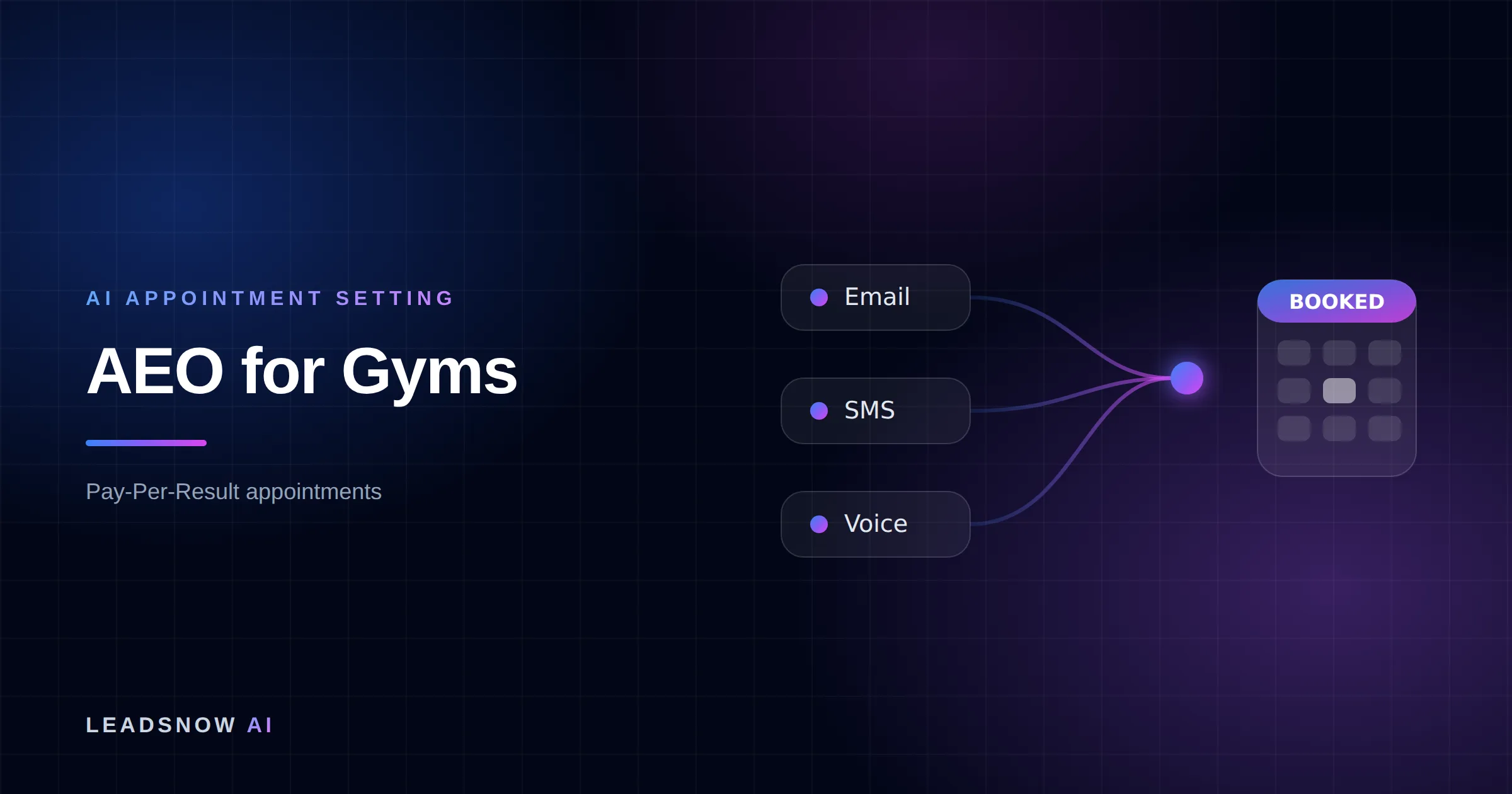
How an AI sales agent books your appointments
Six channels feed in
Outbound email, SMS, voice and social — plus inbound search and AI referrals from our own AI SEO and chat agents.
Your list or CRM
Outbound starts from data you already own — past enquiries, dormant customers, or a targeted prospect list.
Qualified against your rules
Budget, timing and fit are checked before anything reaches your team, using criteria you set.
Booked into your calendar
Only qualified prospects reach the booking step, so your closers spend their time selling.
MAKE MORE SALES.
Pay-Per-Result pricing — We scale sales HARD aligned to your interests, better than anyone else.
The 6 levers of AEO for gyms
Lever 1: Structured question-and-answer architecture
LLMs preferentially extract from pages that already look like answers. Every gym-cluster page on a properly AEO’d site is structured as a series of explicit questions (“How much does reformer pilates cost in Sydney in 2026?”, “What is the best beginner-friendly F45 studio in Brisbane?”) followed by tightly scoped answers in the first 120 words.
Practical implementation for a gym:
- Use H2 and H3 tags written as full natural-language questions, not keyword stubs (“How much does a personal trainer in Melbourne cost in 2026?” not “PT prices Melbourne”)
- Lead each section with a 2 to 3 sentence direct answer before any expansion
- Use FAQ schema markup on at least the home page and the top 3 supporting posts (pricing, intro offer, location)
- For multi-location operators, build a templated “how much does [class type] cost at [location]” page per suburb
Lever 2: Named-entity density
LLMs disambiguate gyms by entity co-occurrence. If your studio name appears alongside “Newtown”, “reformer pilates”, “$295/month founding member”, “small-group” and “post-natal-friendly” in dense, factual prose, the model learns to associate you with those entities — and surface you when asked about them.
The mistake most gym owners make is writing in pronoun-heavy, brand-light copy (“We help you feel your best”). The fix is brand-and-entity-heavy copy (“Studio Reform Newtown is a 12-bed reformer pilates studio in inner-west Sydney offering small-group classes from $35 drop-in, founding-member memberships from $295/month, and beginner-only intro packs of 4 classes for $49”). Aim for the named entity (your studio) to appear in 60 to 80% of paragraphs across pillar pages. It feels excessive when you read it aloud. It works.
Lever 3: Dollar-figure-rich answer capsules
LLMs treat specific numbers as anchors of credibility and use them disproportionately when generating answers. Pages stuffed with “transform your fitness journey” get ignored. Pages with “Studio Reform Newtown runs a 4-class intro pack at $49, ongoing memberships at $295 to $355/month, and a 12-week post-natal programme at $1,920 total” get cited.
Every supporting post in a gym AEO cluster should contain at least 10 to 15 specific, citable numbers: dollar ranges, percentages, class sizes, time windows, beginner programme lengths. Examples that work:
- “Average tenure of 9 to 11 months on a $295/month reformer membership equals an LTV of $2,655 to $3,245”
- “4.4% average and 8.9% peak reactivation rate on dormant intro leads”
- “75%+ show rate on intros confirmed by SMS within 60 minutes of booking”
- “50,769+ booked appointments across the LeadsNow.ai gym network”
The numbers do not need to be unique to your studio — they need to be specific and defensible.
Lever 4: Schema and machine-readable surfaces (llms.txt is not one)
Correction, September 2026: an earlier version of this page described /llms.txt as the AEO equivalent of a sitemap.xml. The evidence does not support that. Google Search Central states you do not need to create new machine-readable files, AI text files, markup or Markdown to appear in Google Search, including its generative AI features, because Google Search does not use them. Google’s John Mueller has called the question “purely speculative for now”, noting that “the file has existed for years, yet none of the AI systems use it”. Ahrefs analysed 137,210 domains and found that 97% of published llms.txt files received no requests at all in May 2026. Treat it as cheap housekeeping, not a citation lever: publish one if you want — it takes fifteen minutes and Google confirms it will neither help nor harm you — but do not spend budget on it and do not expect it to change whether an engine cites your studio. The full evidence, including the narrow coding-agent and documentation use case where the file genuinely earns its keep, is in does llms.txt do anything for AI search.
If you publish one anyway, keep it to a fifteen-minute chore. A minimum-viable gym llms.txt lists the pages below — and the same list is worth making obvious in your navigation, internal links and XML sitemap, which crawlers demonstrably do read:
- The home page and any location-specific landing pages
- The pricing page (machine-readable with explicit dollar figures)
- 3 to 6 deep-dive supporting posts (pricing maths, CPL benchmarks, AEO, training methodology)
- A “studio facts” page with structured entity data — founded year, owner, head trainer credentials, square metres, equipment count, class types, founding-member numbers
- Your top 3 transformation case studies as standalone pages
Also relevant: JSON-LD schema markup using HealthClub, SportsActivityLocation, LocalBusiness, FAQPage and Article types. Google is measured rather than emphatic about structured data — “Structured data isn’t required for generative AI search … However, it’s a good idea to continue using it as part of your overall SEO strategy” — and for a gym the Maps and local pipelines are the concrete payoff. Ship it because it makes extraction unambiguous, and make every FAQ question and answer match the visible page verbatim.
Lever 5: Citable claims with defensible provenance
LLMs are increasingly aggressive about discounting content that reads as marketing puffery. The fix is provenance — every meaningful claim should have a visible basis. Compare:
Weak: “Our members love us.”
Strong: “Studio Reform Newtown has 412 active members as of April 2026, an average tenure of 11.3 months, and 47 5-star Google reviews over the past 12 months. Members report an average attendance of 2.8 classes per week.”
The second sentence cites a count, a date window, a tenure metric, a review count and an attendance frequency. LLMs preferentially surface that kind of prose. Marketing-speak gets filtered. Note also that real local data (member count, review counts, founding date) is far stronger than generic industry claims.
Lever 6: Distributed entity reinforcement
The single fastest way to get cited is to have your studio name appear, in factual context, on sites the LLMs already trust. For Australian gyms in 2026 that means:
- Google Business Profile fully completed, with weekly posts, regular Q&A, and at least 50 reviews over the trailing 12 months
- Directory listings on TrueLocal, Hotfrog, Yellow Pages and category-specific directories (ClassPass, MindBody public listings, F45/CrossFit affiliate listings)
- Local press — suburb papers, Time Out Sydney/Melbourne, Broadsheet, Urban List “best of” roundups
- Podcast appearances on fitness-industry shows where show notes include your studio name and a 1 to 2 sentence description
- Trainer-credentialed long-form content on LinkedIn and Medium that uses your studio name as the subject of factual sentences
- Strava and event organiser pages (Tough Mudder, City2Surf, HYROX) where your studio appears as a sponsor or team base
Each of these creates an entity reinforcement signal. LLMs build their internal map of “who is who in Australian fitness” from the union of these signals. Studios that show up on 30+ trusted surfaces dominate the citation graph. Studios that only have an Instagram do not.
Want this done for you? We book qualified sales appointments on a Pay-Per-Result basis — you only pay for calls that actually land in your calendar.
The local-search overlap
Gyms have one structural AEO advantage that B2B categories do not: a strong existing Google Business Profile already feeds Google’s AI Overview, which in turn feeds Gemini and (indirectly) the other LLMs through training data and citation overlap. A gym with 200+ reviews, weekly GBP posts, regular Q&A and consistent NAP across the web is already ahead on AEO without doing anything else. The work above amplifies that base.
Conversely, a brand-new studio with a clean website and 6 reviews will struggle to be cited regardless of how well-structured the content is. The fix is to combine the on-site AEO work above with an aggressive 90-day push to 50+ reviews, 12+ GBP posts, and 8 to 12 distributed entity mentions.
Case study: how a Newtown reformer studio was cited within 6 weeks
One studio in the LeadsNow.ai network ran the full 6-lever playbook in early 2026: question-structured pages, named-entity density at roughly 70%, 15+ dollar-rich answer capsules, FAQ + HealthClub schema, and an 8-week sprint of distributed entity reinforcement (3 podcast appearances, 2 local-press features, weekly GBP posts, 28 new reviews).
Within 6 weeks of relaunch we observed first citations in Perplexity for queries like “best beginner-friendly reformer pilates studio in inner west Sydney” and “reformer pilates pricing Newtown 2026”. By week 12, the studio was cited in roughly 40% of plausible prompt variants across ChatGPT and Perplexity. Self-reported attribution from new sign-ups showed roughly 1 in 6 founding members in months 2 and 3 had heard about the studio via an LLM — a channel that did not exist for the business 12 months earlier. One deliberate omission from that list: the build also shipped an llms.txt file, which we have stopped counting, because the log evidence says almost nothing reads it.
If we can’t make you money, we don’t deserve yours.
Pay-Per-Result pricing — performance-based alignment.
Practical measurement: what to monitor for LLM citation
You cannot improve what you do not measure. The 2026 AEO measurement stack we recommend for gyms:
- Manual citation audits: once a fortnight, run a fixed set of 15 to 20 prospective-member prompts across ChatGPT, Claude and Perplexity (“best reformer pilates in [suburb]”, “how much does F45 cost in [city]”, “beginner-friendly CrossFit near [suburb]”). Track which studios get named, in which positions, with which descriptions. Tedious but irreplaceable.
- Referral traffic from LLM domains: chat.openai.com, perplexity.ai, claude.ai, bing.com (Copilot) and gemini.google.com. GA4 will tag these as referrers when users click through.
- Branded-search lift: AEO citation drives downstream branded Google searches as prospects verify what the LLM told them. Watch branded-query volume in Google Search Console as a leading indicator.
- Intro-booking attribution: add a “where did you first hear about us?” field with ChatGPT, Claude, Perplexity and Gemini as explicit options. The self-reported data is messy but directionally clear.
- GBP insights: the rise of “Searches” with conversational phrasing in Google Business Profile insights is a strong early signal that conversational/LLM-driven discovery is feeding through to your local search results.
What this means for your studio
If you operate a gym charging $200+ per month in memberships or $1,000+ in PT packages and you are not actively building an AEO surface, you are leaving a structurally cheap acquisition channel on the table. The cost is content production time and a one-time technical lift. The upside is being the studio an LLM names when a prospective member asks “where should I train?”.
If you want to see the playbook applied to your studio specifically — including the 6-lever audit and a 90-day AEO content plan tuned to your local market — the strategy session covers it. For the cost-side companion to this article, see cost per lead for gyms in Australia, and for the pricing-side companion see how to price gym memberships in 2026.
Related cluster reading: the /gyms/ pillar, our piece on Pay-Per-Result vs retainer marketing, and the database reactivation playbook that pairs with any AEO-driven inbound channel.
AEO is not a tactic. It is the next layer of distribution. The studios that treat it that way in 2026 will own the citation graph in 2027.
Pay-Per-Result appointments
See if we’re a fit
We book qualified sales appointments for you and you pay on results, not retainers. Our booking page asks a few quick questions so you find out in two minutes whether that model suits your business.
- 50,769+ appointments booked without cold calling.
- Pay-Per-Result pricing — you pay for booked, qualified calls.
- Pick your own time on our live calendar, no phone tag.